NORTH ISLAND
(Click on images to enlarge.)
Having talked about going overseas for several years, and with covid interrupting any thoughts of doing that in a hurry, New Zealand as our nearest neighbour, but still overseas, was an obvious choice. Then when friends from Canada were going there and (in their words), we “couldn’t be so close without a catch up,” we decided that we could kill two birds , so to speak.
So, on arriving at Auckland and acquiring our prebooked hire car, we set off and, thanks to Google maps, found our way to our apartment which we were to share for the first four nights with our Canadian friends. Their flight was due later in the day and they arrived in time for the dinner that Gary had prepared for the four of us on our first night together.
So for the next three days we did a few touristy things around Auckland .
First up, the Auckland Sky Tower, the telecommunications and observation tower standing within the CBD, and at 328m (1076 feet) tall was the tallest free-standing tower in the southern hemisphere up till 2022. From the observation deck you get great 360° views over the city and out over the islands beyond the harbour. For daredevils, the tower also features the 192m (630foot) cable-guided Sky Jump or the walk around the exterior of the observation deck. Nope! Nope! Nope! Nope Nope!


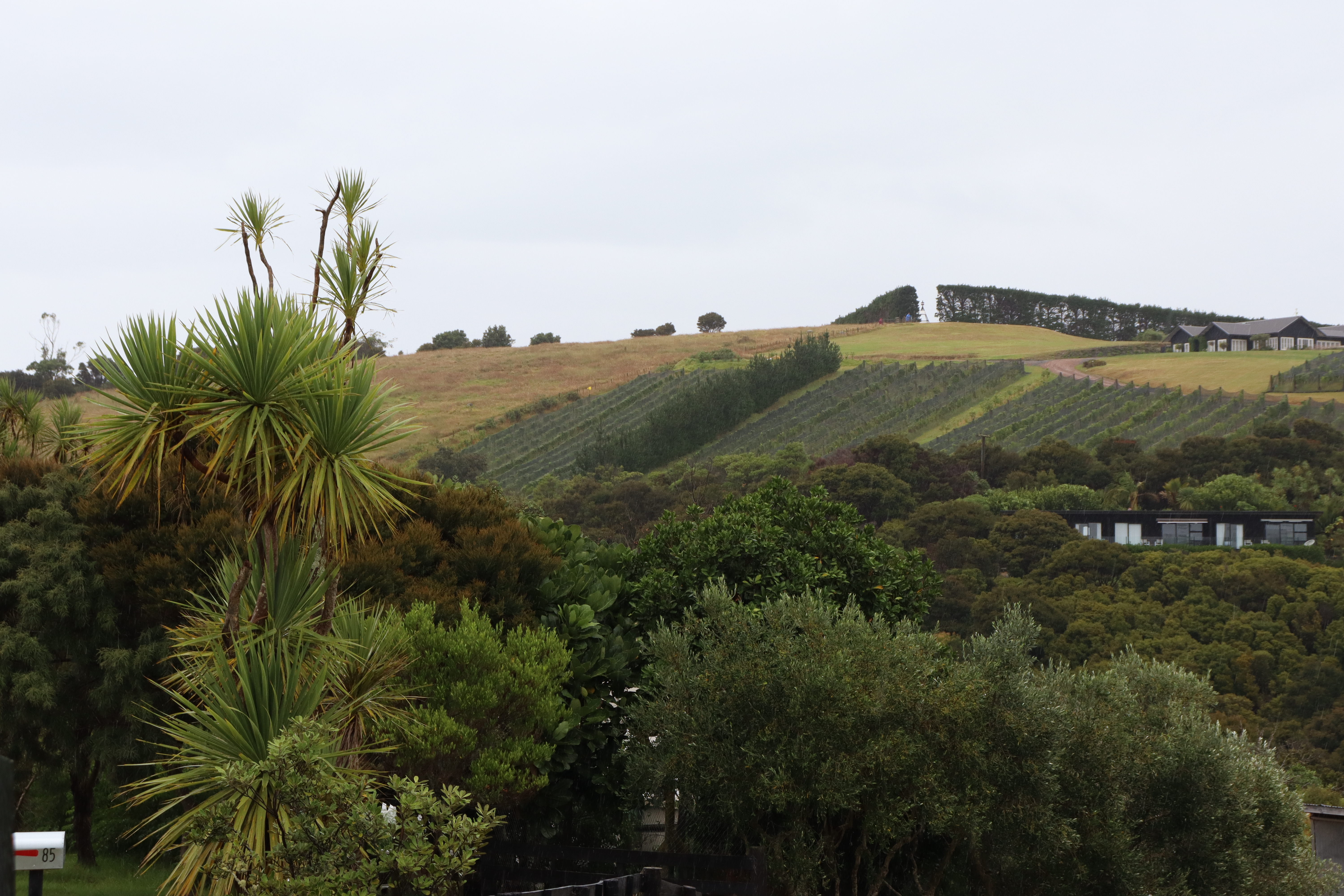
Waiheke island is a very popular destination for visitors to Auckland, so taking the passenger ferry across and then a hop-on-hop-off bus tour seemed a good option. The bus takes you all around the island with stops at most of the wineries it’s famous for. Somehow, we didn’t get to even ONE winery, but we DID get to The Heke brewery and whisky distillery, where we tasted a few of their local brews, and the Allpress Olive Grove for tastings of their locally grown/produced olives and oils. From there we jumped on the next bus coming through and got back to the town centre, and as the bus is driving away, Gary realizes he’s left his phone in the seat pocket. Oh shit!!!! And it turns out it wasn’t one of the hop on-off buses either! In the end, after a couple of worrying hours, we headed back to the ferry terminal hoping someone may have handed it in, but no luck there. However, by a huge stroke of luck, the first driver we’d had for the day (“If you give me a good rating on TripAdvisor, my name is Tony, if you rate me bad, my name is John!”) was there and about to head out again, and when I asked him if he’d heard anything or knew how we could check the bus, he offered to drive us back to the bus depot where he was sure the bus holding Gary’s phone prisoner would be by now. What a relief – the phone was still in the seat pocket where Gary had left it! So then the bus driver (what a great, helpful guy – definitely call him Tony!) radios to the local bus service to come pick us up from there as he still has a tour run to do. So in the end, we not only got the phone back, but a free ride on the local bus taking us on a route the tour bus didn’t go! What a day!!
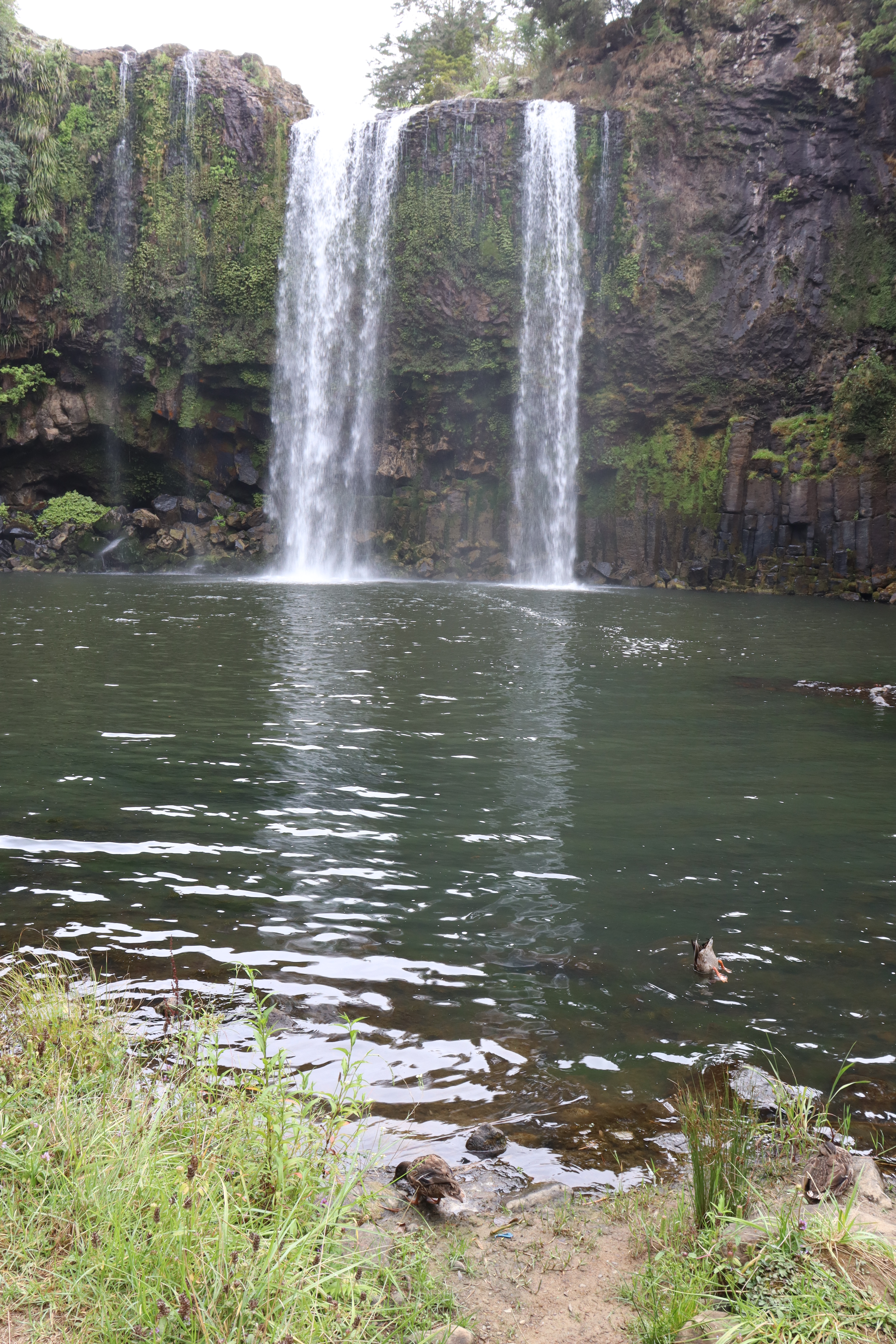
After parting with our Canadian friends, Gary and I started our NZ travels in earnest. Heading north out of Auckland, and after having to take a 10km detour, we got to Whangarei to visit the Whangarei Falls, a very picturesque 26m/85foot cascade with a pleasant walking trail looping from the top to the base. Well worth a look.
Russell, on the Bay of Islands, is a quaint little town and here we walked the trail up to Flagstaff Hill Lookout, where you get great views across the Bay of Islands. It was here that, following the signing of the Treaty of Waitangi across the bay, the flagpole was cut down four times by the local Māori chiefs, angry that, in flying the Union Jack , the British Colonialists were not honouring the terms of the Treaty.
Passing through Kerikeri, we paused for a quick look at the Historic Stone Store, the oldest original stone building in NZ, and Rainbow Falls with its 40m twin falls drop – beautiful.


Cape Reinga, the northernmost point of the North Island, is dominated by the Cape Reinga Lighthouse which overlooks the famed “meeting of the waters” where the Tasman Sea and the Pacific Ocean meet in a clearly visible collision line. In the distance on a clear day you can see the Three Kings Islands which are actually wildlife sanctuaries and the species there are found nowhere else and are protected by their isolation.
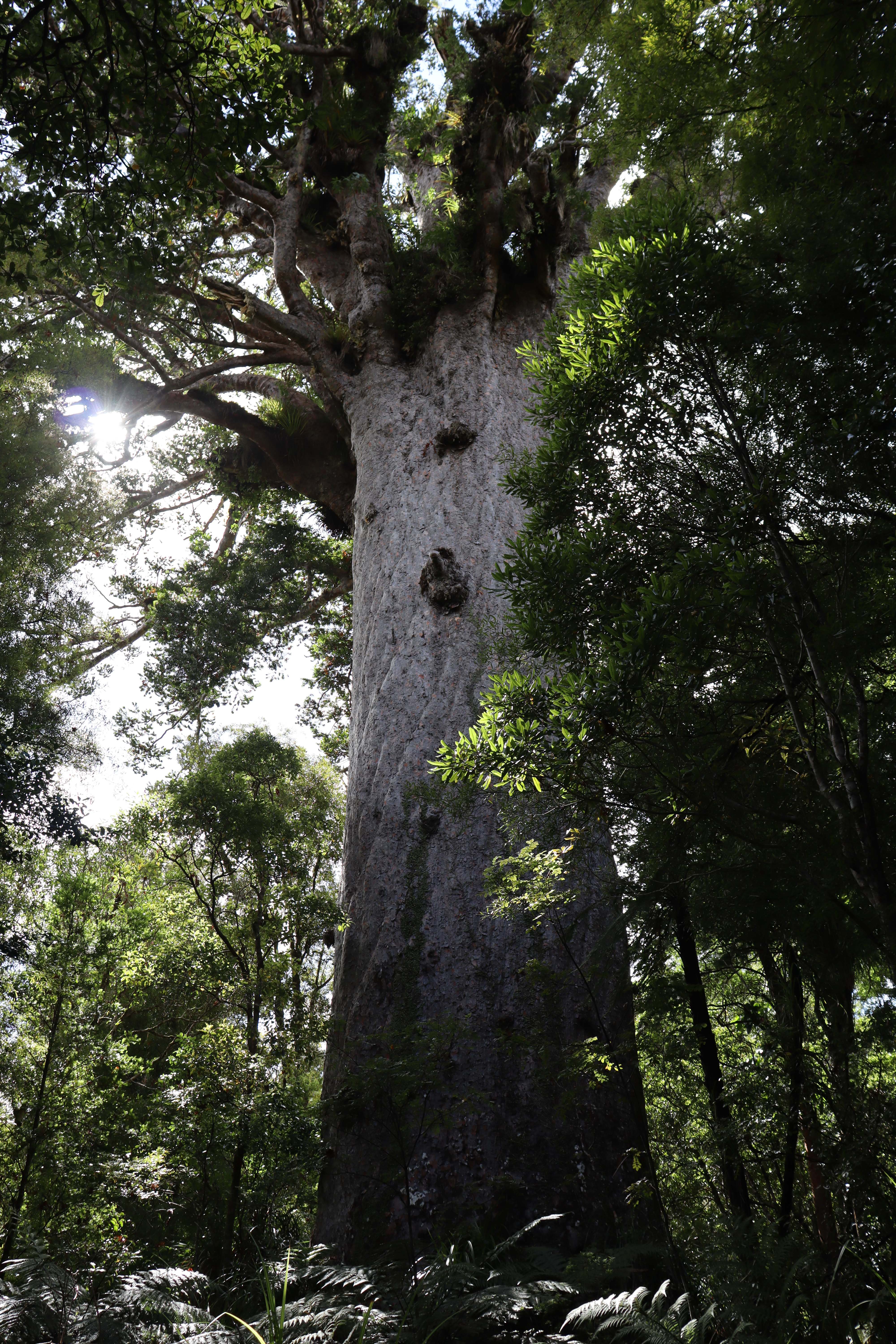
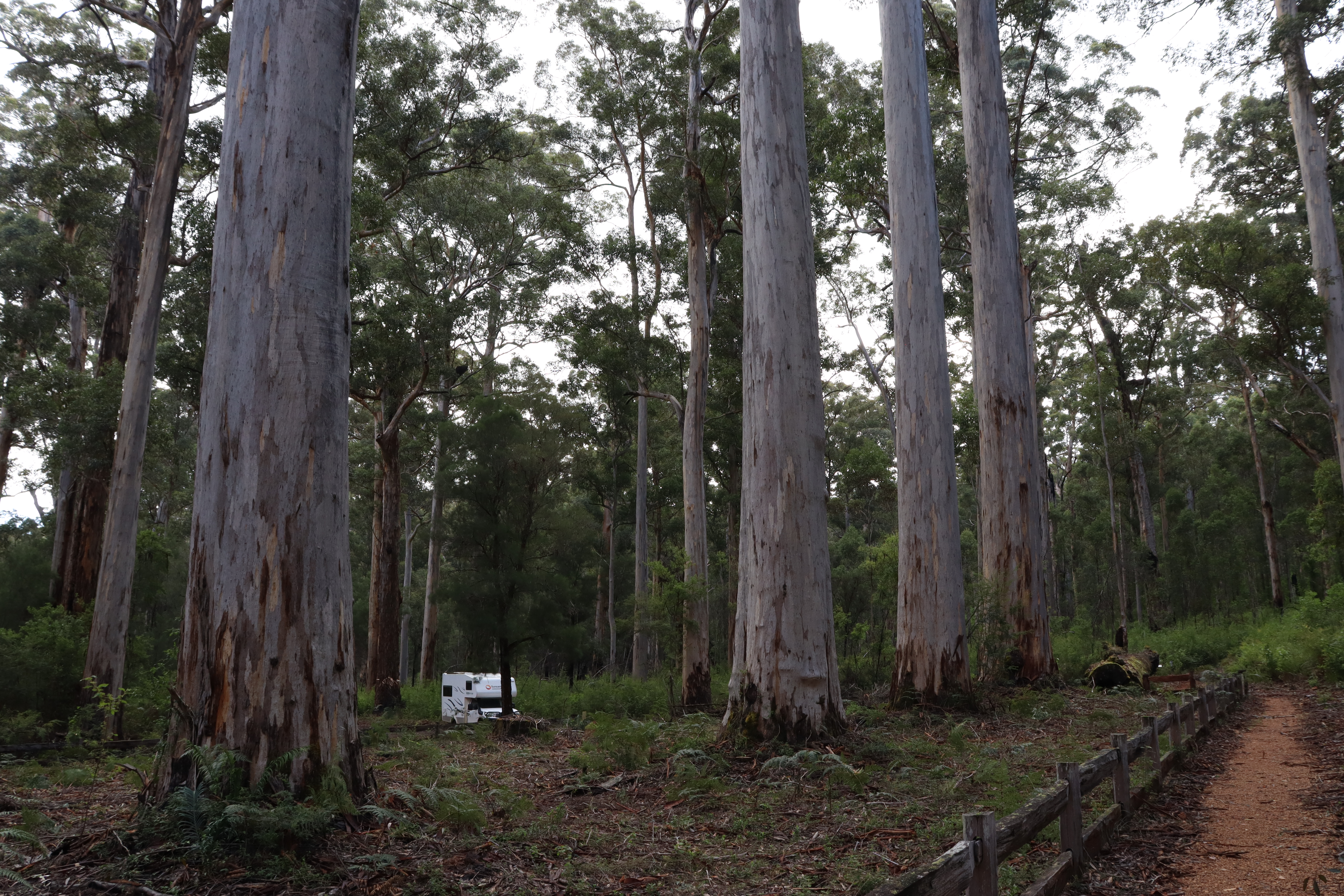
Taking the western branch of the Twin Coast Highway and heading south again, we passed through Waipua Kauri Forest, and paid a visit to “the Lord of the Kauri” – Tana Mahuta – a massive Kauri estimated to be around 2000 years old. At about 55m high with a girth of about 14m almost all the way up, it’s a monster!!
Waitomo Caves are famous for its glowworms, which are actually fly larvae that attach themselves to the roof of the cave and catch their food by suspending sticky lines that catch insects attracted to the light of the glowworm. This tour, taken in boats in the waters at the bottom of the cave, is so peaceful and calm as you are not allowed to make noise for fear of disturbing the worms which would put their lights out, and the spectacle of thousands of these tiny blue lights above you is just amazing. For obvious reasons no photography is allowed, but probably better to experience the real thing.
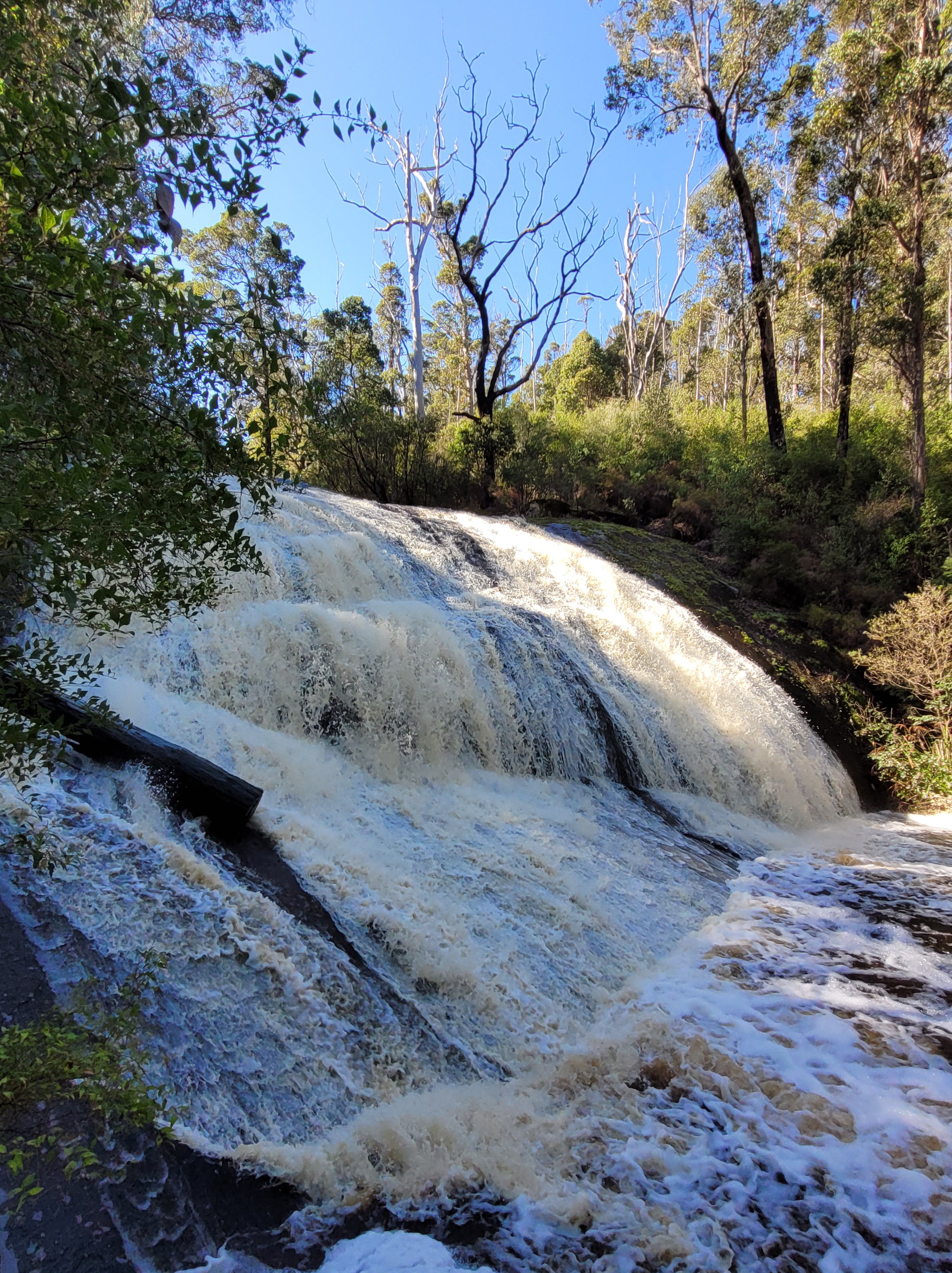
Just 30 or so kilometres beyond the Glow worm caves are the spectacular Marakopa Falls. Only a short walk from the carpark through native forest, these falls with their 35m drop were THUNDERING after the rain we’d had all day, and so were a most impressive sight and worth the walk in the rain and the narrow winding road to get there. Having planned on also visiting the nearby Piri Piri Caves and the Mangapohue Natural Bridge out that way, we were somewhat disappointed to find them both closed, so we’ll have to put them on the list for next time we’re here!

Passing through New Plymouth, we headed out to Okato for a couple of nights hoping to see Mt Egmont/Taranaki, by all accounts a perfect cone shaped volcano, but with all the rain and clouds around, we couldn’t see any sign of a mountain, so I jokingly questioned whether it even exists, only to be told , “Oh yes, you can see it from MILES away on a clear day!” On our first morning – no sign of the mountain – we took a drive AROUND the mountain to the eastern side, to check out Dawson Falls and Wilkies Pools. Now we knew there must be a mountain, as the road to the falls definitely had a fairly steep incline, and once we got to the carpark, we actually got our first – albeit shrouded in clouds – glimpse of the mighty Taranaki.
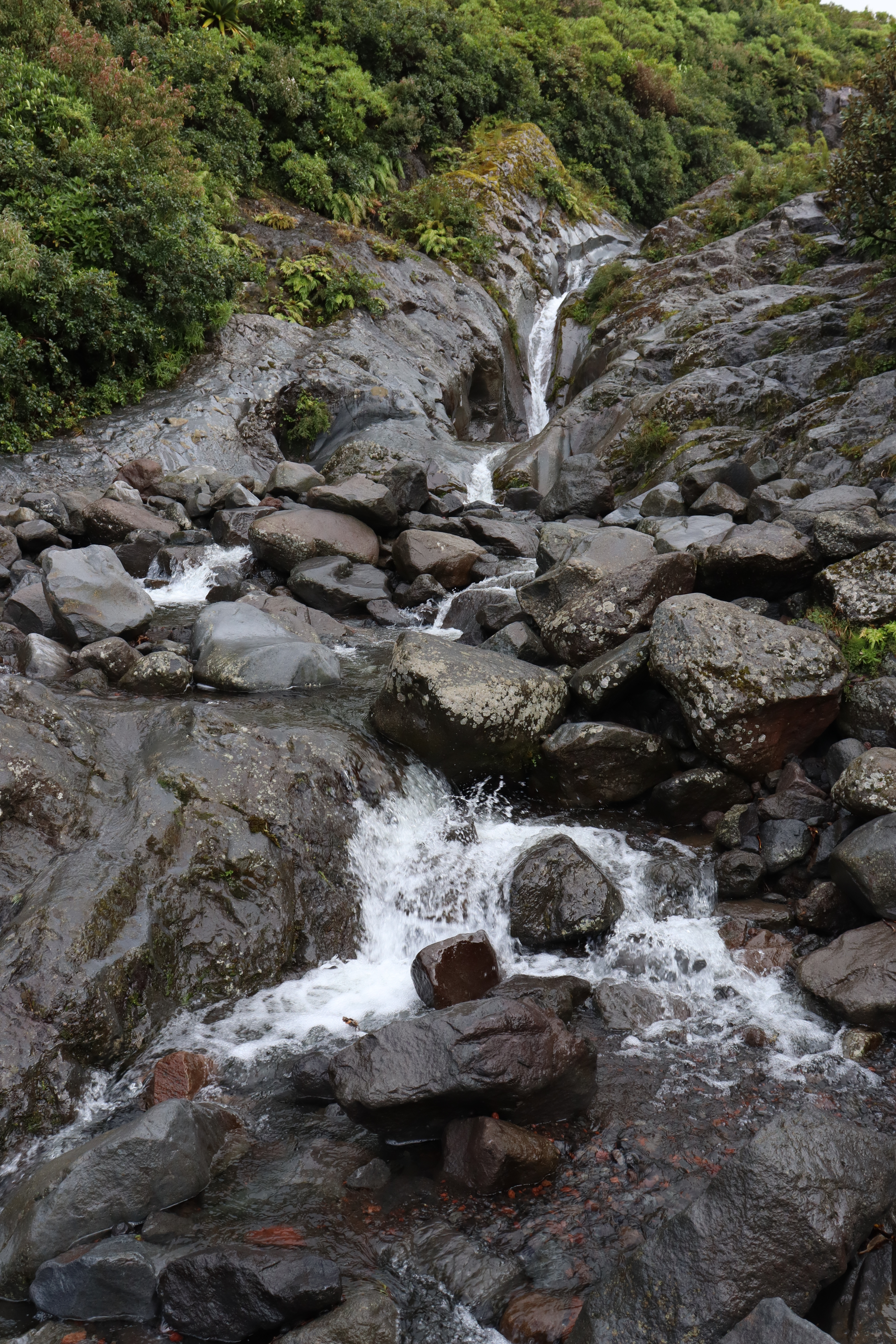
Dawson Falls can be viewed from one viewpoint near the top or another at the base of this lovely 18 metre cascade. We chose to check out both and despite the misty spray that emanated from the falls, I felt the view from the bottom viewpoint was better as the top view was partially obscured by the surrounding rainforest. Either view was pretty special though! Taking another wet and muddy trail though the forest – very much a rainforest on this rainy day! – we found Wilkies Pools, a series of pools and cascades gouged out by the force of the water, rocks and gravel scouring out the 20000-year-old lava. Gorgeous!

Heading back to Okato we called in at both Cape Egmont Lighthouses – yes, there are two of them about 10 kilometres apart, both built around 1864. One appeared to be on private land and had no signposting other than that we could see it down “Cape Road” and the other was signposted as the “Historic Cape Egmont Light” with a museum which was closed. Of course!
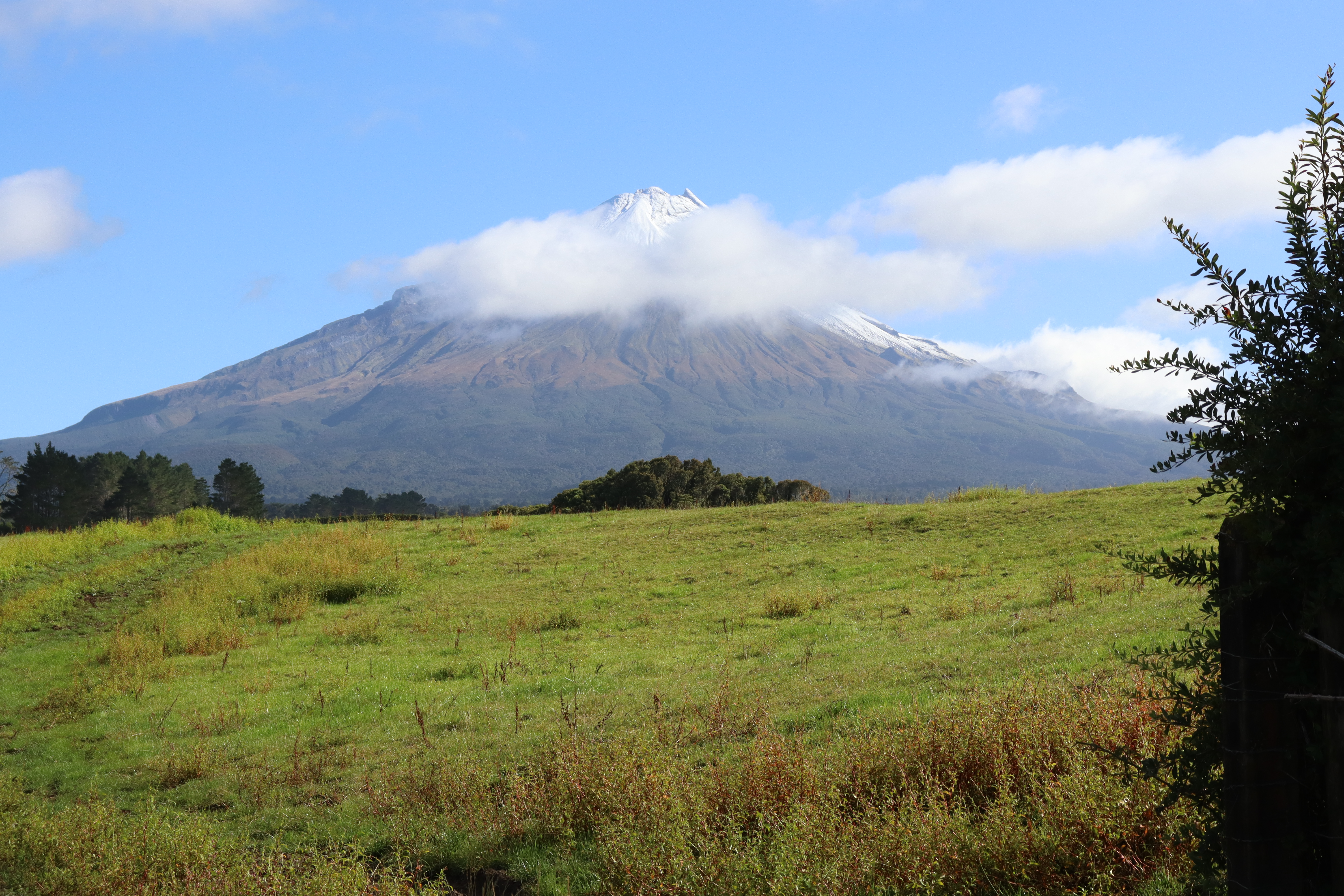
Leaving Okato on a pleasant sunny day gave us our long-awaited views of Taranaki/Mt Egmont in all her snow-capped glory – and proved to us that she actually does exist. Getting a good clear shot, however, wasn’t so easy as the clouds moved across her summit fairly quickly.

Taking the narrow and remote Forgotten World Highway took us through the Republic of Whangamomona, (try and say that three times with a mouthful of marbles!!) a small town that declared its “independence” from New Zealand in objection to the redistribution of local councils, and over the years its elected Presidents have included humans, a goat, a poodle and a turtle! Headquarters of the Republic warrant a visit as they are housed in the historic hotel which dates back to 1902 (current building1911) and is regarded as the most remote pub in the country. Needless to say, we paid the Headquarters a visit!
Further up the Forgotten World Highway, we were held up at roadworks that closed the road for several hours each day, but knowing it was only an hour or so before the road was due to open, the Stop-and-Go lady advised us to go check out the falls that were about 16 km off on a side road. This was perfect as I’d already read about these falls and wanted to go see them, so off we went. At the end of the road, there’s a 1-kilometre walking track to the falls that crosses private farmland, weaving through a forest of tree-ferns and alongside the creek that feeds the falls. But this pleasant meander in no way prepares you for the spectacle of the 74-metre drop of the Mt Damper Falls -it’s just WOW!


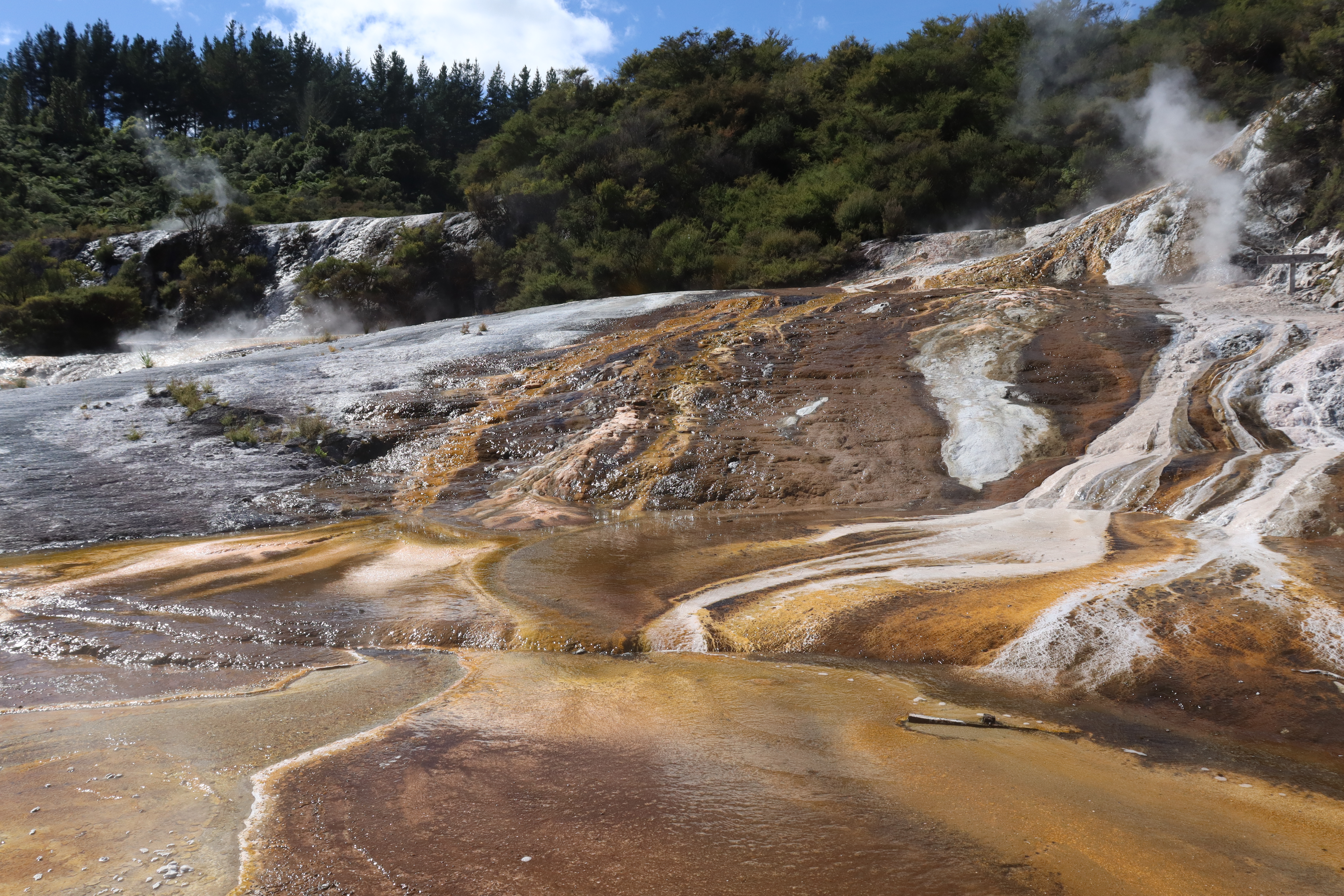
Cutting up northwards through Taupo, with a quick stop at the thunderous Huka Falls, we headed into geothermal country and spent several hours at Orakei Korako-The Hidden Valley, a wonderland of thermal features including geysers, fumaroles, thermal boiling pools and rock faces colored by heat tolerant organisms, silica terraces and boiling mud pools. With the unmistakeable smell of sulphur in the air and clouds of steam hovering above the ground, this park is smaller than, but equally as impressive as the more crowded parks of Rotorua. Whist in Rotorua, we also checked out: Lake Rotorua with its very smelly but aptly named Sulphur Point; the 5.5km walking trail around Blue Lake (which actually turned out to be 6.9km!) with its viewpoints over Blue Lake and Green Lake -such imaginative names, but the lakes are very pretty; and spent an afternoon exploring the Whakarewarewa Forest Park’s amazing plantation of California Redwoods and Douglas firs all dating back to 1901.


Heading out to the northern coastline along the Bay of Plenty, we passed through Whakatane to come to our next stop: Tauranga or Mount Maunganui – depending which side of the entrance to the bay you are on – where the town is dominated by the imposing Mount Maunganui, an extinct volcano at the end of the peninsula. Several walking tracks will take you around the base of the mountain or up to the summit for magnificent 360° views over the township, the bay and the islands nearby. All the summit walks are pretty steep, but somehow I think we managed to find the steepest one!
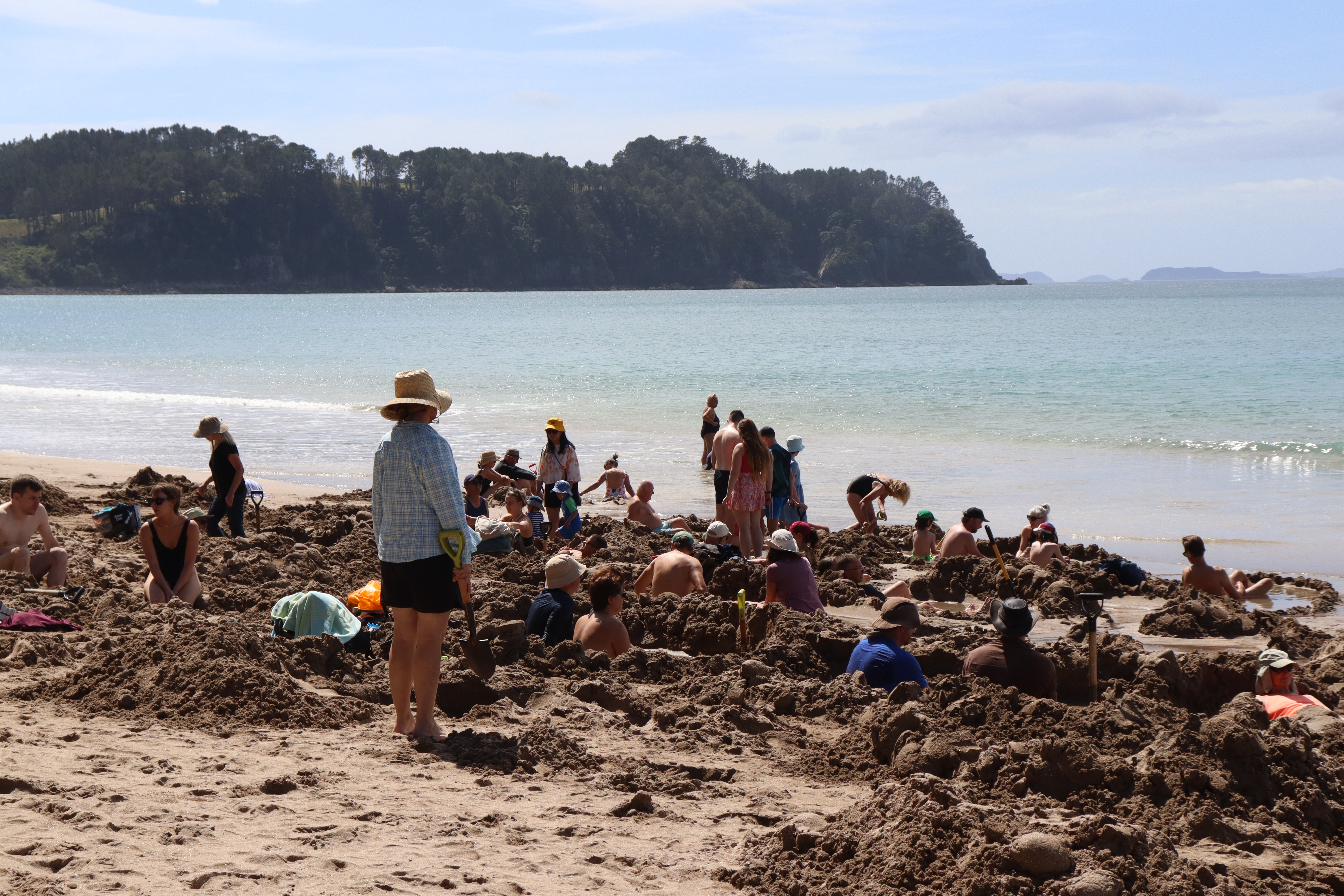
The Coromandel Peninsula is home to the Hot Water Beach at Whenuakite, which is certainly worth a visit, if not to experience the hot waters, at least to witness the crowds that arrive, armed with shovels and spades and proceed to dig holes on the beach to sit or lie in the warm to hot water that rises from beneath the sand, depending on how deep they’ve dug. Hilarious!
The township of Coromandel on the western side of the Peninsula is a small town that caters well to the tourist hordes that visit, with hiking trails, beaches, restaurants and tours. A highlight here is the Driving Creek Railway; a narrow-gauge railway built over a thirty-year period by its original owner and operator. Being the country’s first NZ-born potter, he initially built the railway to transport clay and pinewood from the hills above and down to his studio and kiln. Over time he extended the tracks to enable replanting of native trees on the hillsides, and due to the steep inclines, he engineered several innovations including zig-zagging tracks, tunnels, bridges, spiral sections and his famous double decker viaduct. The 90-minute tour takes you to the top of the hills to his “Eyefull Tower” Lookout, where you get amazing views over the Peninsula and the islands of the bays.

From Coromandel, it was a pleasant day’s drive around the coast and back to Auckland’s airport for our flight to Christchurch.
And so ended our three-week circuit of North Island.
Stay tuned for South Island adventures!
WTF or HA HA!!
- Have you ever tried to cook spaghetti and Bolognese sauce for four adults in one 14cm pot and two small frypans?? Somehow Gary managed it on our first night in Auckland!
- Wakachangi beer – worth buying a box of it just to read the hilarious “history” of its origin.
- Driving up Cape Reinga through lots of open farmland with sheep and cattle – then suddenly there’s an EMU -just one!
- Taking the Hokianga Ferry across to Rawene, got chatting to a guy from Melbourne who was doing the Tour Aotearoa. That’s a bike ride from Cape Reinga to Bluff ie northern tip to southern tip and its over 3000km. If doing it by the rulebook you must do it in no less than 10 days but no more than 30! WHAT? Madness!!
- Another EMU….and a couple of ostriches….AND a hedgehog -never seen one of them before!
- What is it with people??? At Orakei Korako Geothermal Park, when the sign says “Danger – Fragile Surface” and “Keep to the walkways,” why does some stupid IDIOT woman think it’s ok to step out and jump onto the silica terraces. Secretly I was hoping the ground would crumble beneath her and she’d find out the hard way!!
- Get to the motel in Mount Maunganui, ready for a nice cup of tea, but there’s no milk. When I asked the owner, “Is there any milk?’ his serious answer was, ‘No, the milkman never came!” Never mind the fact that this motel is about half a block from a big supermarket!!
- Heading to the Bakehouse for lunch, Google maps says its less busy than usual – yep, it sure was LESS busy – it was CLOSED!
- We’ve decided that the biggest employer by far in New Zealand is the Roadworks Department-we’ve had to stop so many times EVERY day for 10, 15, or even up to 20minutes for roadworks! And that was just on the North Island!!
















 Tabers Travels