TABERSTRAVELS IN THE LAND OF THE LONG WHITE CLOUD

NORTH ISLAND

(Click on images to enlarge.)

Having talked about going overseas for several years, and with covid interrupting any thoughts of doing that in a hurry, New Zealand as our nearest neighbour, but still overseas, was an obvious choice. Then when friends from Canada were going there and (in their words), we “couldn’t be so close without a catch up,” we decided that we could kill two birds , so to speak.

So, on arriving at Auckland and  acquiring our prebooked hire car, we set off and, thanks to Google maps, found our way to our apartment which we were to share for the first four nights with our Canadian friends. Their flight was due later in the day and they arrived in time for the dinner that Gary had prepared for the four of us on our first night together.

So for the next three days we did a few touristy things around Auckland .

First up,  the Auckland Sky Tower, the telecommunications and observation tower standing within the CBD, and at 328m (1076 feet) tall was the tallest free-standing tower in the southern hemisphere up till 2022. From the observation deck you get great 360° views over the city and out over the islands beyond the harbour. For daredevils, the tower also features the 192m (630foot) cable-guided Sky Jump or the walk around the exterior of the observation deck. Nope! Nope! Nope! Nope  Nope!

Waiheke island is a very popular destination for visitors to Auckland, so taking the passenger ferry across and then a hop-on-hop-off bus tour seemed a good option. The bus takes you all around the island with stops at most of the wineries it’s famous for. Somehow, we didn’t get to even ONE winery, but we DID get to The Heke brewery and whisky distillery, where we tasted a few of their local brews,  and the Allpress Olive Grove for tastings of their locally grown/produced olives and oils. From there we jumped on the next bus coming through and got back to the town centre, and as the bus is driving away, Gary realizes he’s left his phone in the seat pocket. Oh shit!!!! And it turns out it wasn’t one of the hop on-off buses either! In the end, after a couple of worrying hours, we headed back to the ferry terminal hoping someone may have handed it in, but no luck there. However, by  a huge stroke of luck, the first driver we’d had for the day (“If you give me a good rating on TripAdvisor, my name is Tony, if you rate me bad, my name is John!”) was there and about to head out again, and when I asked him if he’d heard anything or knew how we could check the bus, he offered to drive us back to the bus depot where he was sure the bus holding Gary’s phone prisoner would be by now. What a relief – the phone was still in the seat pocket where Gary had left it! So then the bus driver (what a great, helpful guy – definitely call him Tony!) radios  to the local bus service to come pick us up from there as he still has a tour run to do. So in the end, we not only got the phone back, but a free ride on the local bus taking us on a route the tour bus didn’t go! What a day!!

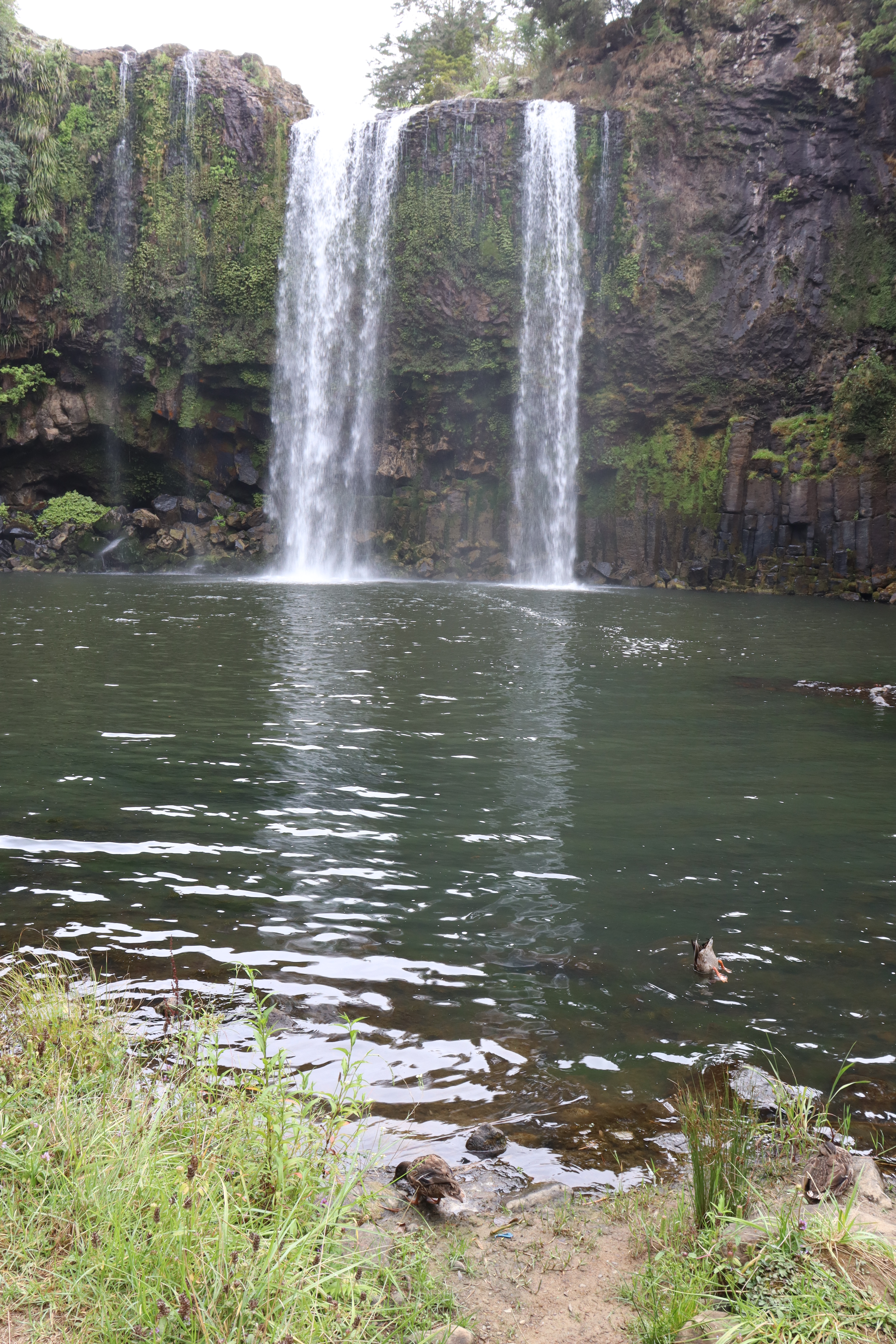
After parting with our Canadian friends, Gary and I started our NZ travels in earnest. Heading north out of Auckland, and after having to take a 10km detour, we got to Whangarei to visit the Whangarei Falls, a very picturesque 26m/85foot cascade with a pleasant walking trail looping from the top to the base. Well worth a look.

Russell, on the Bay of Islands, is a quaint little town and here we walked the trail up to Flagstaff Hill Lookout, where you get great views across the Bay of Islands. It was here that, following the signing of the Treaty of Waitangi across the bay, the flagpole was cut down four times by the local Māori chiefs, angry that, in flying the Union Jack , the British Colonialists were not honouring the terms of the Treaty.

Passing through Kerikeri, we paused for a quick look at the Historic Stone Store, the oldest original stone building in NZ,  and Rainbow Falls with its 40m twin falls drop – beautiful.
Cape Reinga, the northernmost point of the North Island, is dominated by the Cape Reinga Lighthouse which overlooks the famed “meeting of the waters” where the Tasman Sea and the Pacific Ocean meet in a clearly visible collision line. In the distance on a clear day you can see the Three Kings Islands which are actually wildlife sanctuaries and the species there are found nowhere else and are protected  by their isolation.

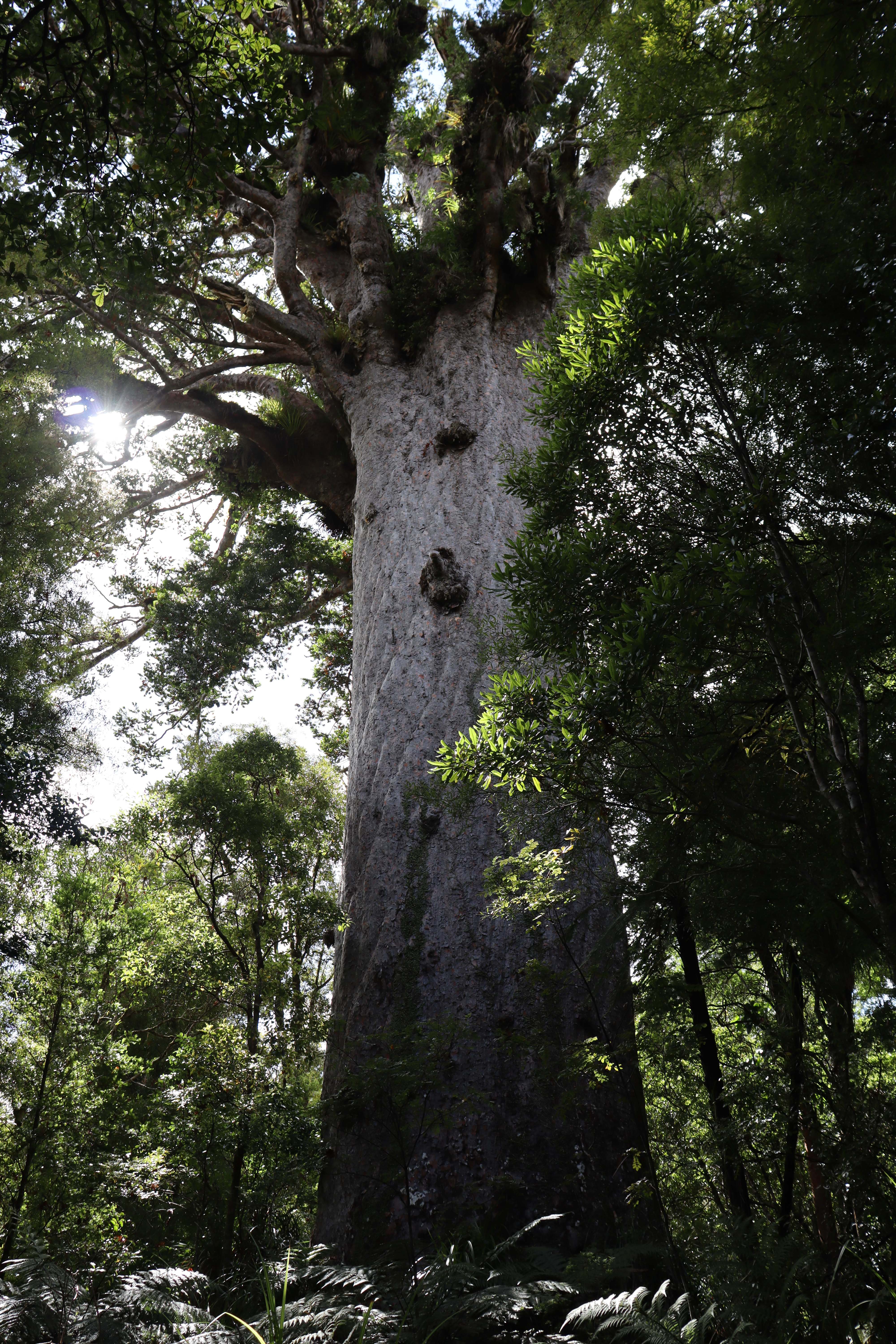
Taking the western branch of the Twin Coast Highway and heading south again, we passed through Waipua Kauri Forest, and paid a visit to “the Lord of the Kauri” – Tana Mahuta – a massive Kauri estimated to be around 2000 years old. At about 55m high with a girth of about 14m almost all the way up, it’s a monster!!

Waitomo Caves are famous for its glowworms, which are actually fly larvae that attach themselves to the roof of the cave and catch their food by suspending sticky lines that catch insects attracted to the light of the glowworm. This tour, taken in boats in the waters at the bottom of the cave, is so peaceful and calm as you are not allowed to make noise for fear of disturbing the worms which would put their lights out, and the spectacle of thousands of these tiny blue lights above you is just amazing. For obvious reasons no photography is allowed, but probably better to experience the real thing.

Just 30 or so kilometres beyond the Glow worm caves are the spectacular Marakopa Falls. Only a short walk from the carpark through native forest, these falls with their 35m drop were THUNDERING after the rain we’d had all day, and so were a most  impressive sight and worth the walk in the rain and the narrow winding road to get there. Having planned on also visiting the nearby Piri Piri Caves and the Mangapohue Natural Bridge out that way, we were somewhat disappointed to find them both closed, so we’ll have to put them on the list for next time we’re here!
Passing through New Plymouth, we headed out to Okato for a couple of nights hoping to see Mt Egmont/Taranaki, by all accounts a perfect cone shaped volcano, but with all the rain and clouds around, we couldn’t see any sign of a mountain, so I jokingly questioned whether it even exists, only to be told , “Oh yes, you can see it from MILES away on a clear day!”  On our first morning – no sign of the mountain – we took a drive AROUND the mountain to the eastern side, to check out Dawson Falls and Wilkies Pools. Now we knew there must be a mountain, as the road to the falls definitely had a fairly steep incline, and once we got to the carpark, we actually got our first – albeit shrouded in clouds – glimpse of the mighty Taranaki.

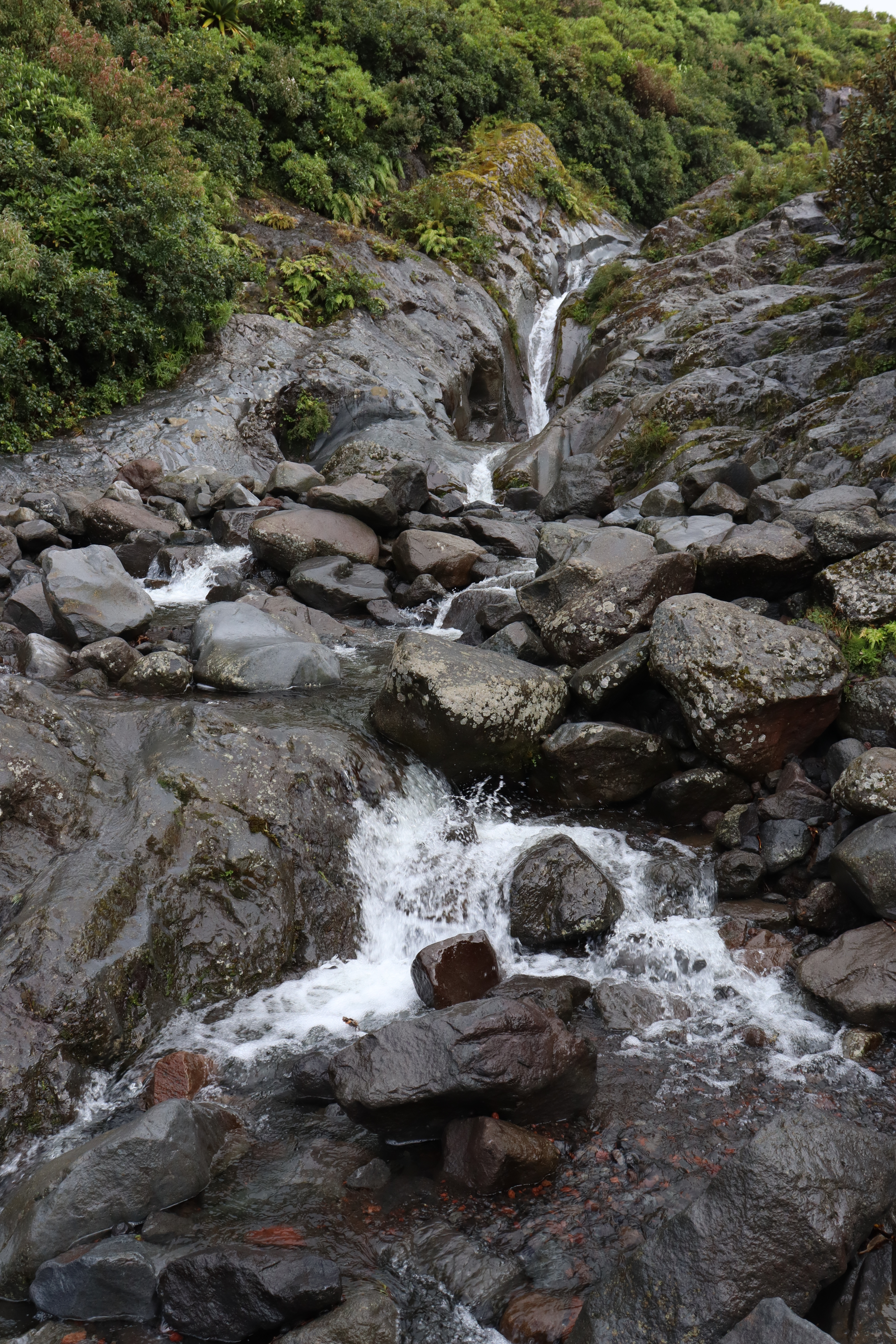
Dawson Falls can be viewed from one  viewpoint near the top or another at the base of this lovely 18 metre cascade. We chose to check out both and despite the misty spray that emanated from the falls, I felt the view from the bottom viewpoint was better as the top view was partially obscured by the surrounding rainforest. Either view was pretty special though!  Taking another wet and muddy trail though the forest – very much a rainforest  on this rainy day! – we found Wilkies Pools, a series of pools and cascades gouged out by the force of the water, rocks and gravel scouring out the 20000-year-old lava. Gorgeous!
Heading back to Okato we called in at both Cape Egmont Lighthouses – yes, there are two of them about 10 kilometres apart, both built around 1864. One appeared to be on private land and had no signposting other than that we could see it down “Cape Road” and the other was signposted as the “Historic Cape Egmont Light” with a museum which was closed. Of course!

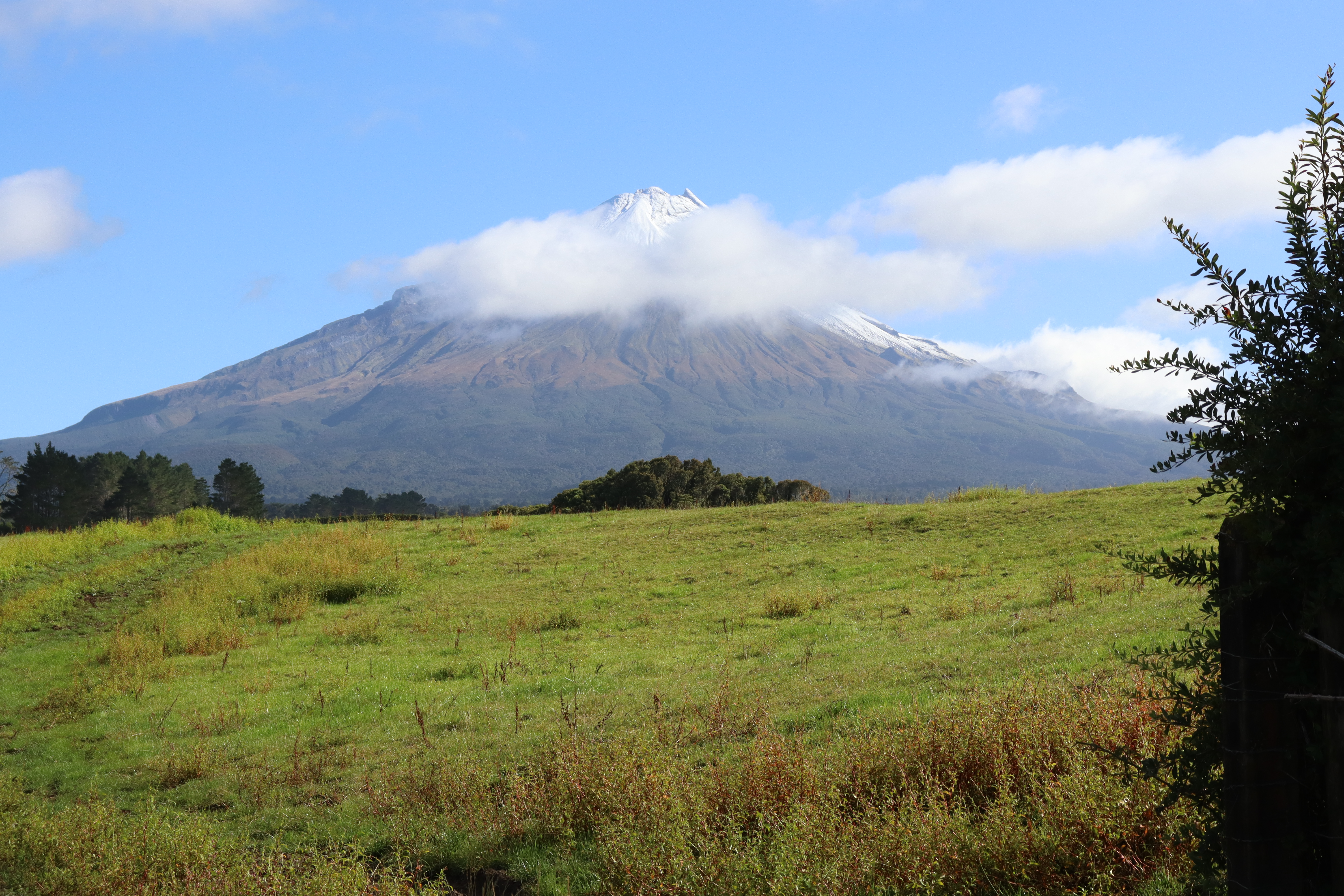
Leaving Okato on a pleasant sunny day gave us our long-awaited views of Taranaki/Mt Egmont in all her snow-capped glory – and proved to us that she actually does exist. Getting a good clear shot, however, wasn’t so easy as the clouds moved across her summit fairly quickly.

Taking the narrow and remote Forgotten World Highway took us through the Republic of Whangamomona, (try and say that three times with a mouthful of marbles!!) a small town that declared its “independence” from New Zealand in objection to the redistribution of local councils, and over the years its elected Presidents have included humans, a goat, a poodle and a turtle! Headquarters of the Republic warrant a visit as they are housed in the historic hotel which dates back to 1902 (current building1911) and is regarded as the most remote pub in the country. Needless to say, we paid the Headquarters a visit!

Further up the Forgotten World Highway, we were held up at roadworks that closed the road for several hours each day, but knowing it was  only an hour or so before the road was due to open, the Stop-and-Go lady advised us to go check out the falls that were about 16 km off on a side road. This was perfect as I’d already read about these falls and wanted to go see them, so off we went. At the end of the road, there’s a 1-kilometre walking track to the falls that crosses private farmland, weaving through a forest of tree-ferns and  alongside the creek that feeds the falls. But this pleasant meander in no way prepares you for the spectacle of the 74-metre drop of the Mt Damper Falls -it’s just WOW!

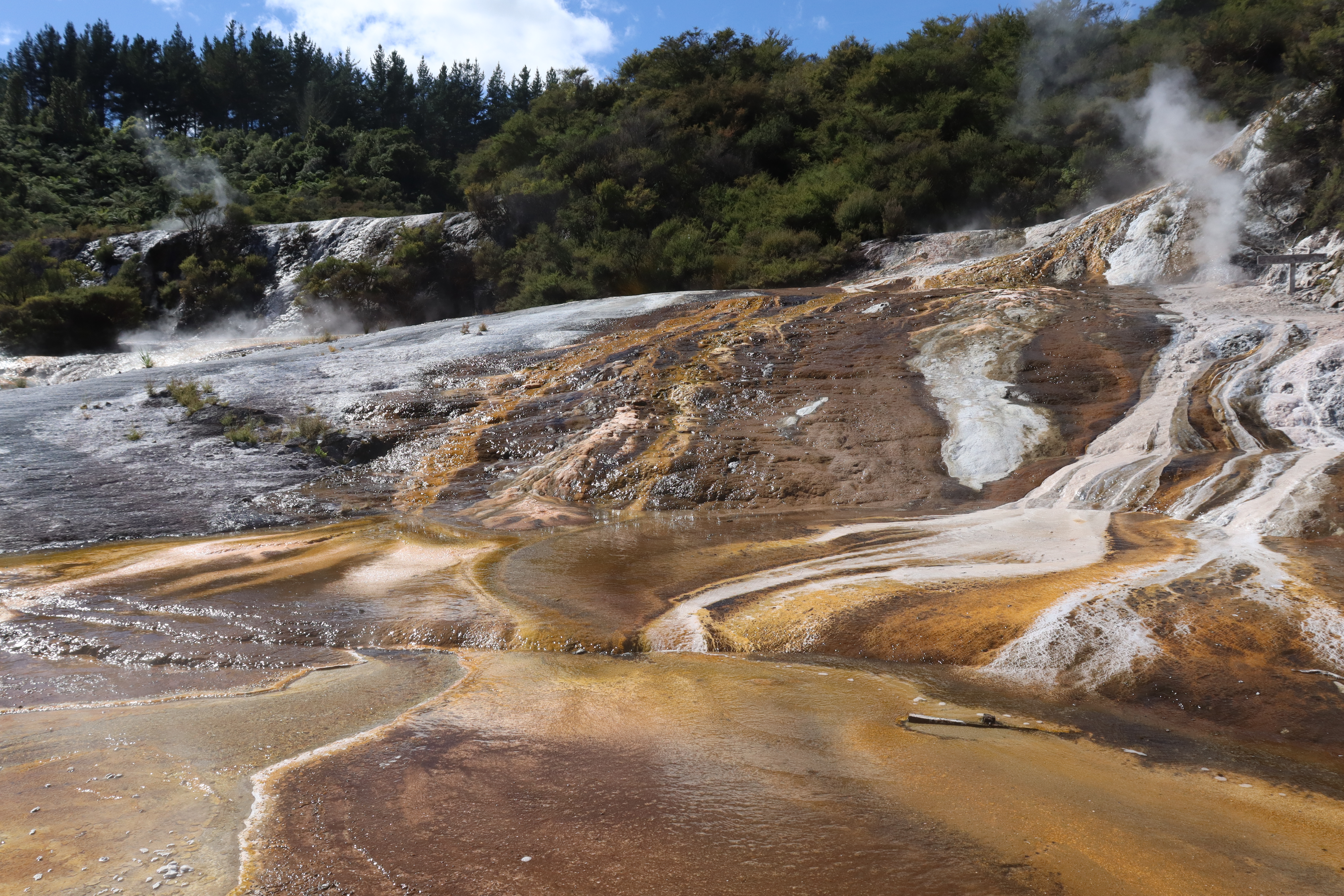
Cutting up northwards through Taupo, with a quick stop at the thunderous Huka Falls, we headed into geothermal country and spent several hours at Orakei Korako-The Hidden Valley, a wonderland of thermal features including geysers, fumaroles, thermal boiling pools and rock faces colored by heat tolerant organisms, silica terraces and boiling mud pools.  With the unmistakeable smell of sulphur in the air and clouds of steam hovering above the ground, this park is  smaller than, but equally as impressive as the more crowded parks of Rotorua.  Whist in Rotorua, we also checked out: Lake Rotorua with its very smelly but aptly named Sulphur Point;  the 5.5km walking trail around Blue Lake (which  actually turned out to be 6.9km!) with its viewpoints over Blue Lake and Green Lake -such imaginative names, but the lakes are very pretty;  and spent an afternoon exploring the Whakarewarewa Forest Park’s amazing plantation of California Redwoods and Douglas firs all dating back to 1901.

Heading out to the northern coastline along the Bay of Plenty, we passed through Whakatane to  come to our next stop: Tauranga or Mount Maunganui – depending which side of the  entrance to the bay you are on – where the town is dominated by the imposing Mount Maunganui, an extinct volcano at the end of the peninsula. Several walking tracks will take you around the base of the mountain or up to the summit for magnificent 360° views over the township, the bay and the islands nearby. All the summit walks are pretty steep, but somehow  I think we managed to find the steepest one!

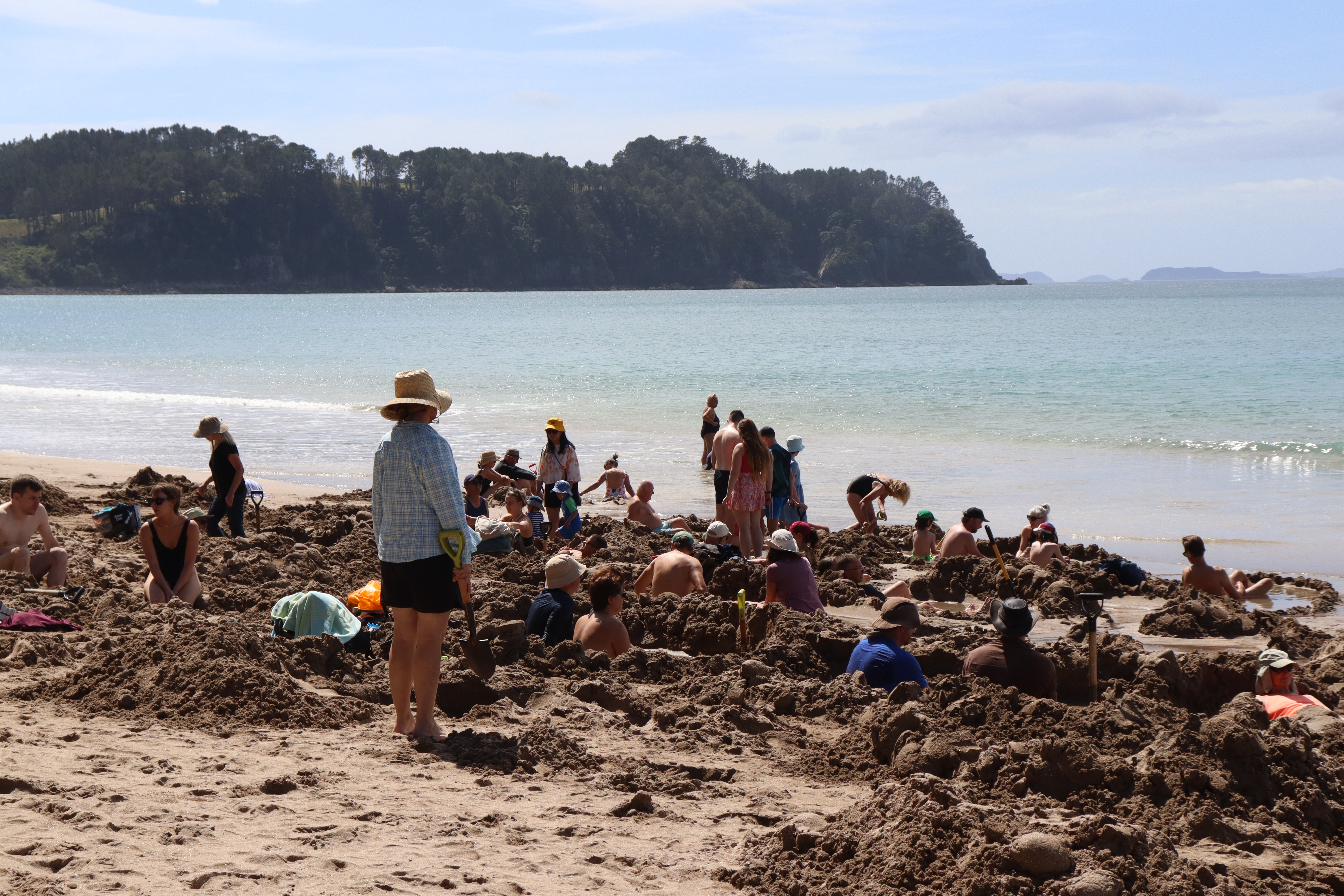
The Coromandel Peninsula is home to the Hot Water Beach at Whenuakite, which is certainly worth a visit, if not to experience the hot waters, at least to witness the crowds that arrive, armed with shovels and spades and proceed to dig holes on the beach to sit or  lie in the warm to hot water that rises from beneath the sand, depending on how deep they’ve dug. Hilarious!

The township of Coromandel on the western side of the Peninsula is a small town that caters well to  the tourist hordes that visit, with hiking trails, beaches, restaurants and tours. A highlight here is the Driving Creek Railway; a narrow-gauge railway built over a thirty-year period by its original owner and operator. Being the country’s first NZ-born potter, he initially built the railway to transport clay and pinewood from the hills above and down to  his studio and kiln. Over time he extended the tracks to enable replanting of native trees on the hillsides, and due to the steep inclines, he engineered several innovations including zig-zagging tracks,  tunnels, bridges, spiral sections and his famous double decker viaduct. The 90-minute tour takes you to the top of the hills to his “Eyefull Tower” Lookout, where you get amazing views over the Peninsula and the islands of the bays.
From Coromandel, it was a pleasant day’s drive around the coast and back to Auckland’s airport for our flight to Christchurch.

And so ended our three-week circuit of North Island.

Stay tuned for South Island adventures!

WTF or HA HA!!

  • Have you ever tried to cook  spaghetti and Bolognese sauce for four adults in one 14cm pot and two small frypans?? Somehow Gary managed it on our first night in Auckland!
  • Wakachangi beer – worth buying a box of it just to read the hilarious “history” of its origin.
  • Driving up Cape Reinga through lots of open farmland with sheep and cattle – then suddenly there’s an EMU -just one!
  • Taking the Hokianga Ferry across to Rawene, got chatting to a guy from Melbourne who was doing the Tour Aotearoa. That’s a bike ride from Cape Reinga to Bluff ie northern tip to southern tip and its over 3000km. If doing it by the rulebook you must  do it in no less than 10 days but no more than 30! WHAT? Madness!!
  • Another EMU….and a couple of ostriches….AND a hedgehog -never seen one of them before!
  • What is it with people??? At Orakei Korako Geothermal Park, when the sign says “Danger – Fragile Surface” and “Keep to the walkways,”  why does some stupid IDIOT woman think it’s ok to step out and jump onto the silica terraces. Secretly I was hoping the ground would crumble beneath her and she’d find out the hard way!!
  • Get to the motel in Mount Maunganui, ready for a nice cup of tea, but there’s no milk. When I asked the owner, “Is there any milk?’ his serious answer was, ‘No, the milkman never came!”  Never mind the fact that this motel is about half a block from a big supermarket!!
  • Heading to the Bakehouse for lunch, Google maps says its less busy than usual – yep, it sure was LESS busy – it was CLOSED!
  • We’ve decided that the biggest employer by far in New Zealand is the Roadworks Department-we’ve had to stop so many times EVERY day for 10, 15, or even up to 20minutes for roadworks! And that was just on the North Island!!
Tabers Travels Go West

Click on images to enlarge.

Western Australia.

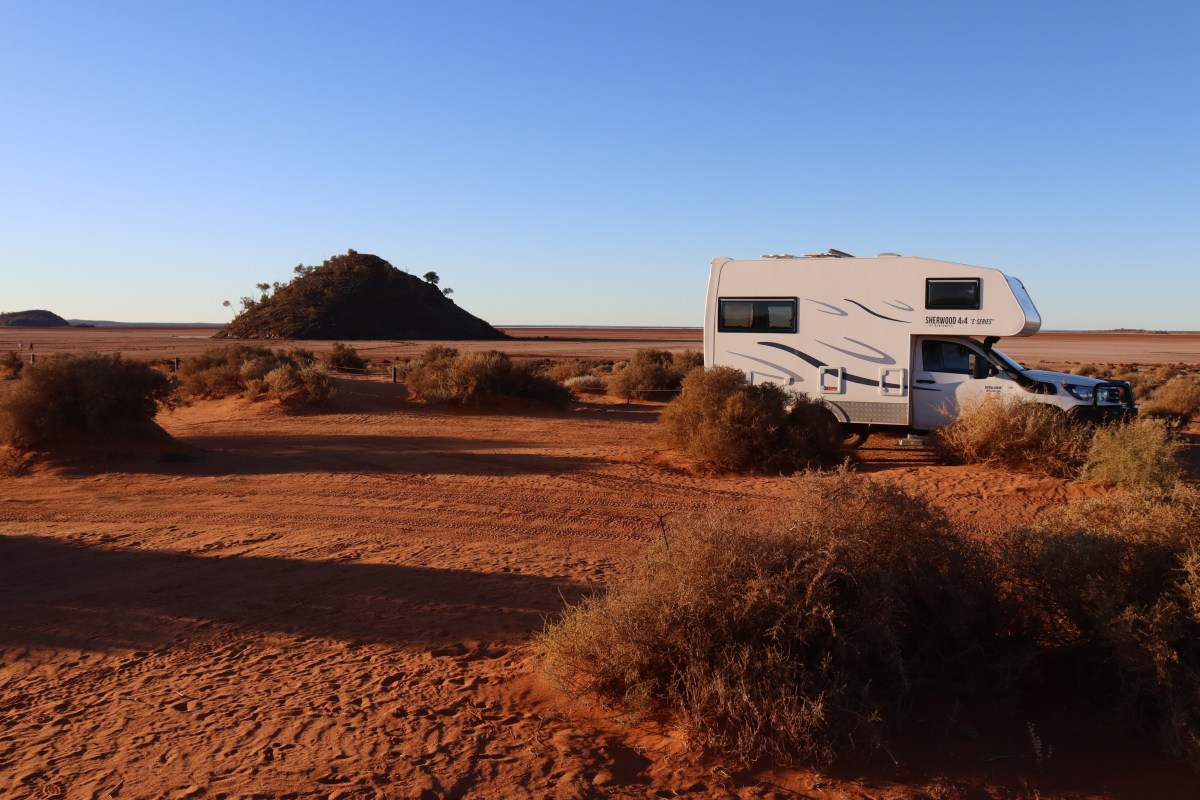
It had been over 36 years since we had travelled over there (except for a brief stop in Perth airport on our way to Broome for a Kimberley Cruise) and we had a few places on the list that we had never been to, so we packed up Roxy (the motorhome) and took off.

Rain once again had impacted on our initial travel plans: we had intended driving up into the Northern Territory and across to WA on the (dirt/gravel) Great Central Road, but as we began our trip, that road was closed due to  rains, as were several others. We even managed to get stranded for a few nights in a couple of places where the rains came after we travelled in and so we had to wait till roads dried a bit and opened again before we were able to get out again. No drama – all part of travelling the outback during winter.

So instead of heading north, we took the “easy” option and drove across the Nullarbor, which was great as we hadn’t done that for 36 years either.

Along the way, we stopped in at a number of places to vary the route and make it a little more interesting.

Starting with a couple of nights camping on the Murray just out of Robinvale, we headed up through Mildura to take a back road (dirt of course) across to Renmark, thus avoiding the main highways and traffic. Pulled up for the night at a free camp on the Rufus River Road at Lake Victoria, and true to form, the rain came which kept us there for the next three nights as the road was closed to all traffic. We managed to fill in those days quite easily by exploring the local area, although we couldn’t venture too far as we had to go on foot – even then we found ourselves getting taller with the sticky mud clinging to our shoes. So we checked out Lake Victoria with its resident populations of pelicans and cormorants and other water birds, and its sad history of the Rufus River Massacre of 1841. We also took a longer walk out to the Lock 7, one of the 13 Locks along the Murray River which maintain flow, water levels and navigation of the river. No boats coming through that day, so we turned around and walked the long sticky walk back to our campsite.

After three days we heard the road was open again, so rather than continuing through to Renmark, we thought it was wiser to backtrack the shorter distance to the bitumen and stay on bitumen for a while. In doing this we still had to navigate about 60km of sticky gluey road and we quickly concluded that this road should NOT have been open to traffic yet!! However, we made it back to Wentworth, with Roxy weighing a whole lot more than when we went in, due to the mud that had collected in every wheel well and on the mud guards and bumpers. We even had to stop at one point to clean off the manual step that had dropped down with the weight of the mud it had collected as we drove along.

Staying on bitumen till we got through Port Augusta, we turned onto a dirt road to spend a few nights in the Gawler Ranges at Mt Ive Station, a working sheep station that offers camping, accommodation and a bar, along with its unique tourist sites including Lake Gairdner, a huge salt lake where annual Speed Week events occur and Land Speed Records are attempted.  Four-wheel drive tracks around the property take you to other sites of interest, including the Organ Pipes, a large stand of rhyolite pillars, and The Embankment, a dry-stone wall dam built in the late 1800s for water catchment. This dam wall does have a small leak and although he tried (and unlike the little Dutch boy) Gary was unable to stem the flow by plugging it with his finger!
Leaving Mt Ive, we passed through the Gawler Ranges National Park – spotting a Mallee Fowl on the roadside – and down to meet the Eyre highway at Minnipa, to continue on our way out west, with a couple of overnight roadside stops.

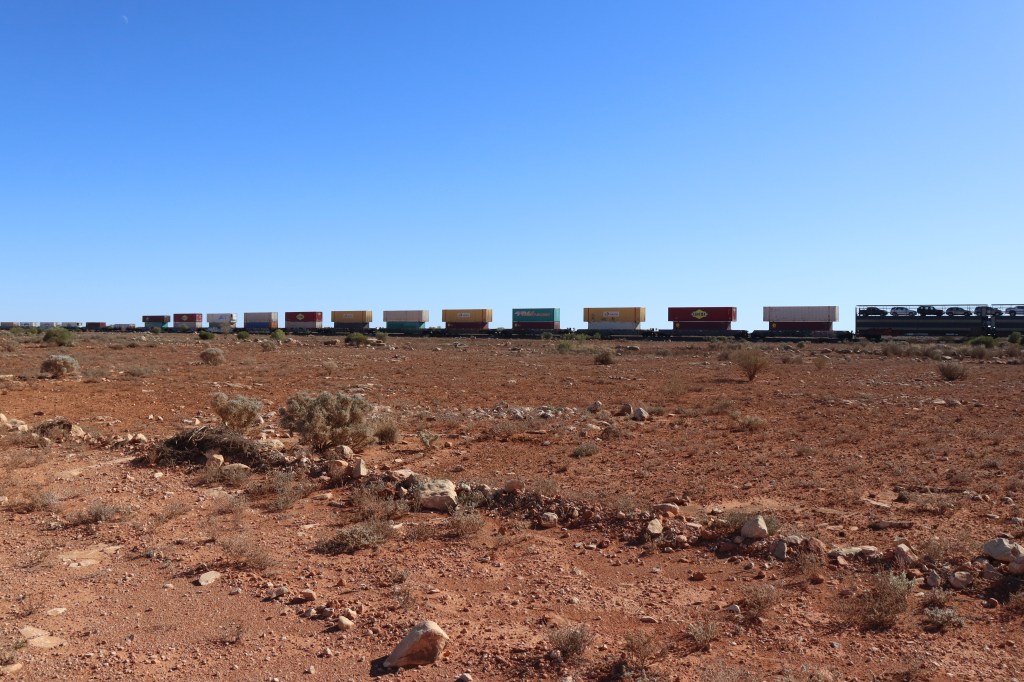
After crossing into WA and driving about 300 km, we detoured off the main highway and crossed the plains northwards on a pretty rough “road” (120 kilometres took us 6 hours!!), through 11 farm gates of varying styles, till we hit the Trans Australian Railway line at Haig, one of the original “towns” along the Line.  From there, we followed the railway line on the Trans Access Road, a very well-maintained dirt road, the rest of the way into Kalgoorlie and the Goldfields.  Stopping in at Rawlinna (population 30) another of the towns along the line, we had lunch and a cuppa on the huge tables at the station, where passengers on the Indian Pacific train trip across the country are treated to an “Outback Experience” of dinner under the stars.

Kalgoorlie has a great FREE (in our price range) Museum of the Goldfields, and lots of grand buildings dating back to the height of the gold rushes there. The town is dominated by the “Superpit”, the huge hole in the earth formed by dredging for gold. If you do nothing else in Kalgoorlie, it is well and truly worth going up to the Lookout which overlooks this massive operation, where, since gold was first discovered in 1893, over 60 million ounces of gold has been produced, making it one of the richest gold producers in the world.

The Super Pit gold mine, Kalgoorlie

North of Kalgoorlie, we called in at the Two Up Shed, one of only two venues in Australia where Two-up, the gambling game popularized by WW1 Australian soldiers, is legally played any time, happening here most weekends and public holidays. Elsewhere playing the game is illegal except on Anzac Day.

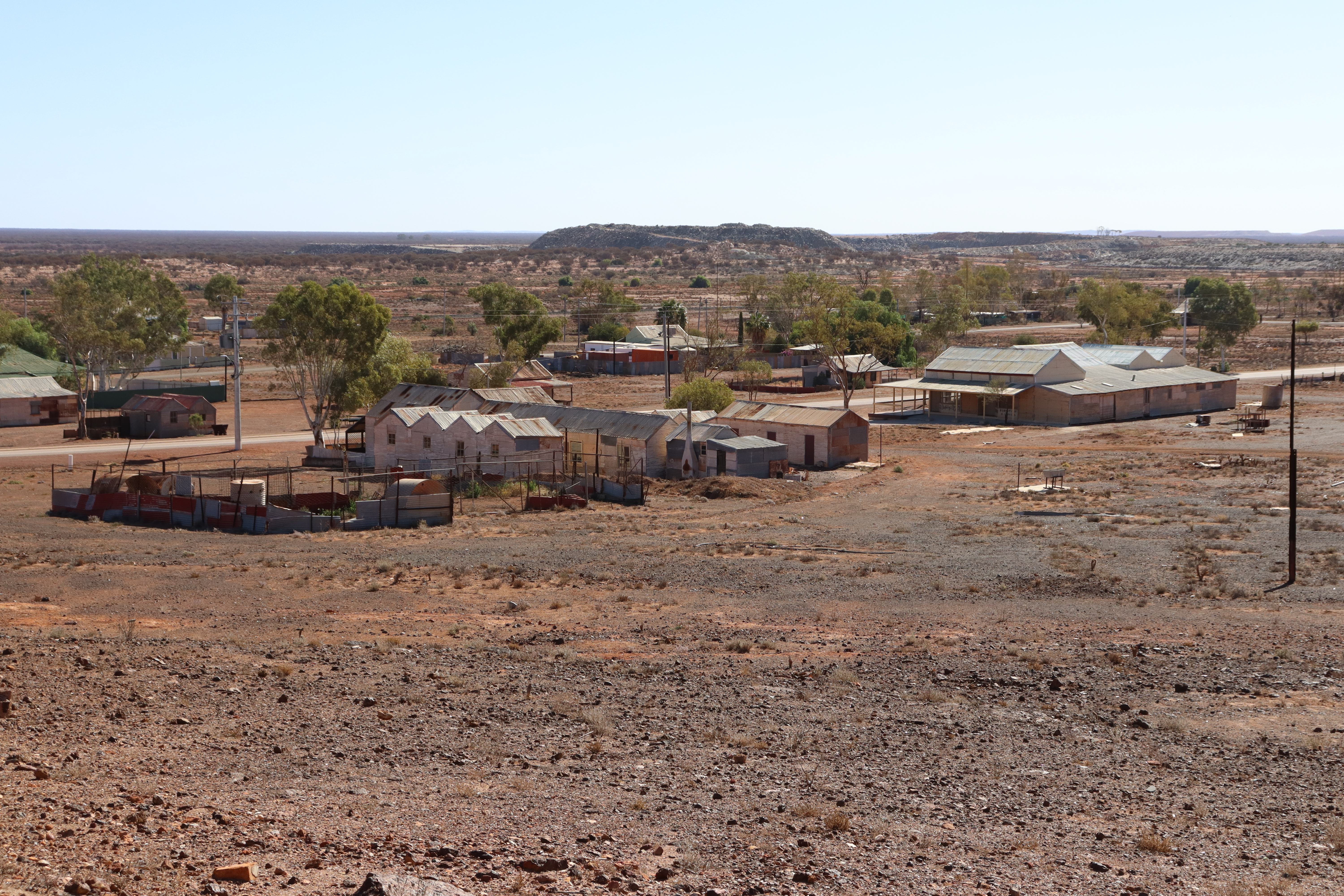
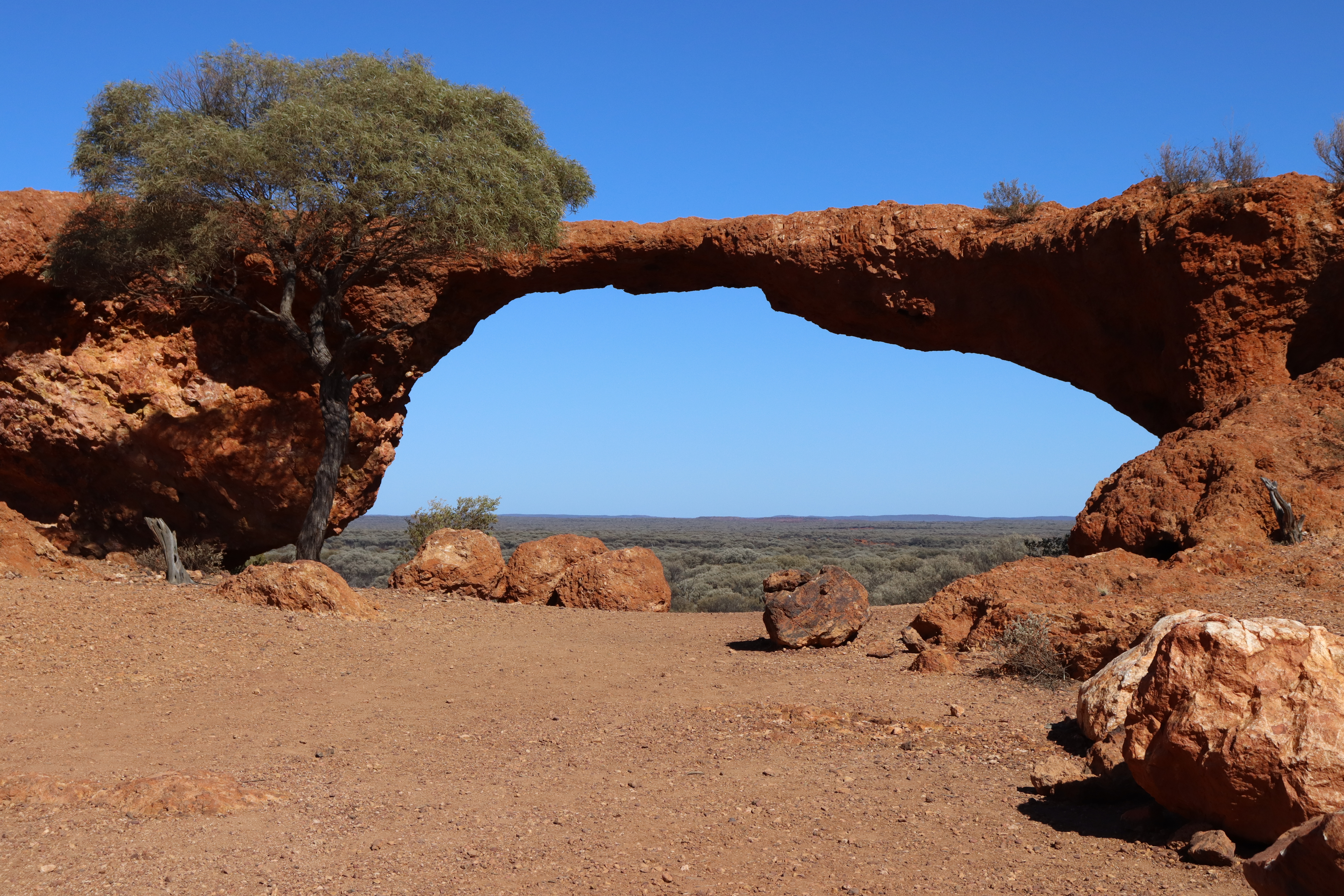
After lunching on the biggest hamburgers I’ve ever seen at Broad Arrow Tavern, we followed the Golden Quest Discovery Trail along  some minor trails and backroads to places steeped in goldfield history, including: Ora Banda, Copperfield, Goongarrie,  Davyhurst and Mount Morgans,  most of which are now just sites of former towns;  and Kookynie, a stop on the rail line that still boasts an open pub – but getting a drink can take a while as feeding the local horse at the front door takes precedence!  And the quaint old town of Gwalia, home of the 1.6 kilometre-deep, 1897-established Sons of Gwalia Mine, once managed by (future US President) Herbert Hoover, and where old miners’ cottages and “camps” (shacks) have been preserved and restored by volunteers. Goldfields towns that still have  decent (and friendly) populations and include Leonora, Menzies, Laverton and Sandstone, are surrounded by some amazing country and natural features, notably The Granites, and Ularring Rocks, both of which are piles of large red boulders and rocks that resemble a mini version of the Devils Marbles of NT; and the impressive London Bridge, a weathered basalt archway believed to be around 350 million years old.

Lake Ballard, a huge (mostly) dry salt lake has an outdoor art gallery featuring 51 life-sized metal statues representing people from the nearby town and spaced out across the surface of the lake, so you need to walk several kilometres to see them all. Gary managed to find about 32 of them but I only got to about 10!

From the goldfields we headed south through Meckering, site of the 1968 earthquake that was felt over a 700 km radius, virtually destroying the township and leaving a 37 km-long fault marking the quake’s vertical lift of 1.98 metres.

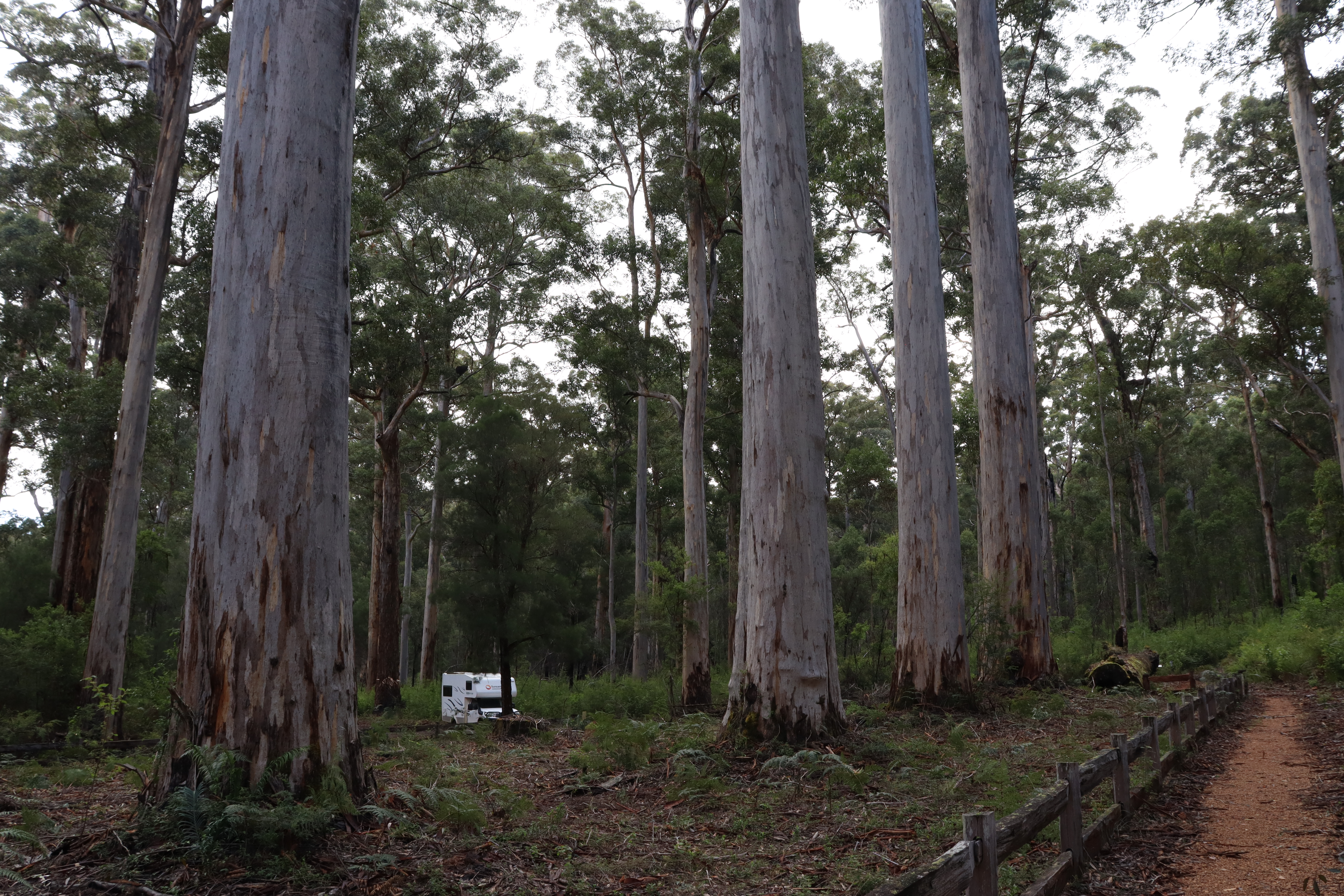
After a couple of days in Mandurah to visit Gary’s sister and brother-in-law, and checking out the Mandurah Giants, massive giants sculpted from timber offcuts – well we only managed to get to one – we continued southwards to visit the giant trees of the Southern Forests. These Karri, Red Tingle and Jarrah trees are amongst Australia’s tallest trees growing to heights between 45 and 80 metres and girths up to 20 metres at the base. Famous among these giants are the fire lookout trees, where the fire-spotters used to climb the peg-ladders to the top of the trees to spend their days on the lookout for fires in the forests. In the past you could climb several of these trees as a tourist thing, but (luckily!!) they were closed for climbing when we were there and due to safety concerns have now been closed indefinitely. We got the tall tree experience by walking the Tree Top Walk in the Valley of the Giants, where you walk along suspension platforms 40 metres above the forest floor, which sway as you walk, simulating the movement of the top sections of these giant trees. Pretty impressive.         

Starting to head eastward again, following the south coast of WA took us through some amazing places, mainly National Parks of the south coast.

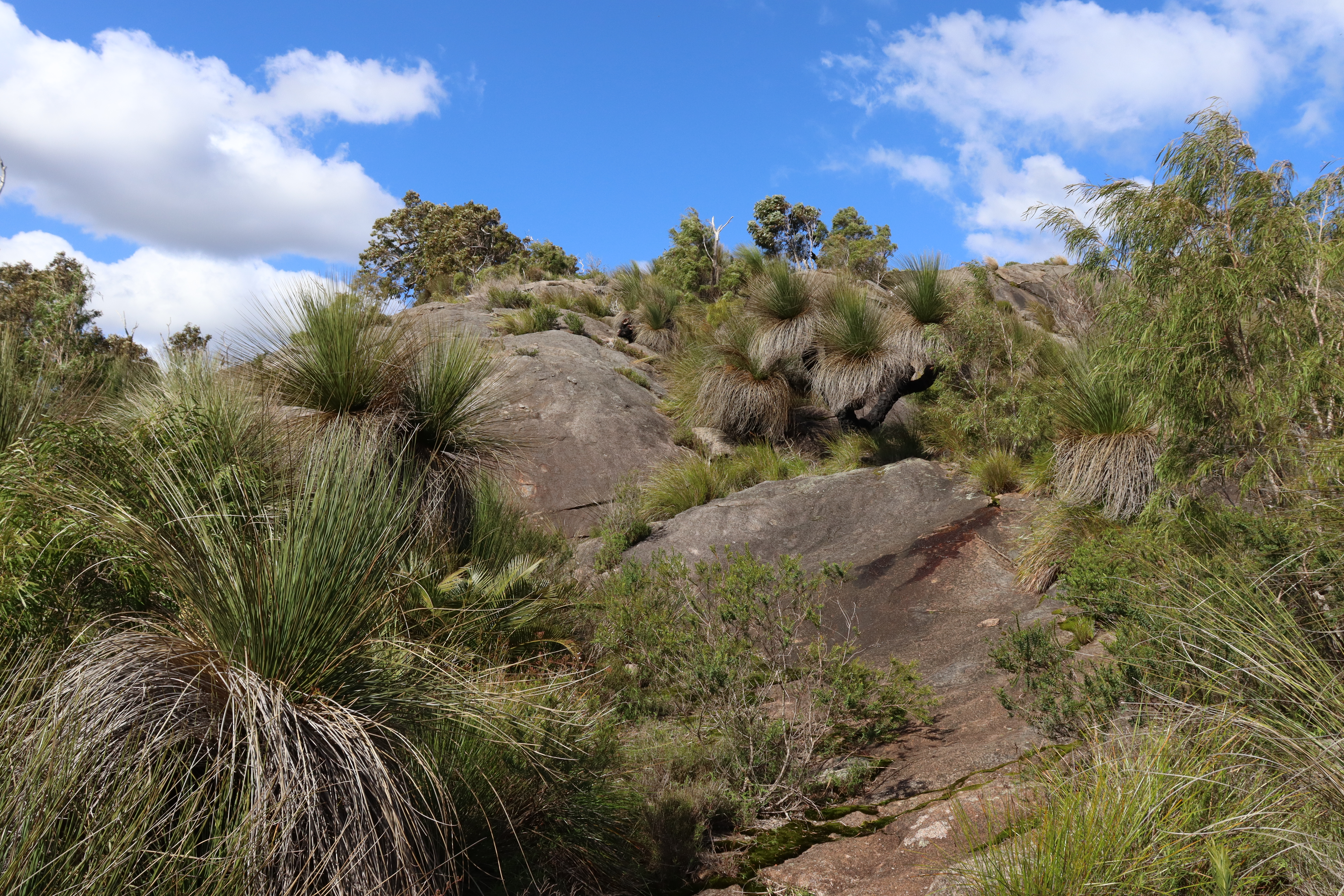
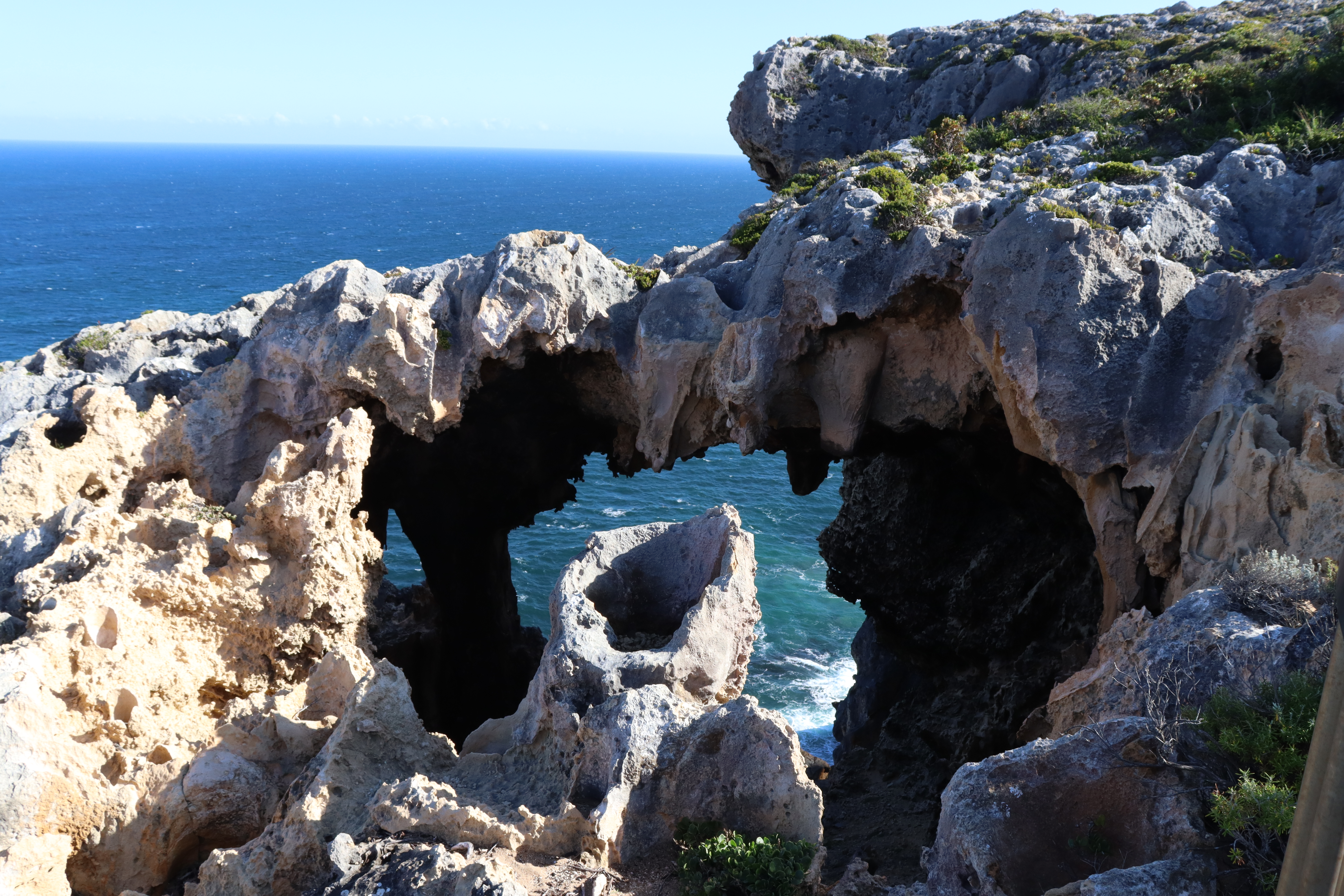
 The D’Entrecasteaux NP ‘s two sections are vastly different from each other but both well worth visiting. The coastal section near Windy Harbour showcases the wild rugged beauty of the coastline bordering the Southern Ocean here and features several lookout points with the highlight being the amazing “Windows” rock formation. Further inland, the NP’s Mount Chudalup section features (oddly enough!!) Mt Chudalup where we walked the 1.5-kilometre trail and scrambled over some steep sections of rocks to the summit of this great granite outcrop for amazing 360° views across the surrounding country all the way to the coast. This section is a botanical treasure trove hosting 42 native moss species, 28 lichens and 6 liverworts, as well as trees, bushes, grasses and grasstrees.

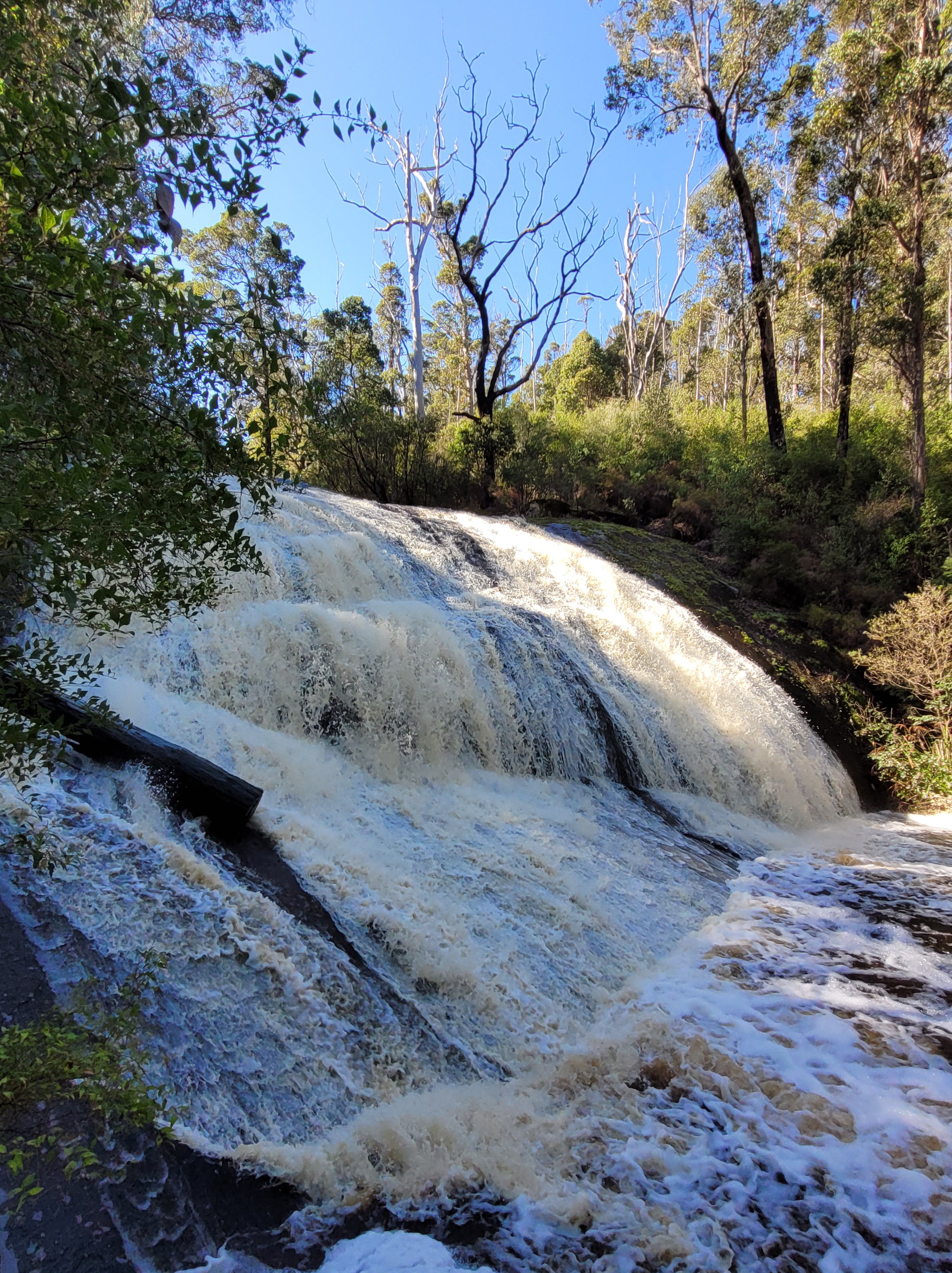
Passing through a number of other National Parks – Boorara Gardner with its spectacular Lane Poole Falls; Shannon NP, site of former timber-workers’ town but now a large camping area; Mount Frankland South NP with the thunderous Fernhook Falls; Mount Frankland NP with its steep trail, over 300 steps and several vertical ladders (and a warning NOT to proceed if “faint of heart or foolhardy” -ha ha!) to reach the summit, where we were nearly blown away by the gale like wind! – we finally came back out to the coast.

Torndirrup NP near Albany, is home to spectacular coastal sites that demonstrate the awesome power of the sea, namely: The Gap, where waves rush into a narrow chasm in the cliff, gradually wearing away the rock over millions of years; The Natural Bridge, where the waves have worn away the rock leaving an arch; and the Blowholes, where a small plaque on the rocks near some small cracks warn you to “Stand Clear – Heavy Swells force air and spray through cracks with great  pressure!” which indeed they do! Standing near the cracks, we were suddenly BLASTED with a huge rush of air which had us in hysterics at the unexpectedness of it!!
Albany is also home to the Historic Whaling Station, and a visit here is well worth it. There are several relics from the days of whale hunting including a whaling boat complete with harpoons, the cutting floor, several skeletons and LOTS of information. You leave this place wondering how the hunters could have continued hunting these beautiful, amazing creatures, and thankful that it has been banned.

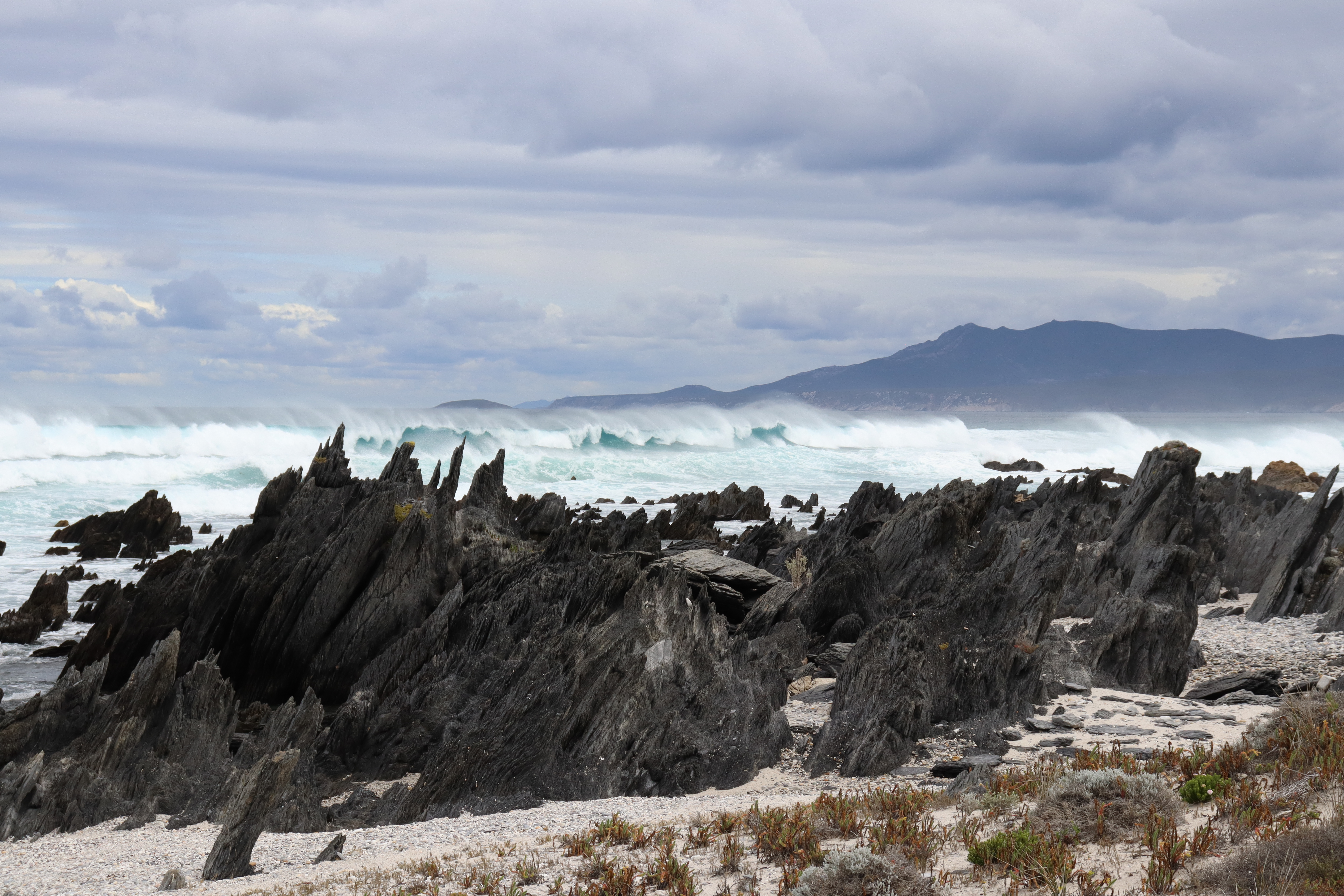
Near Hopetoun on the south coast, Fitzgerald River NP’s skyline is dominated by East Mt Barren rising high above the pristine white sandy beaches and turquoise bays, including Hamersley Inlet and Beach, where the inlet is closed off from the beach by a large sandbar that apparently only opens every ten years or so. Beyond the bar, the beach is filled with hundreds of large, sharp, jagged, shale- or slate-like rock formations sticking up vertically from the sand and the water. AND…. Sooo many coastal wildflowers!
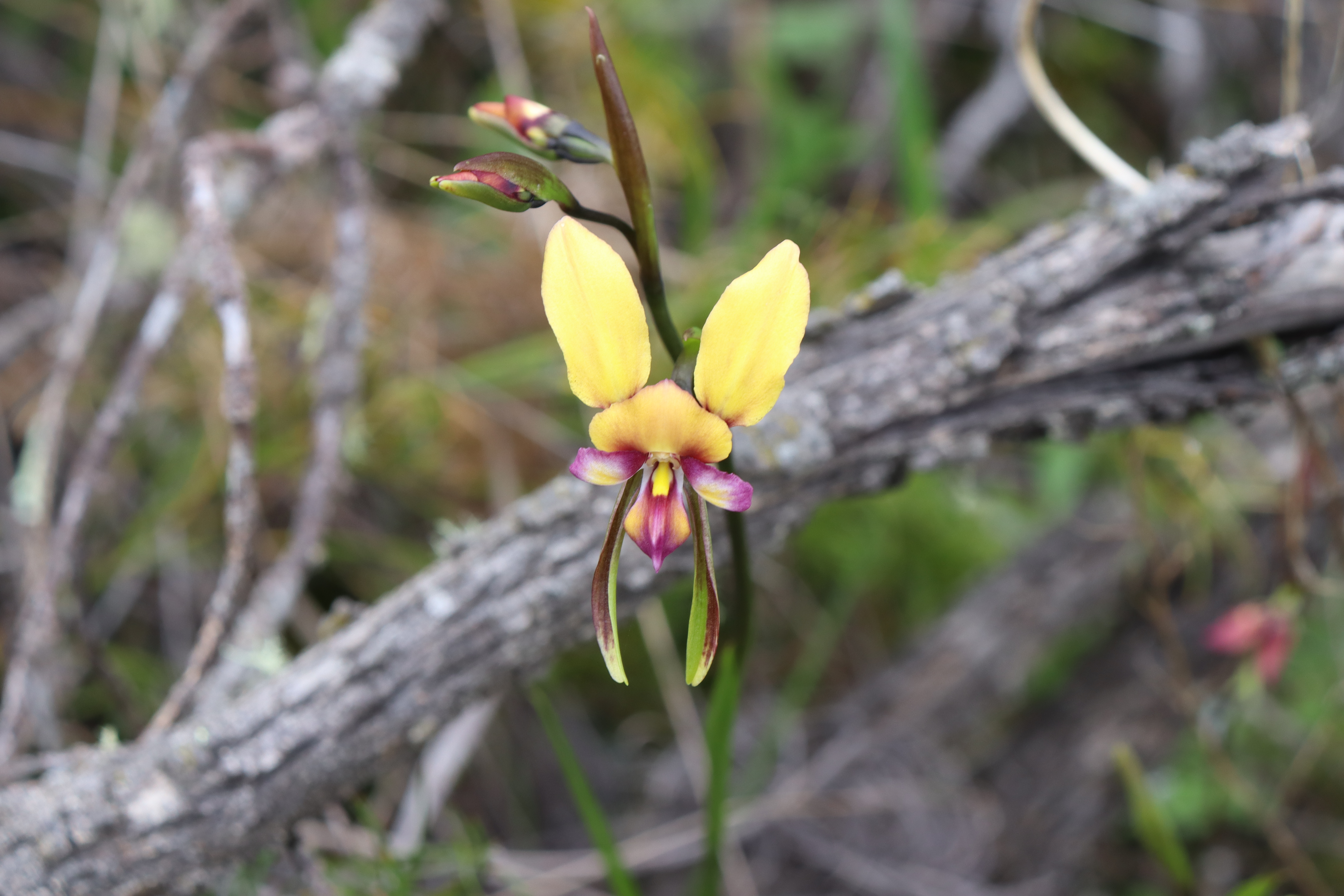
Not far from Esperance is Cape Le Grand NP, where we were treated to the most amazing coastal scenery with rocky ridges, pure white sand and the most perfectly turquoise waters I think I’ve ever seen!  A 3 km walk along the fine white squeaky sands of Lucky Bay – the Jewel in the Crown of this NP – takes you to the far end of the Bay where the turquoise waters break against red granite boulders on which several green copper plaques commemorate Matthew Flinders’ landing here in 1802 in HMS Investigator using the bay as safe anchorage during his circumnavigation of Australia. From the campground, we walked the opposite direction, passing another plaque honoring Flinders, over the headland on the Coastal Walking Trail to Thistle Cove, named in memory of John Thistle, Master of HMS Investigator, and where the huge “Whistling Rock” makes whistling, ocean-like sounds as wind passes through. Further afield more stunning beaches include Hellfire Bay with the same white sand, red granite and turquoise waters, Cape LeGrand Beach where you can drive 22km along the beach to Wylie Bay, and Rossiter Bay where seaweed has washed up and dried creating a carpet about a metre thick! And once again, we were treated to a wondrous display of native wildflowers, including lots of different native orchids in bloom. Magic!

Traversing back across the Nullarbor, we paused to visit the remnants of the Eucla Telegraph Station that are slowly being consumed by the sand dunes, and had to do a U-turn to stop along the highway and take some pics of the only “garden” of the exquisite Sturt’s Desert Pea we saw on our entire trip. Further eastward, we stopped to view the awe-inspiring Bunda Cliffs of the Great Australian Bight, planning to spend the night there like stacks of others. However during the night the wind blew up  to such a force that not only kept us awake, but also had us fearful of Roxy being flipped over, so at 3 in the morning, we got up and drove about ten kilometres further along the highway till we found a little spot that was more sheltered from the wind – and THEN we managed to sleep!

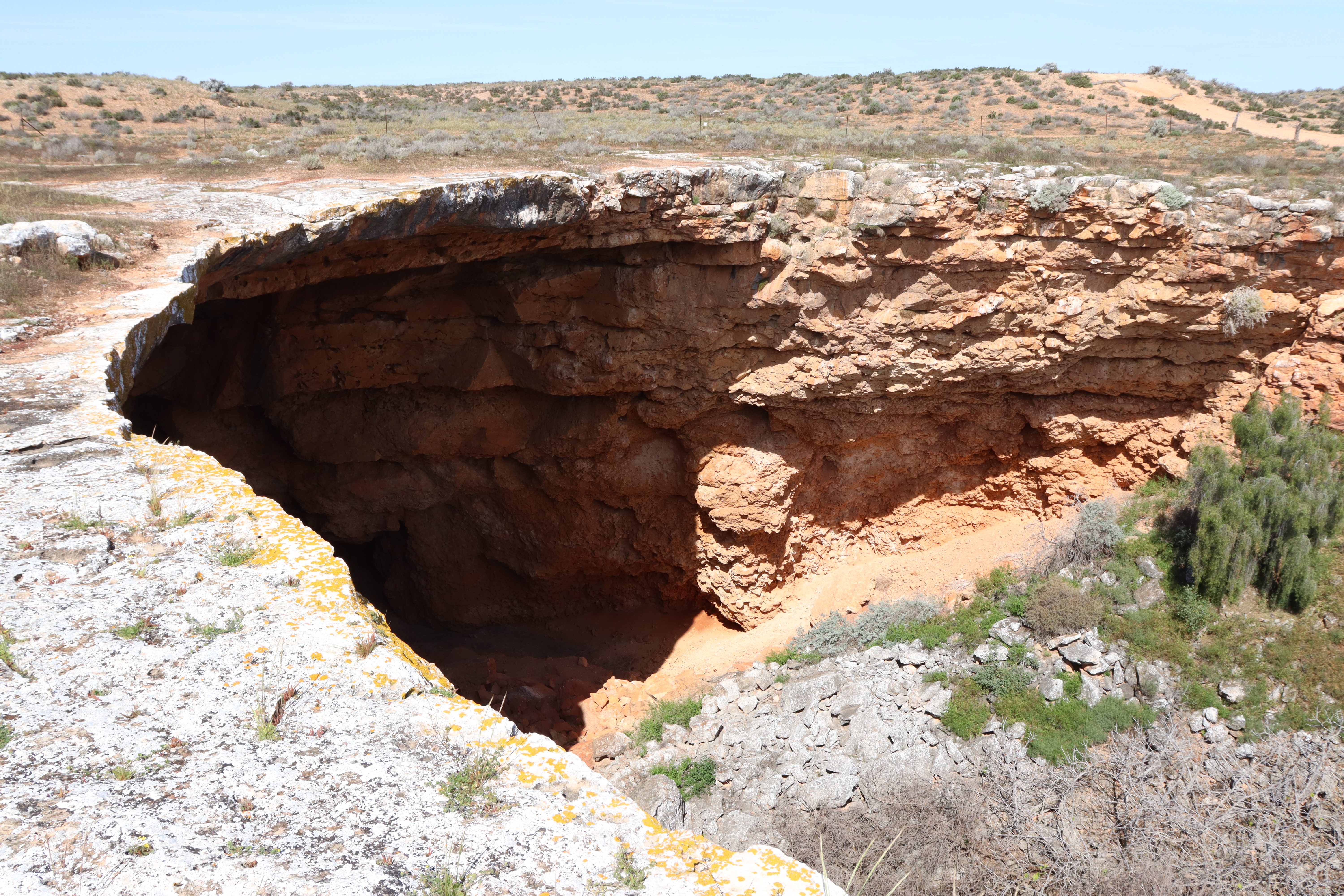
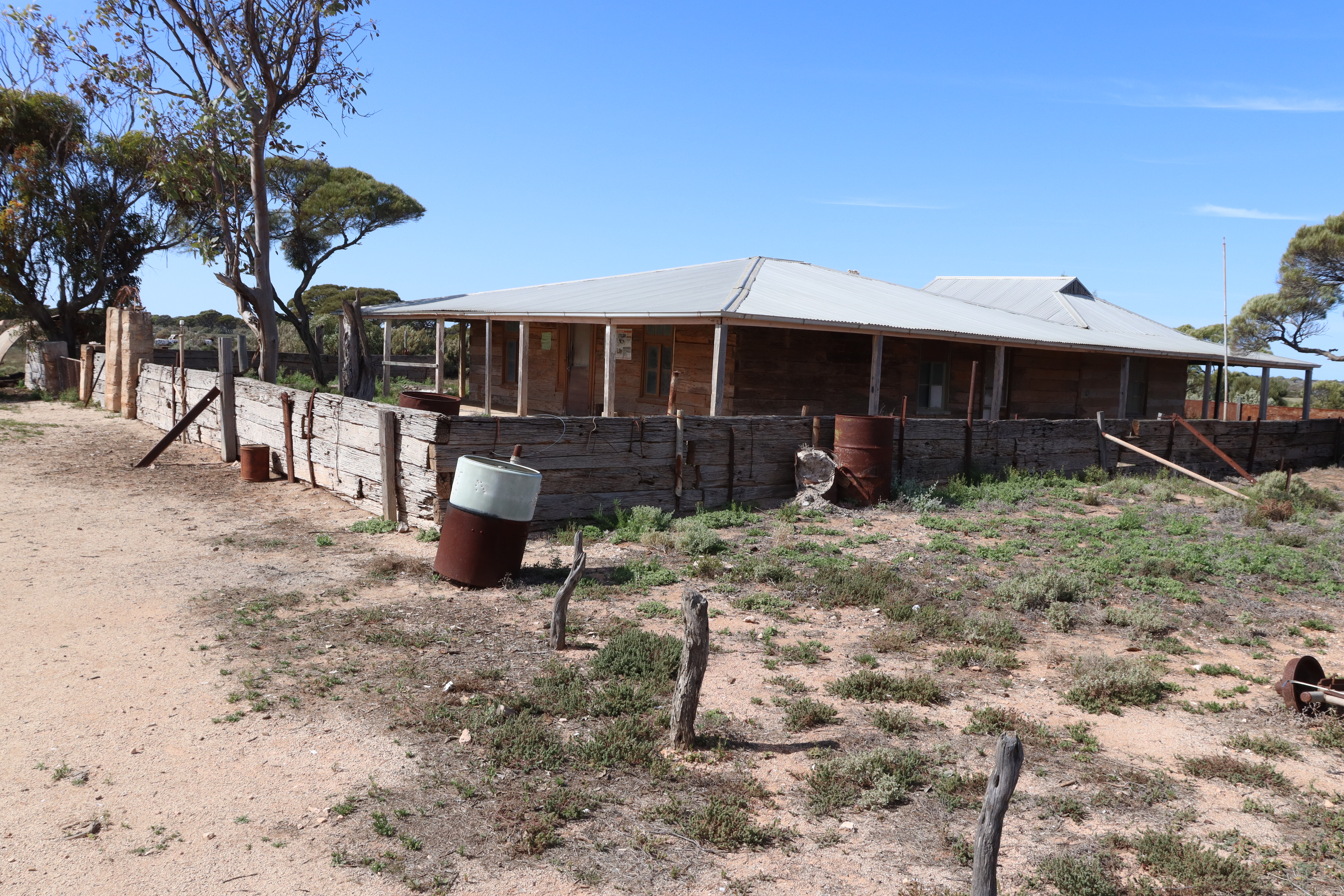
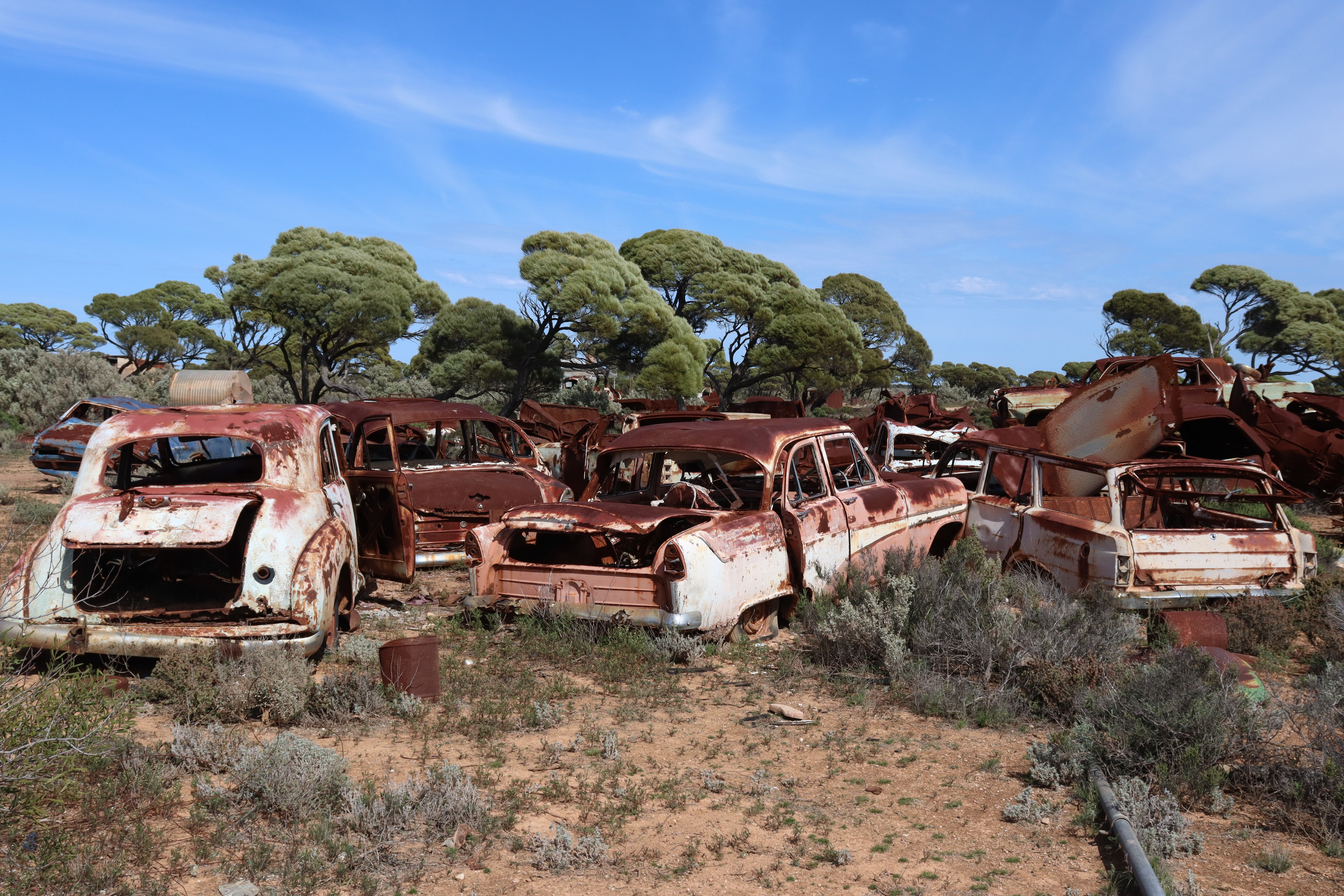
Heading inland, north off the highway, into Nullarbor NP we  checked out the historic Koonalda Homestead, where several of the old buildings, built from old railway sleepers from the  Trans Australia Railway and recycled materials from the old Eucla Telegraph Station,  remain in remarkably good condition, surprisingly with no vandalism or graffiti. What struck us most about this place was the number of “dead” cars – hundreds of them – parked everywhere. Turns out the Homestead was also a roadhouse or service point for travellers along the Old Eyre Highway, and over the years it became a graveyard for the vehicles that broke down! Some 8 kilometres beyond the homestead lies the Koonalda Cave, a huge sinkhole with underground water supplies from which water was pumped to service the homestead and for their stock.

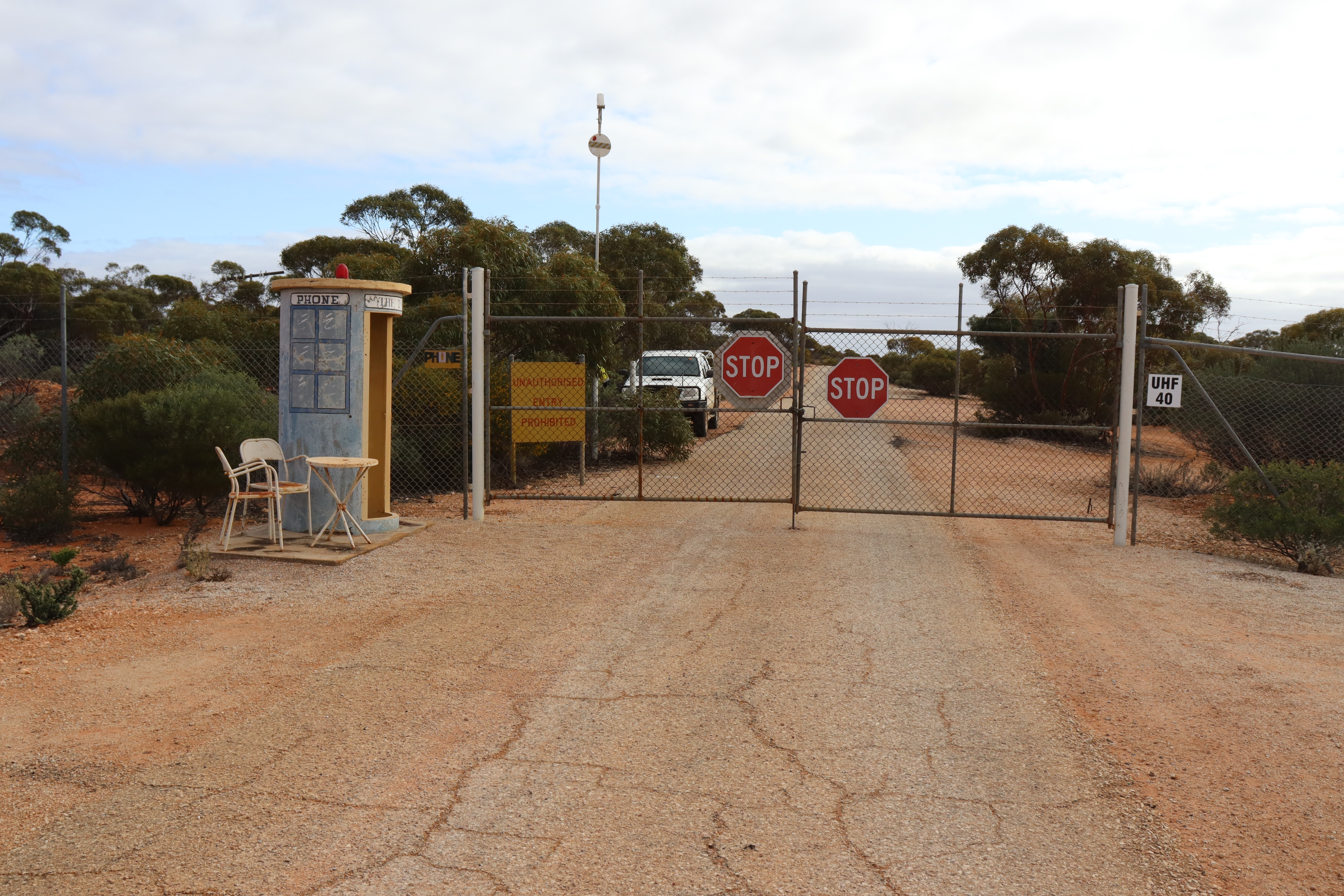
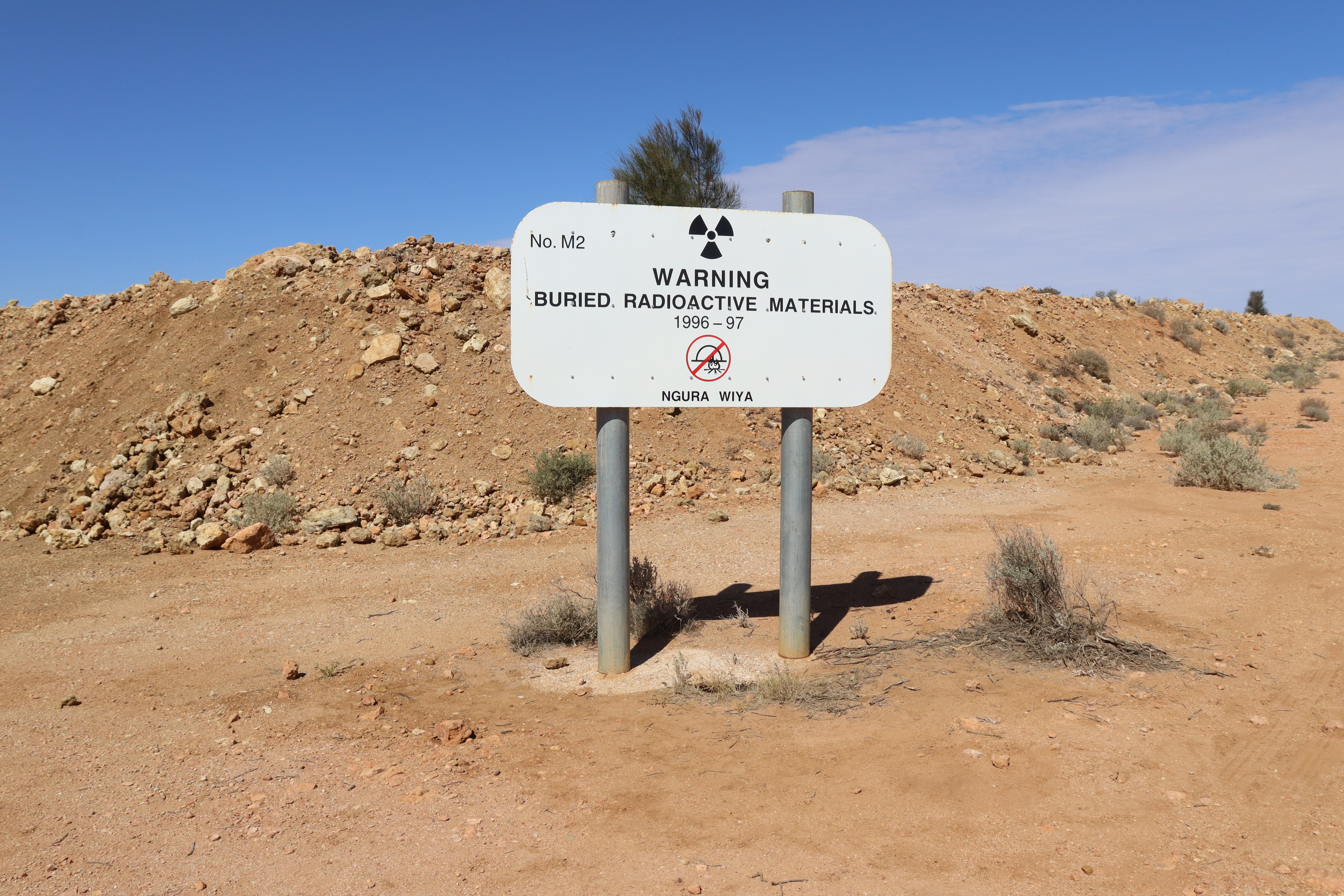
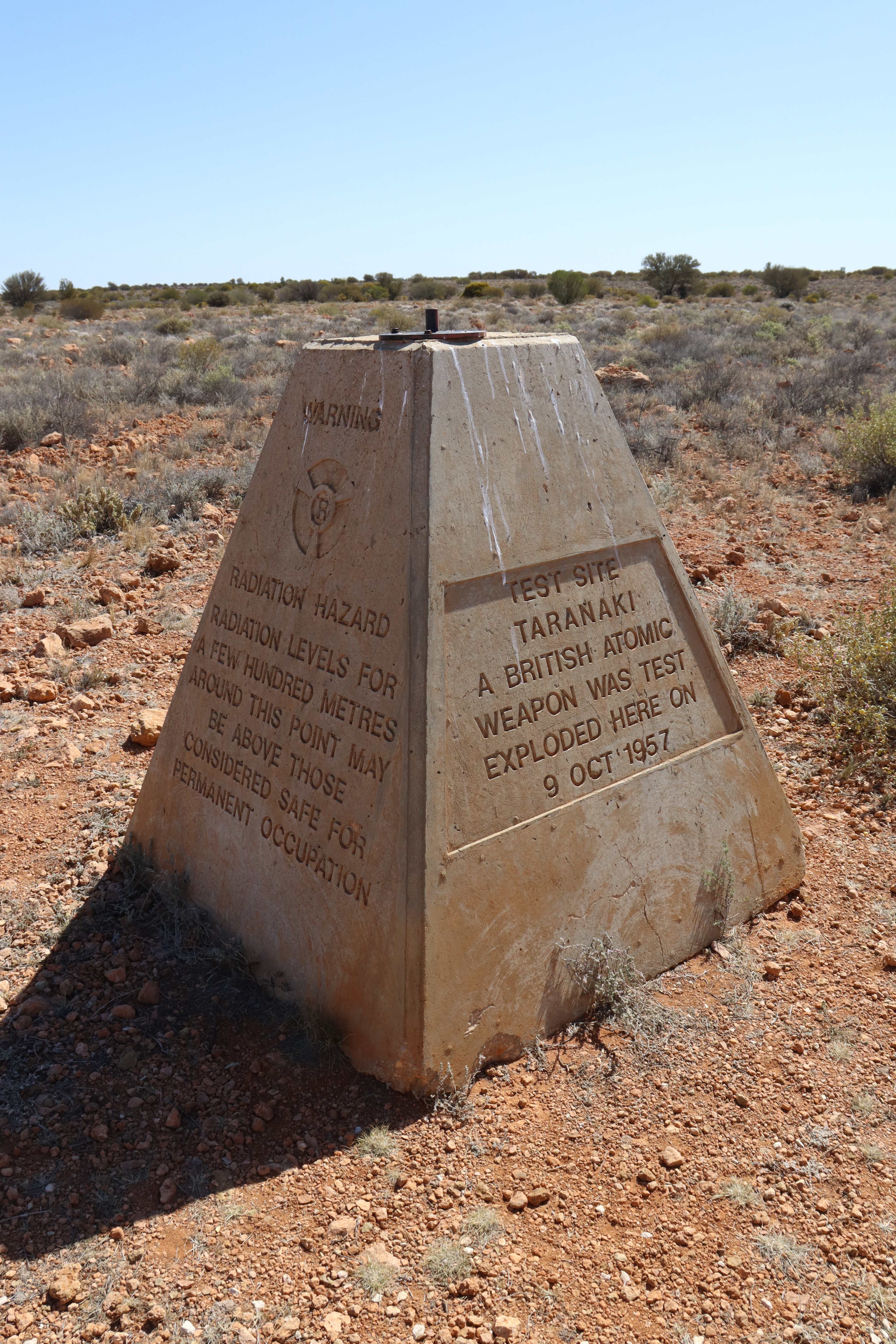
As a conclusion to this trip away, we had decided to spend a few nights and take in a tour of Maralinga, the site of Atomic testing in the 1950s. Camping at the village and then a bus tour out to ground zero of the multiple atomic tests is fascinating but also sobering when you realise the impact these tests had on the local people, their future generations and on the landscape. Our guide was a wealth of information about the building of the town, the test sites and the aftermath and cleanups. There are still lots of radioactive fragments lying around on the ground in the ground zero precinct, although our guide assured us that they were at very minor and safe levels of radioactivity. Hope he’s right!!

In our last few weeks of this trip, we made the decision to sell Roxy, as our plans for the next couple of years included a trip to New Zealand and hopefully an extended time in Europe, which would mean Roxy would sit unused for a couple of years – not good for the vehicle and too much money tied up in her to have her sitting around. So we advertised and due to there being none available and a 2-year-plus wait for a new one, we sold her within a couple of weeks of first advertising, which was great (although a little sad to see her go!). It’s great to know, however, that she is continuing her duties and taking her new owners (who continue to call her Roxy!) to many of the special places this great country has to offer.

WTF or Ha Ha!!

  • Camp at a free camp, go across to the pub for dinner and couple of drinks – AND end up winning the meat raffle!!
  • Roadside camp, not free but gets a few in. We tuck up the back to not be in anyone’s way. Then 2 cars with vans come in and virtually block us in. The wife seems a little embarrassed, but HE says, “If he (obviously referring to Gary) can’t get out of there, he’s a shit driver!”
  • We’re about 100 kilometres short of Kalgoorlie, still on the Trans Access Road (following the Trans Australia rail line) and there on the side of the road is a chest freezer!
  • At Kookynie Pub, Charlie the horse gets hand-fed in the front doorway, then proceeds to “wash” the windows with his tongue!
  • Laverton Lookout has a big tower with water tank on top – and underneath the framework, a picnic table held in place with a big chain!
  • Road signs near Gwalia – “Road Subject to Closure for Blasting”!
  • Caravanning etiquette – apparently, it’s ok to park your coaster camper right across the front of someone’s car, essentially blocking them in, just so you can get better satellite TV reception!
  • Big tourist site at the Valley of the Giants Tree Top Walk in Walpole Nornalup NP – and there’s NO café!!!
  • WHY are 4WD vehicles allowed to drive all along the pristine beach at Lucky Bay in Cape LeGrand NP??
  • WHY do so many National Parks only take camping bookings online ……BUT rarely, if ever, have phone service or Wi-Fi capability to do so??????
  • Old Mate with his dog in a little white van with a surfboard on top in an off-the-highway free camp area, drives around and around EVERY SINGLE track for at least 20 minutes, before he finally settles on a spot. FFS – it’s a FREE camp for ONE night!!
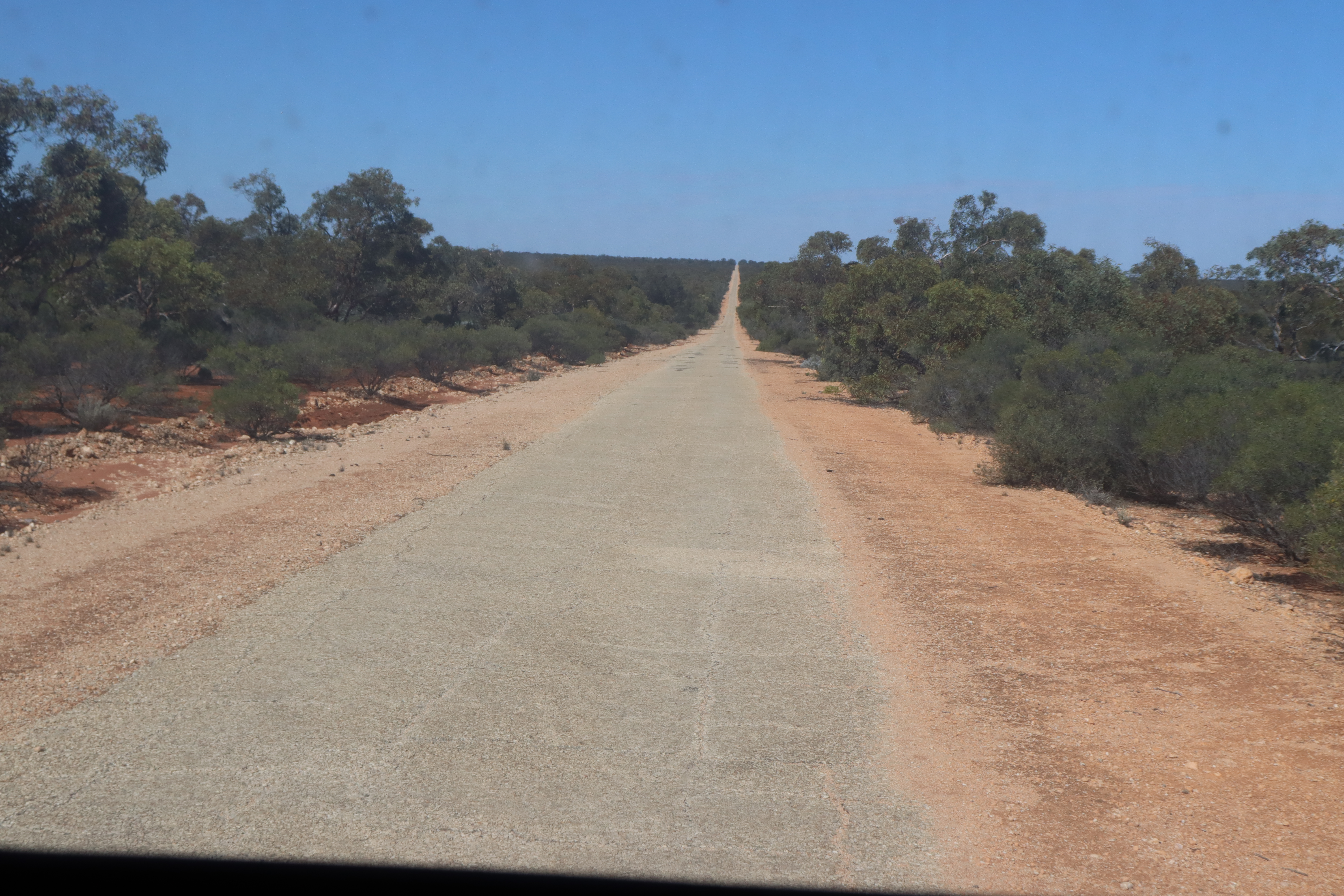
  •  Maralinga town, test sites, and airstrip – which is the world’s ONLY other designated landing site for the space shuttle – was all built within 16 months by 2000 service personnel.  AND the 270 km of sealed and 2500 km unsealed roads were made to last, having never been upgraded or resealed. Maybe those roadbuilders need to come and work for VicRoads!!!
  • What is wrong with people crossing State borders?? Coming through Ceduna (Fruit and Vegie) Quarantine Station, we had nothing to get rid of or declare and the officer was most appreciative of our being “so well organized,” telling us that they had already seized over 80 kilograms of restricted product THAT DAY!!

Outback 2022 – Part 1

Home to Oodnadatta.

Most years when we head off in Roxy, we head “north for the winter,” generally up into Queensland to absorb some warmer weather, but last year we had a different idea, namely, to travel a loop incorporating some of the National Parks we had missed the year before. However, the weather impacted on our travel plans, and our route of travel changed several times, due to closed roads or closed National Parks, but in the end, we did manage to get into a couple of parks from our list and even a couple of new ones.

For the first few weeks, we stuck to the bitumen and headed across to South Australia, visiting a few of the older and smaller towns along the way.

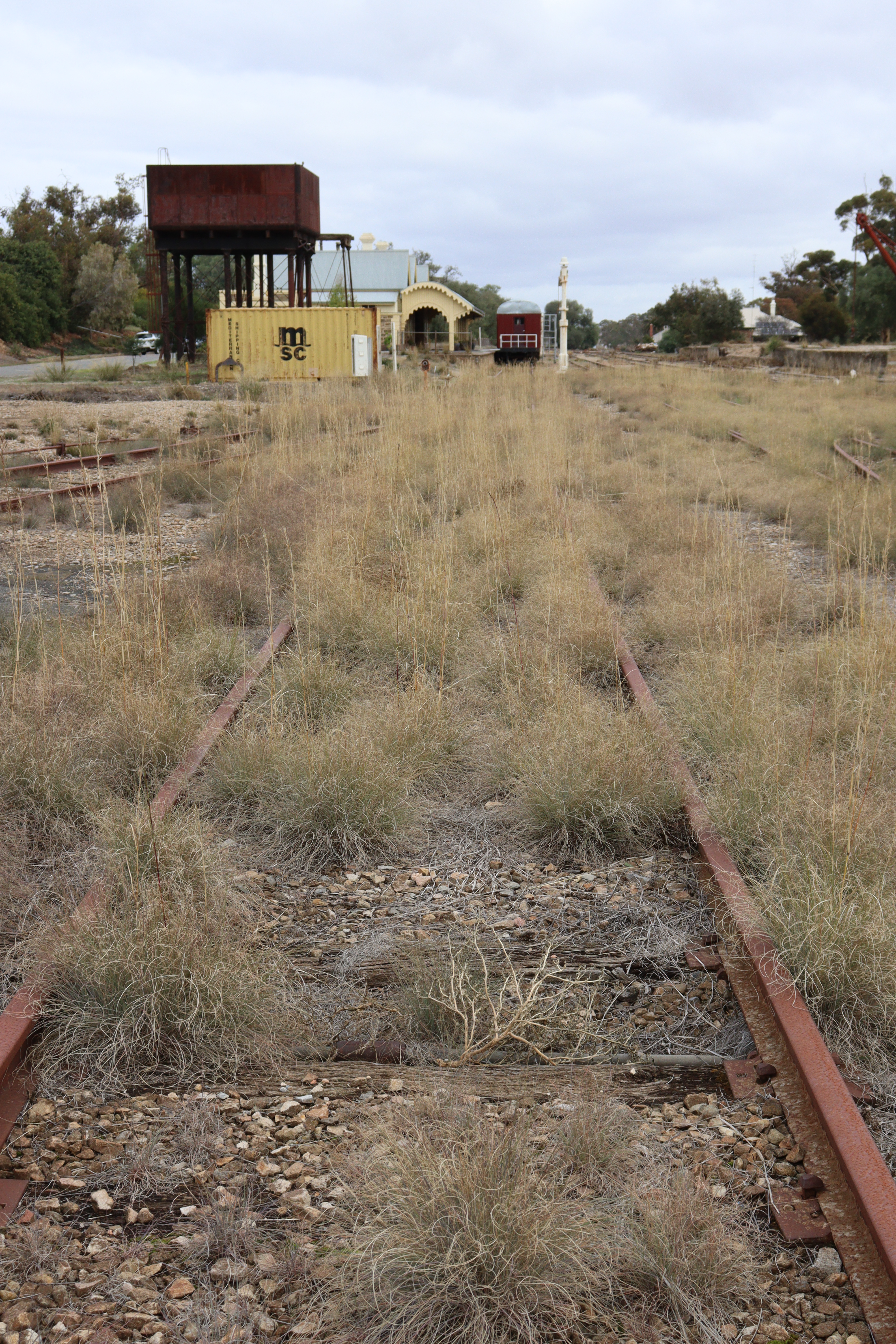
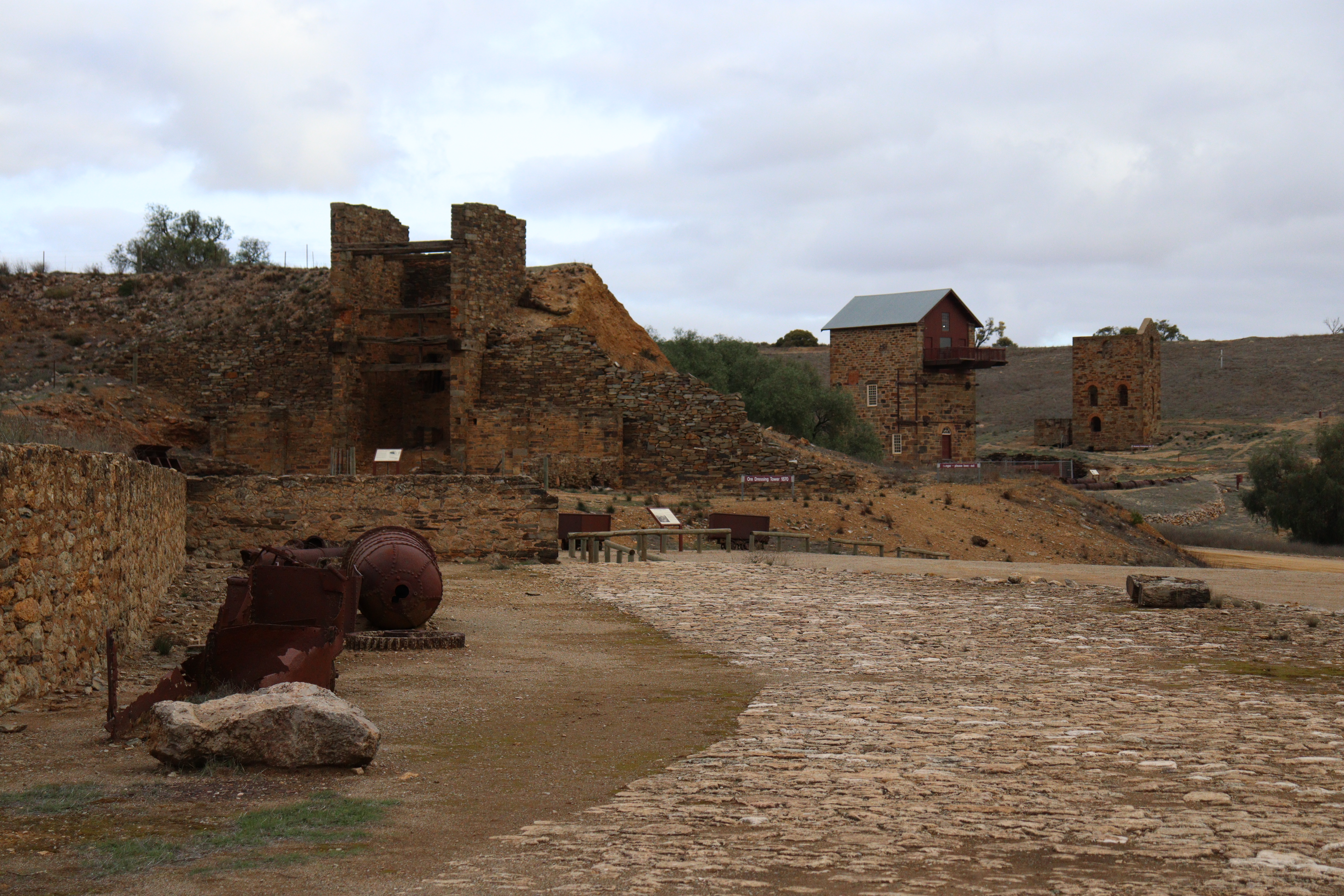
Burra is a quaint little town that we have passed through on several previous occasions, but never really stopped to have a good look at what it has to offer – aside from its yummy Cornish pasties – so we chose to spend a couple of nights there. After checking in to the campground, we set off walking around the town. Following the disused rail line we found the old Railway Station, which has been restored and maintained in a lovely condition.  From there we made our way up the hill to the town lookout and found that we were just near the old open-cut Burra Burra copper mine, so we spent the next few hours in the mining precinct exploring the heritage listed buildings and remnants of the mine’s former glorious past. This mine was one of the first in Australia to employ the revolutionary open cut method, and between 1845 and 1877 produced 50 000 tonnes of copper metal from 700 000 tonnes of ore and was deemed unprofitable, but when it reopened and operated from 1971 to 1981, it produced 24 000 tonnes of copper metal from two million tonnes of ore. Personally, I can’t see how the figures from the first operation deemed it unprofitable when looking at those from the second?? Anyway, we filled in our afternoon checking it all out, so I guess it was kind of profitable for us!

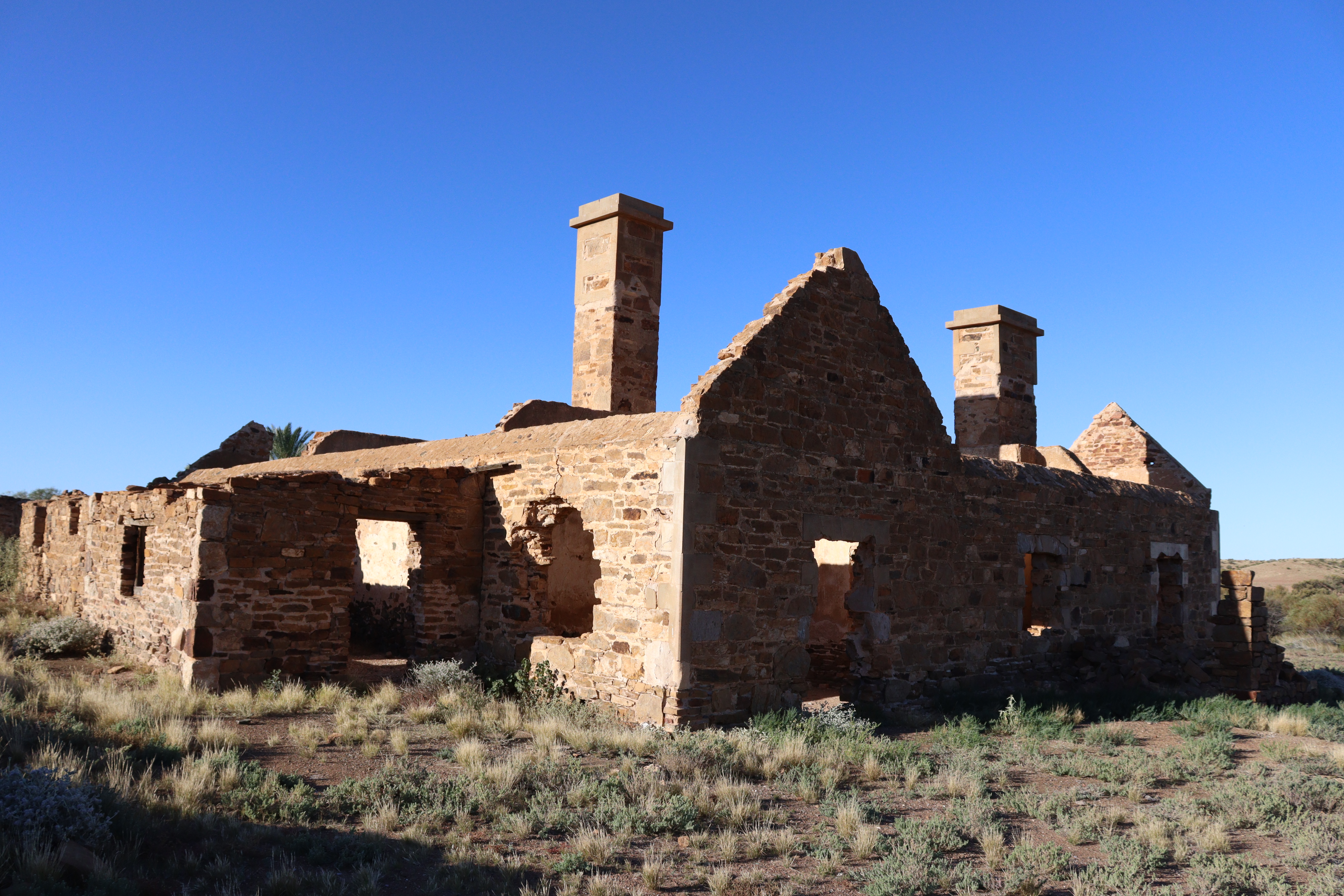
Leaving Burra we stopped just out of town for the must-do photo of the Burra Homestead or Cobb and Co Coach House Hotel (ruins), the humble little stone house on its own in a paddock, which became famous after it featured on the cover of Midnight Oil’s Diesel and Dust album. It’s probably now one of the most photographed little houses of its type and although it’s on private property, there’s a gravel carpark just off the road so you can stop to take your own version of this classic photo.

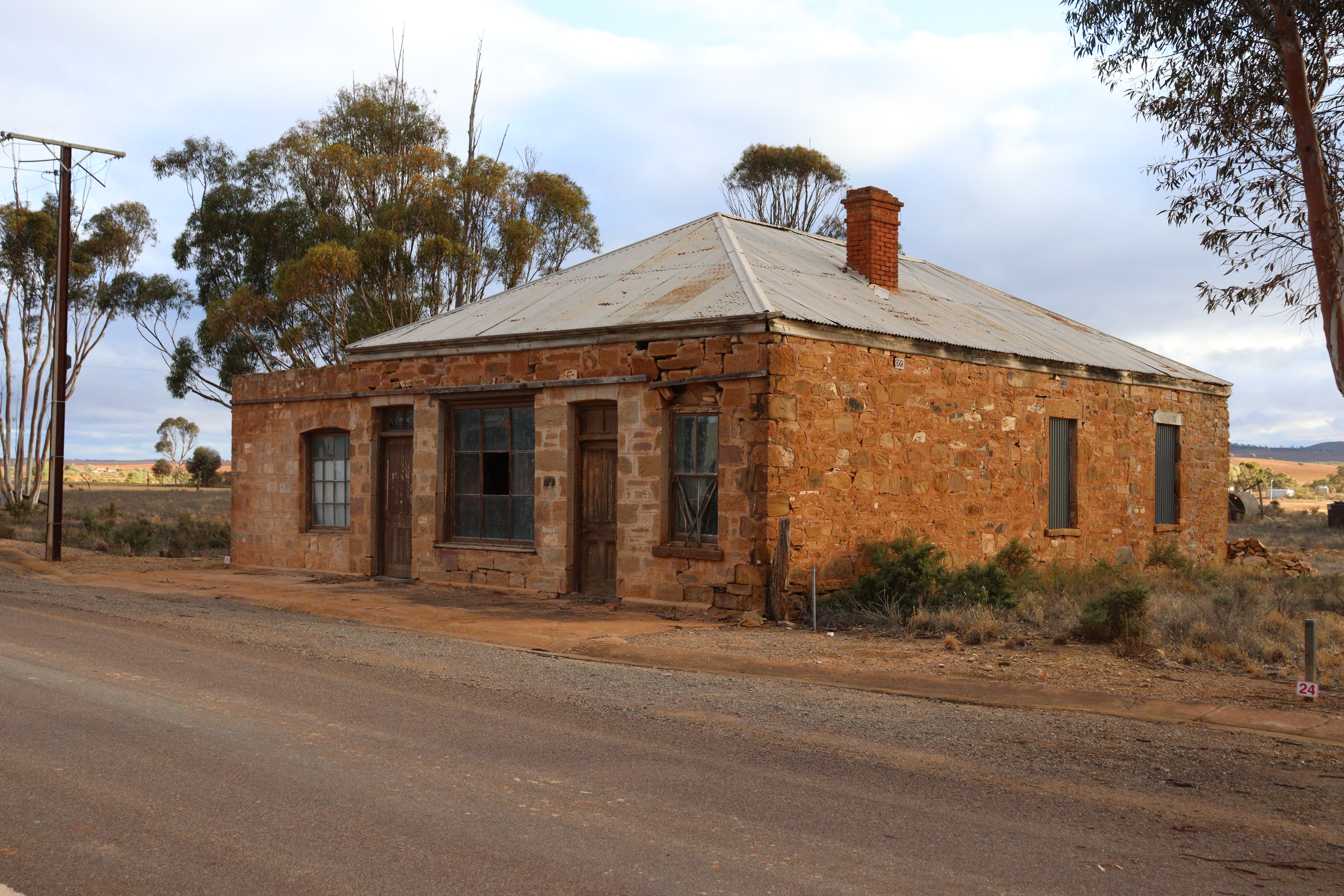
Carrieton, a tiny, charming town in the southern Flinders Ranges, is well worth a visit, if only to check out the old buildings. Surveyed and proclaimed a town in the 1870s, its population had grown to over 200 by the 1890s and, with the railway coming through, the town prospered and added some 40 or so buildings, some of which are still there today. The school which opened in 1882 and at one stage grew to over a hundred students – with just one teacher!! – finally closed in 1997, and it, along with the community store and memorial hall and clubrooms, were taken over by the Progress Association, which also leases the local swimming pool from the council. The Association converted the school into the town’s caravan park, where we were greeted with a friendly welcome and some tourist advice as well. Although the town’s population is now only about 23, I think every one of them, along with many from elsewhere, crowded into the historic pub, The Carrieton Hotel, on the Friday night when we went in for dinner, and the atmosphere was again most hospitable and pleasant.

Taking the tourist advice offered in Carrieton, we drove the 80-kilometre Johnburgh loop, which took us out of town, through the Oladdie Range and down into Johnburgh historic township, where we spent several hours exploring the remnants of the town’s buildings. Built of local stone, like most of South Australia’s old towns, many of the buildings are in reasonable condition, and offer plenty of photo opportunities.

Ikara-Flinders Ranges National Park is always worth a visit. With its stunning and ancient mountain backdrops, its pioneering history and the amazing Wilpena Pound, we were quite happy to re-visit this Park, and as per usual, we discovered something we hadn’t seen there before. Taking a walk along part of the Heysen Trail following Wilpena Creek, we found the Old Wilpena Station complex, comprising the original homestead dating back to 1860, and outbuildings such as the Store, Blacksmithy, Stables, and several houses, all built from local stone and all nestled in the valley amongst the huge river redgums.

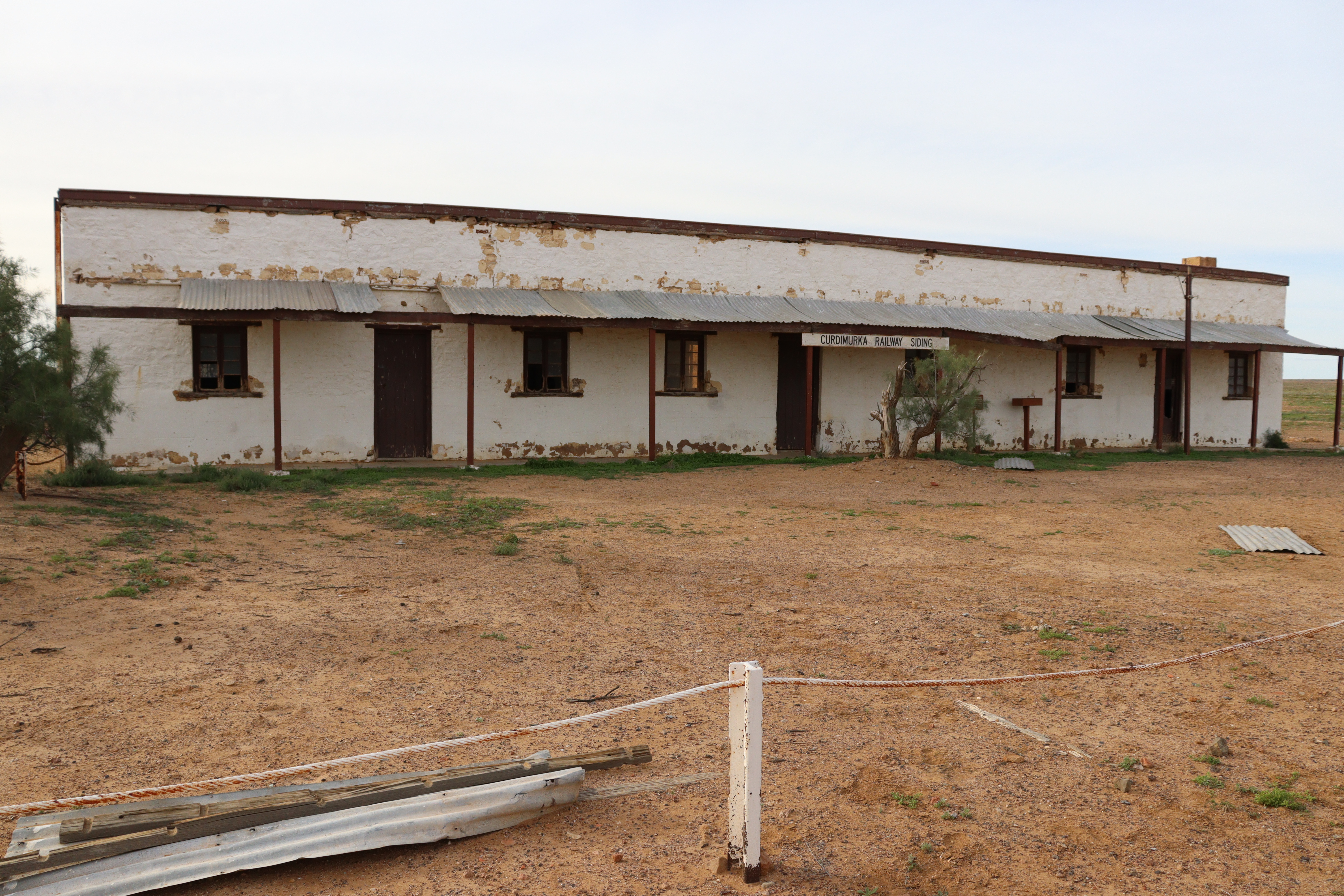
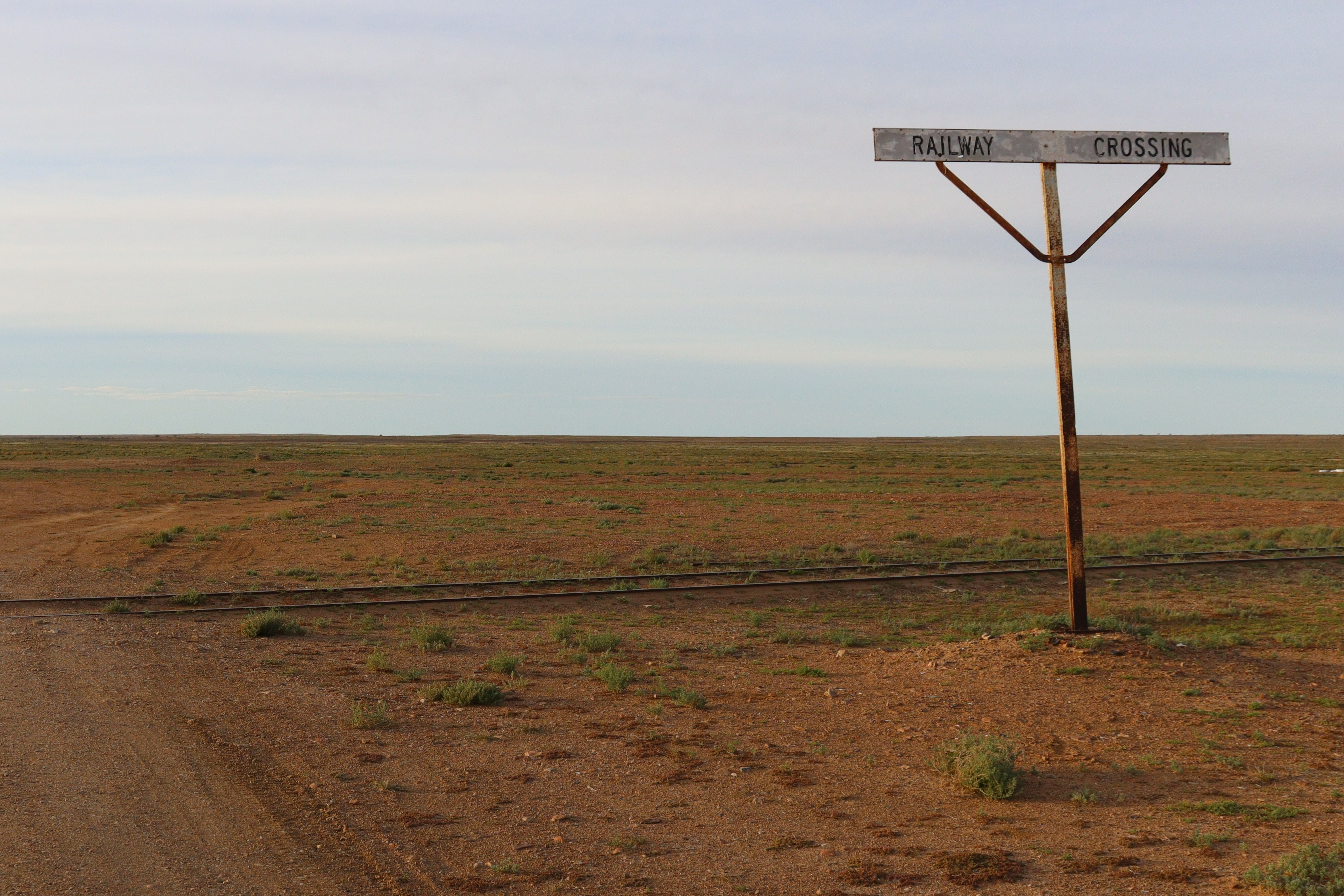
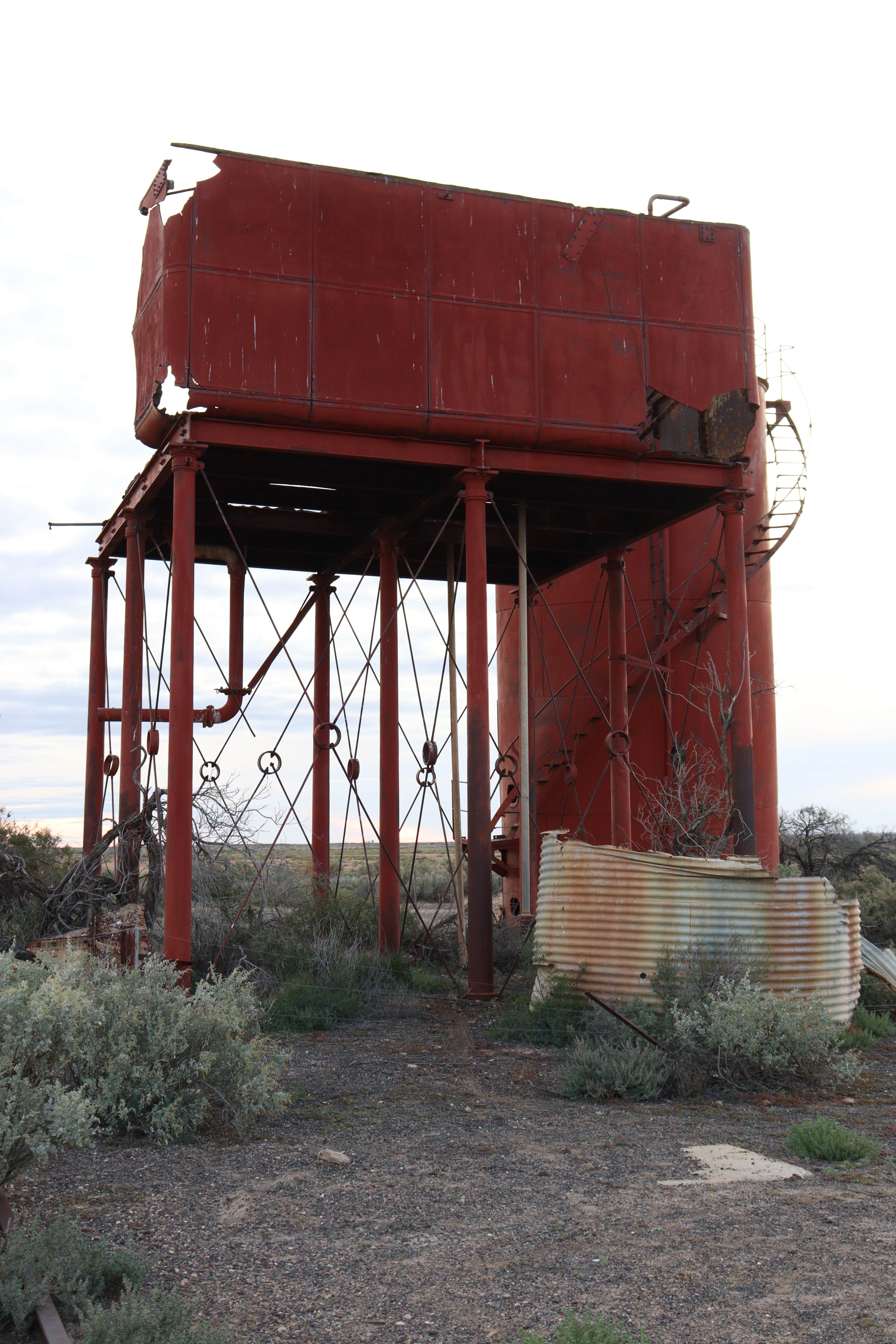
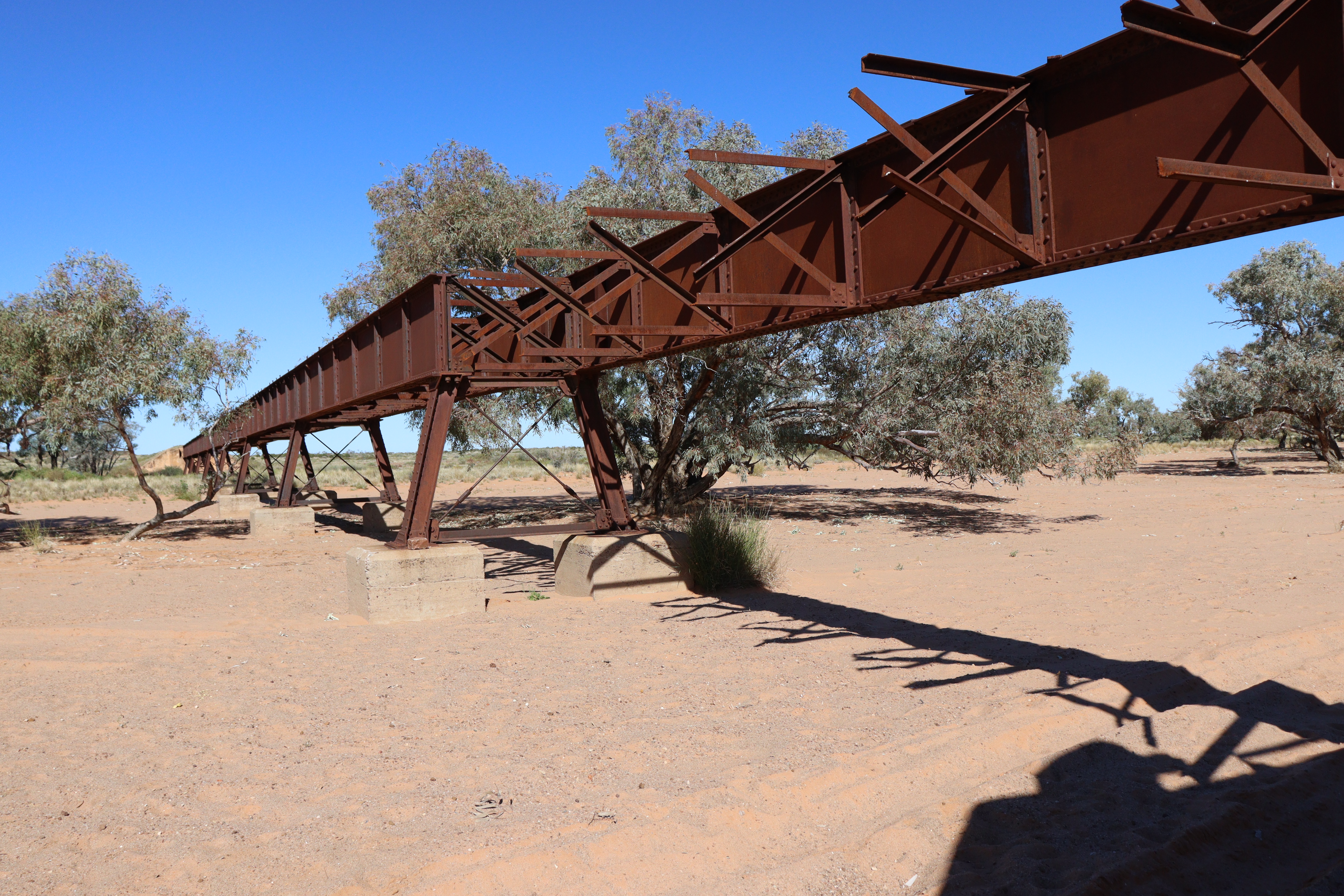
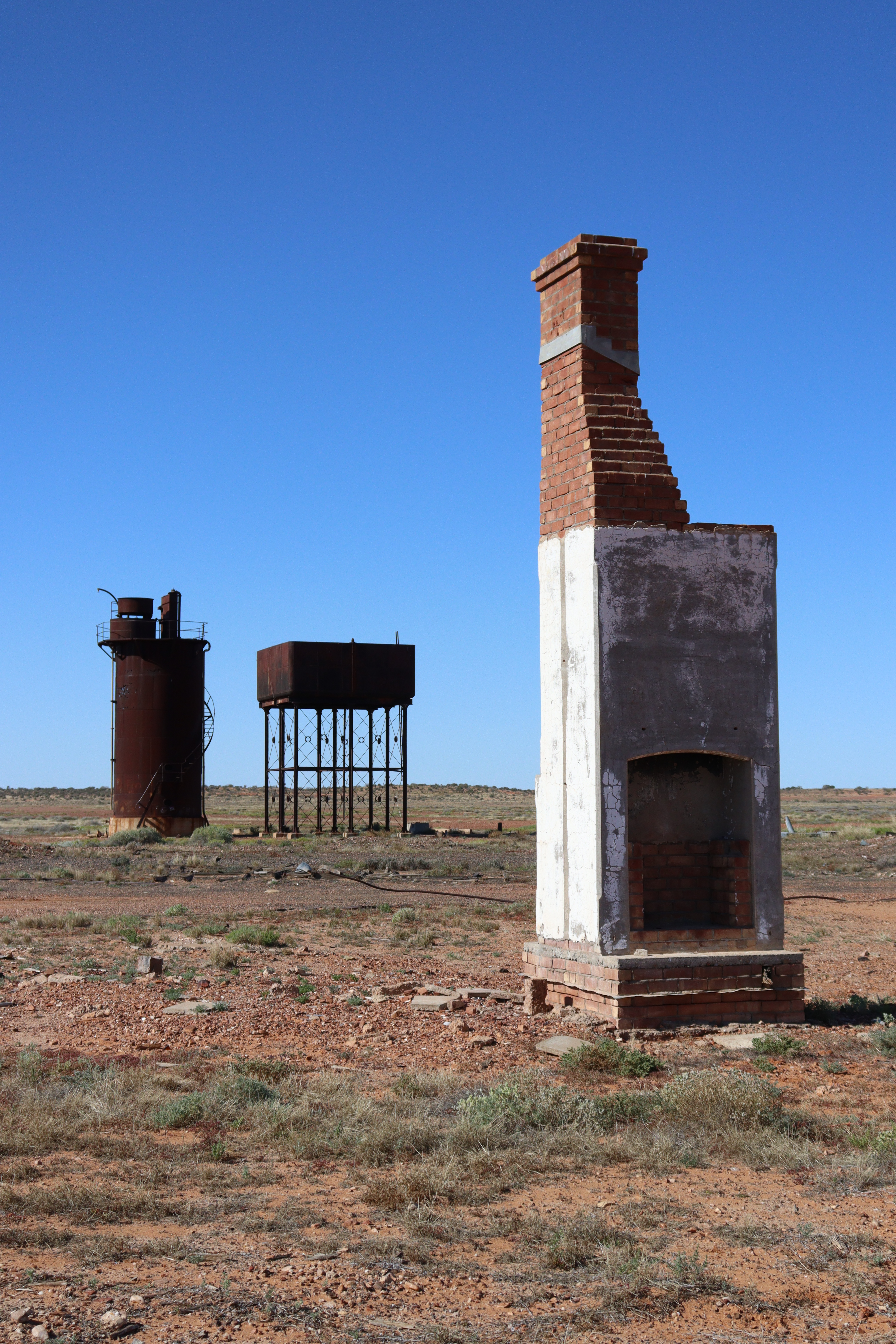
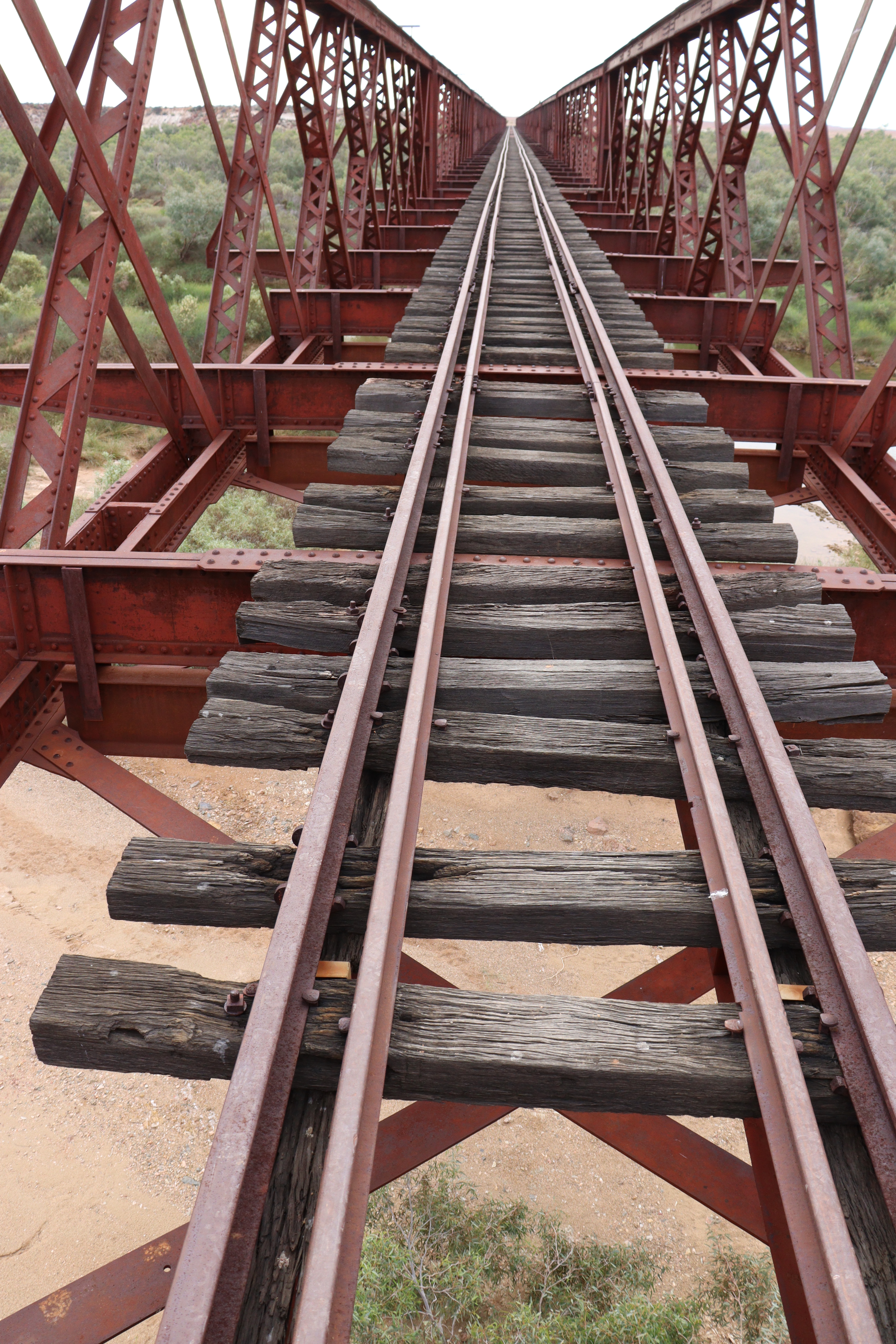
The Oodnadatta Track is an iconic road route that follows the route of the original Old Ghan Railway that linked Adelaide and Alice Springs. Having travelled the Track in the past we knew what to expect, but this time we slowed down and really explored the many sites it offers along the way. Many of these sites, such as Curdimurka, Beresford, and Edward Creek, are the old railway sidings that incorporate fettlers cottages, huge water tanks and Kennicott water softeners and remnants of the old railway tracks. Historic railway bridges occur as frequent reminders of how quickly waterways can fill after a downpour, with some of these bridges being over 300 metres long.

…and so it begins!

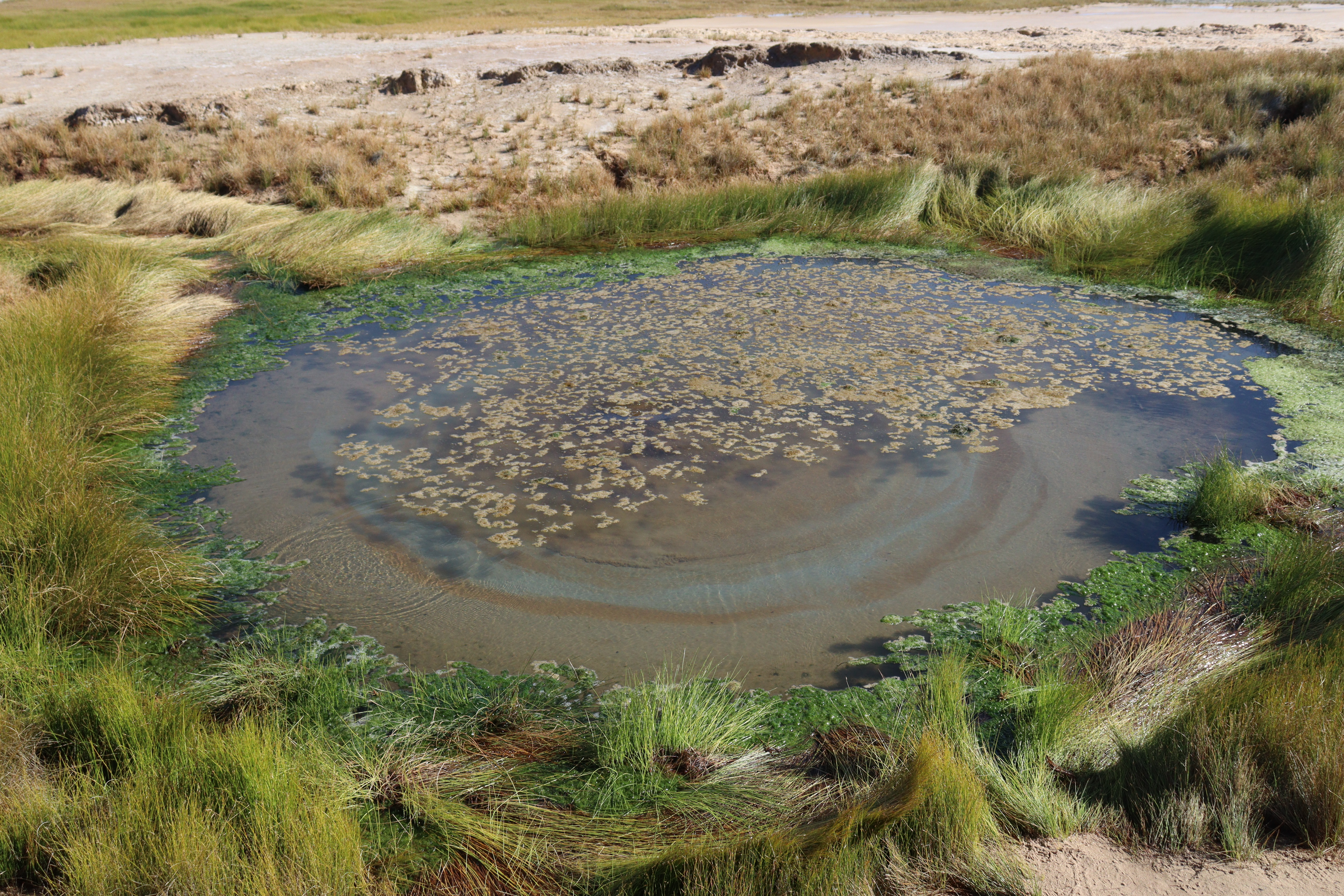
Wabma Kadarbu Mound Springs Conservation Park with its active mound springs bringing water from the Great Artesian Basin to the surface, is worth the short drive off the main track. The Bubbler lives up to its name with water continuously bubbling up from the depths creating lovely patterns in the colored sands, while the Blanche Cup sits atop a fairly high mound with its hot water pool surrounded by a thick growth of reeds.

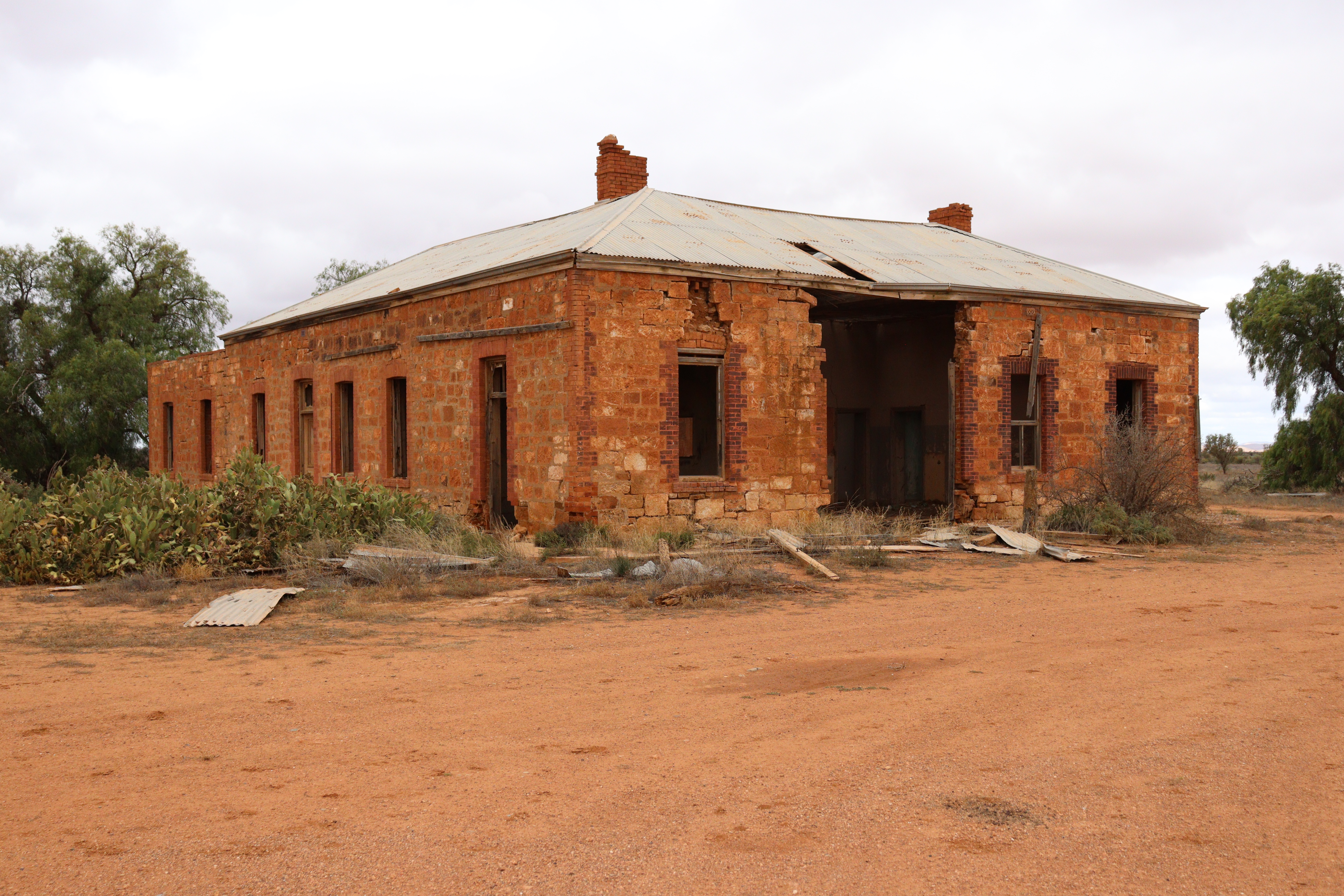
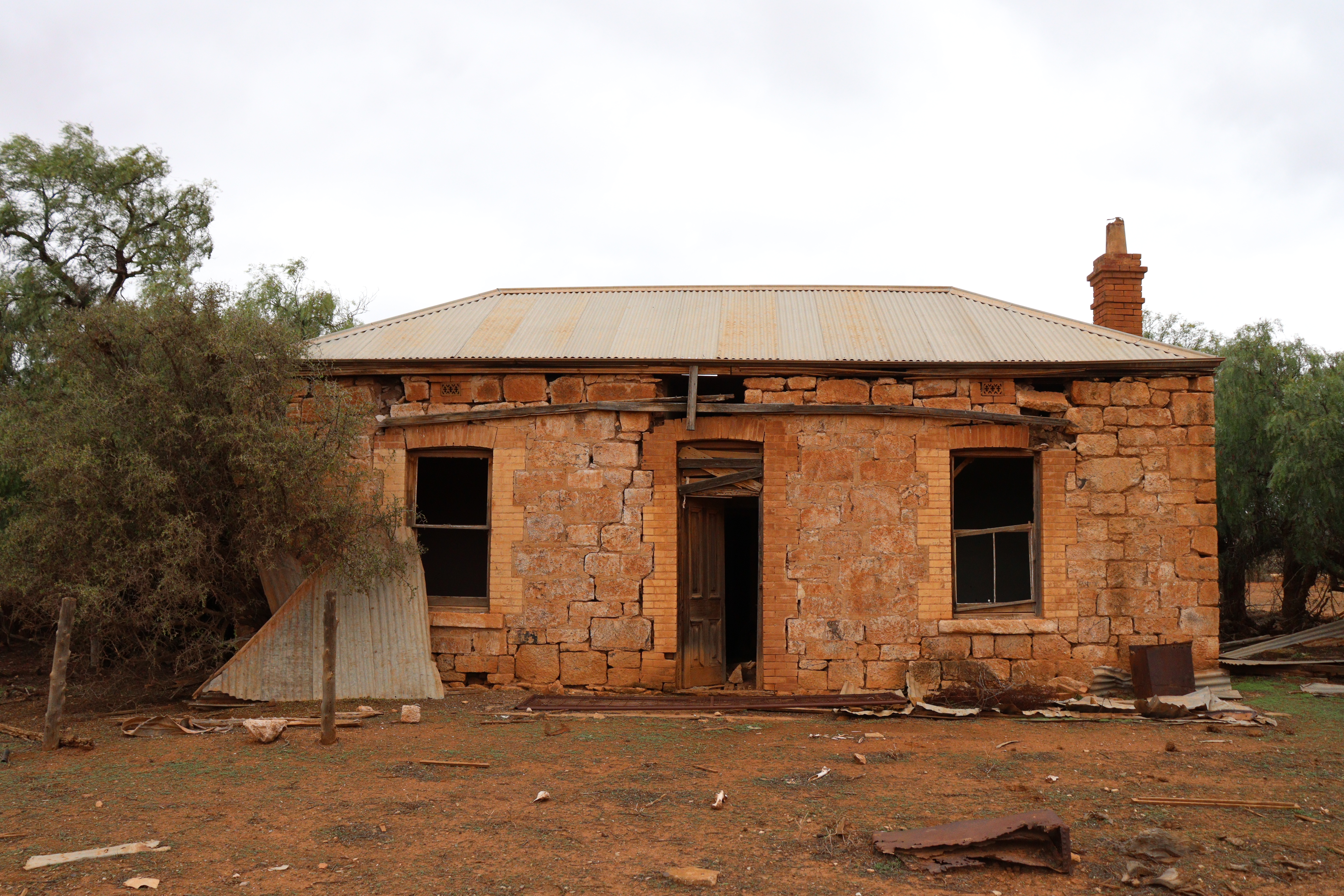
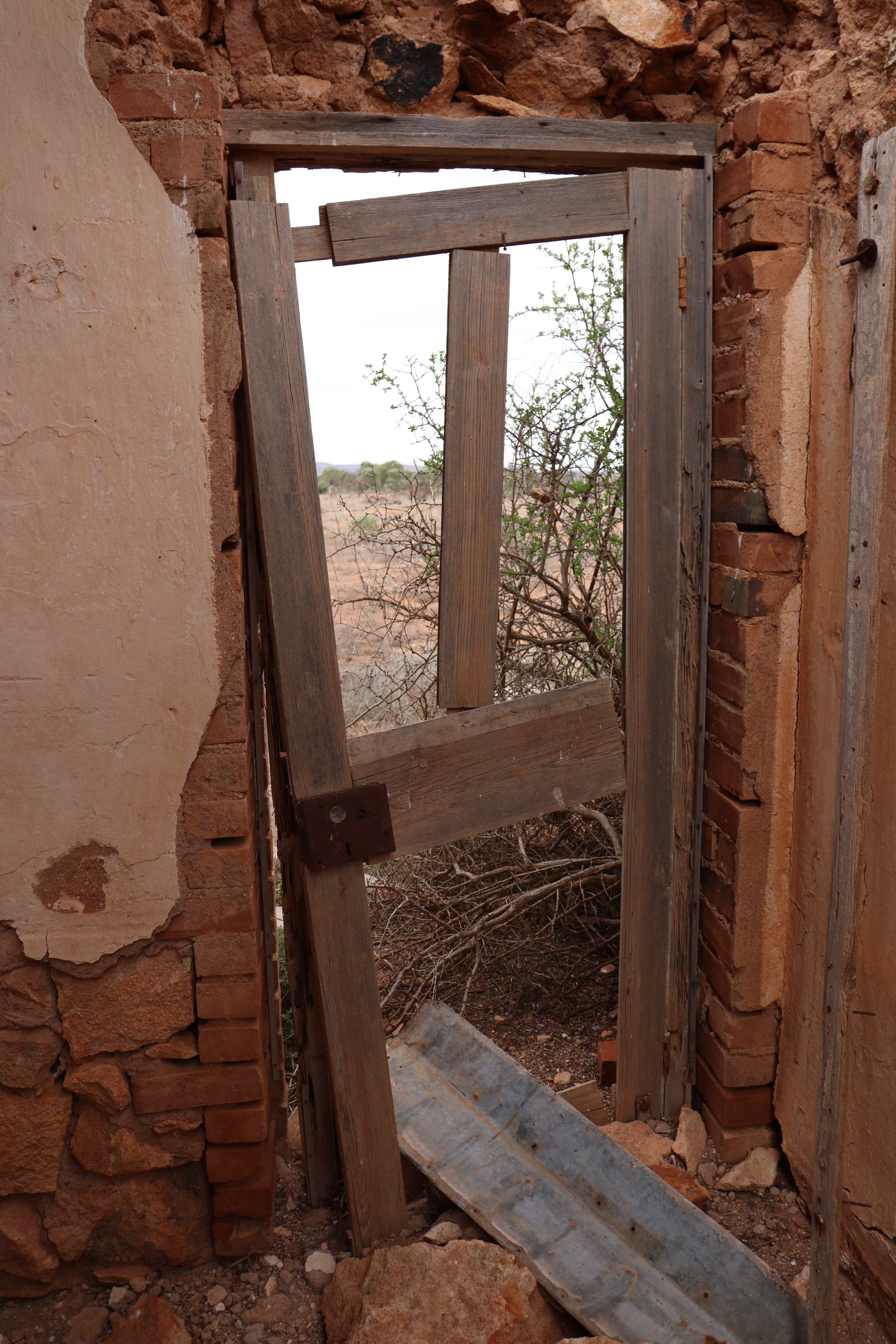
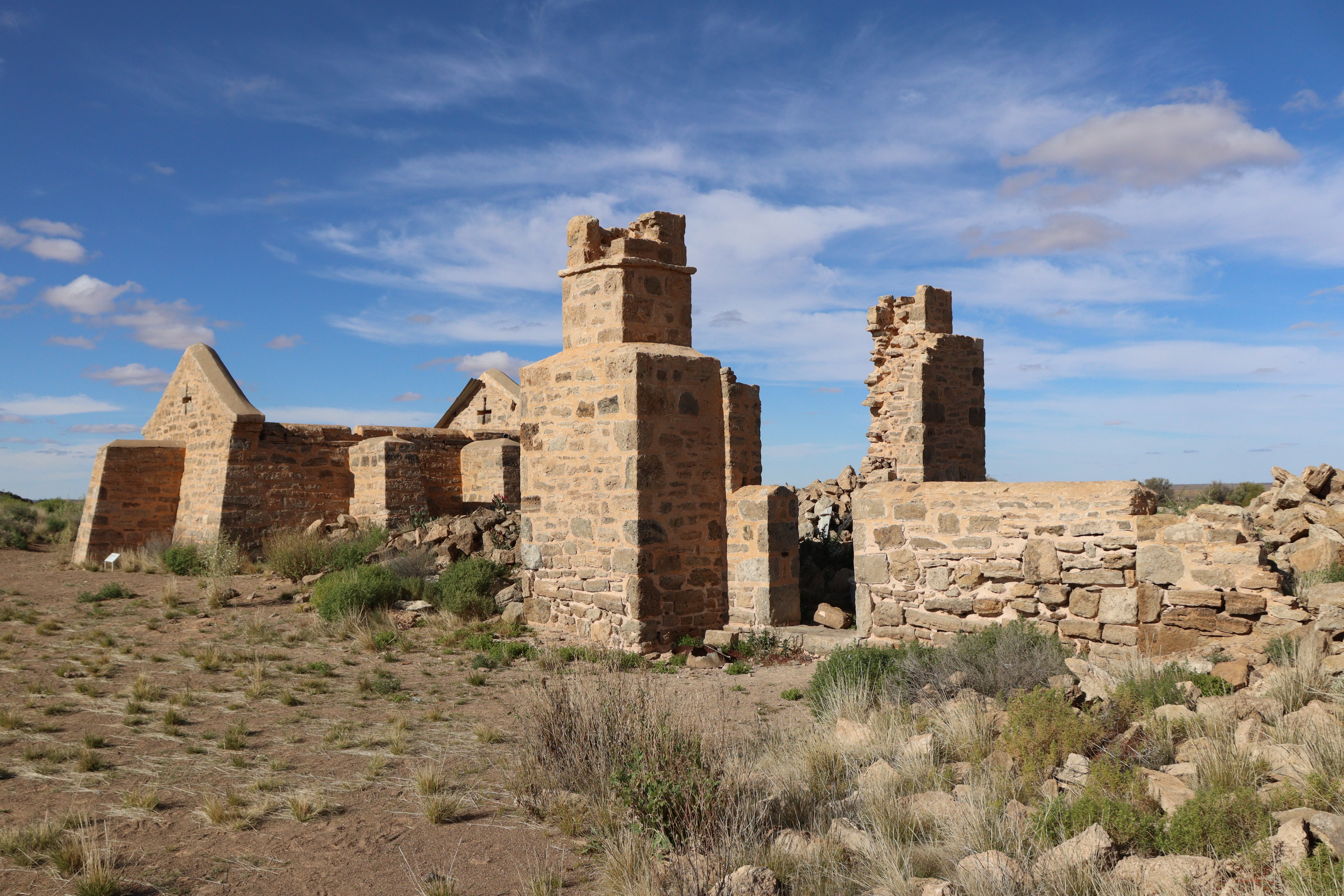
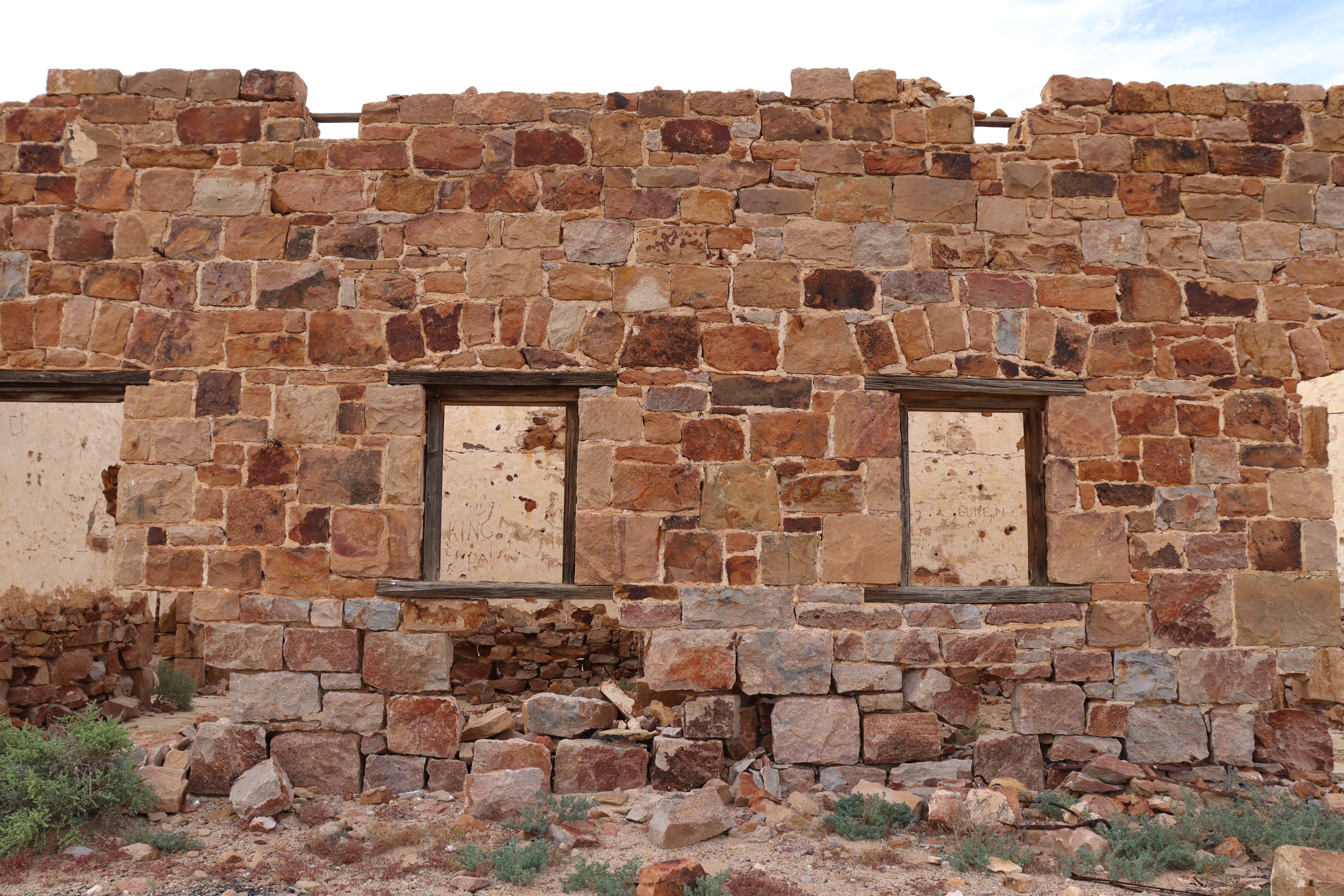
Strangways Springs and The Peake were historic pastoral leases and Overland Telegraph Repeater Stations dating back to the 1870s. While Strangways is a short two kilometres off the Track, The Peake ruins are found at the end of a slow 20-kilometre 4WD track, but both are well and truly worth the effort of getting there. Both of these State Heritage Listed locations feature a number of buildings in varying stages of disrepair and include some very interesting and photo-worthy structures.

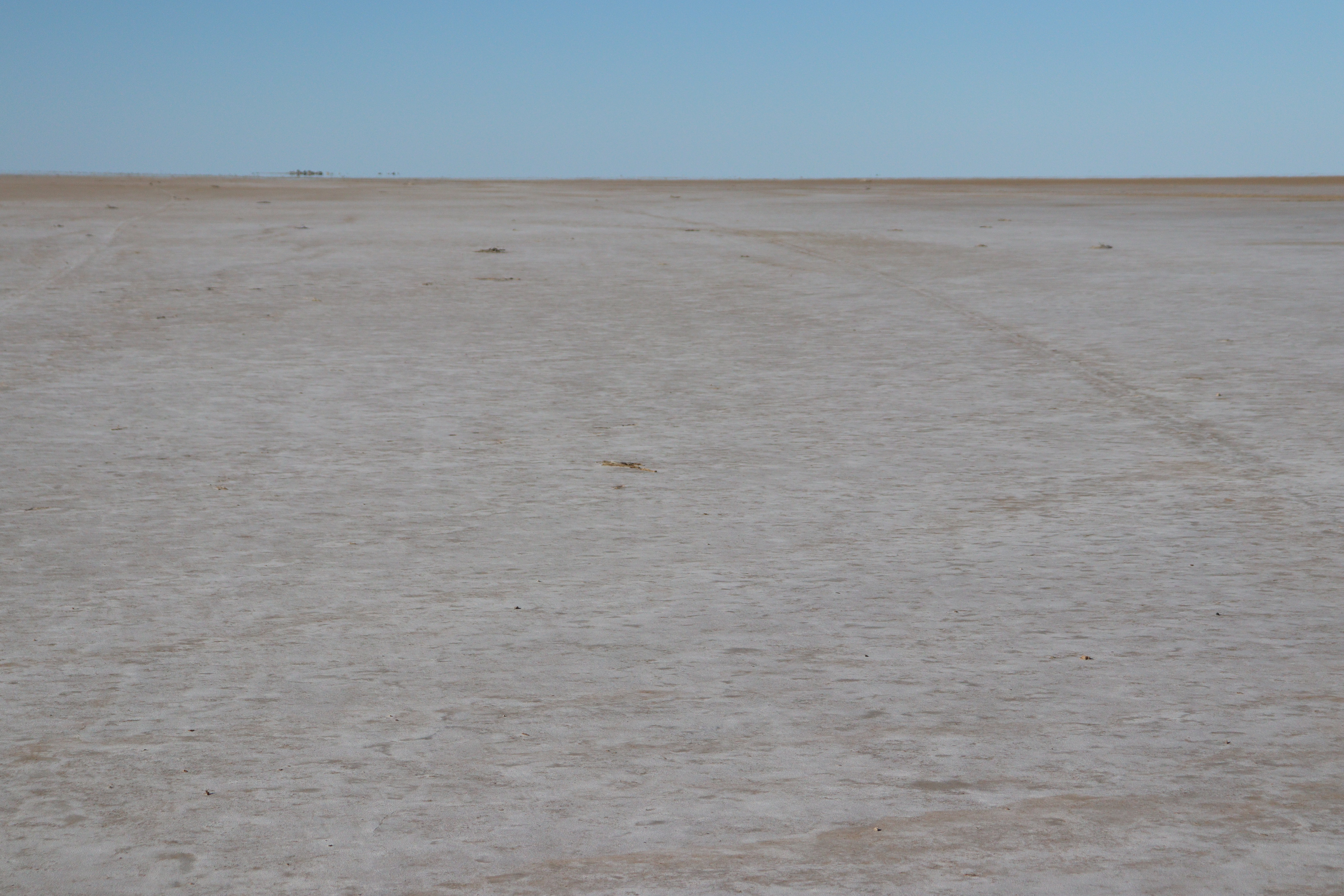
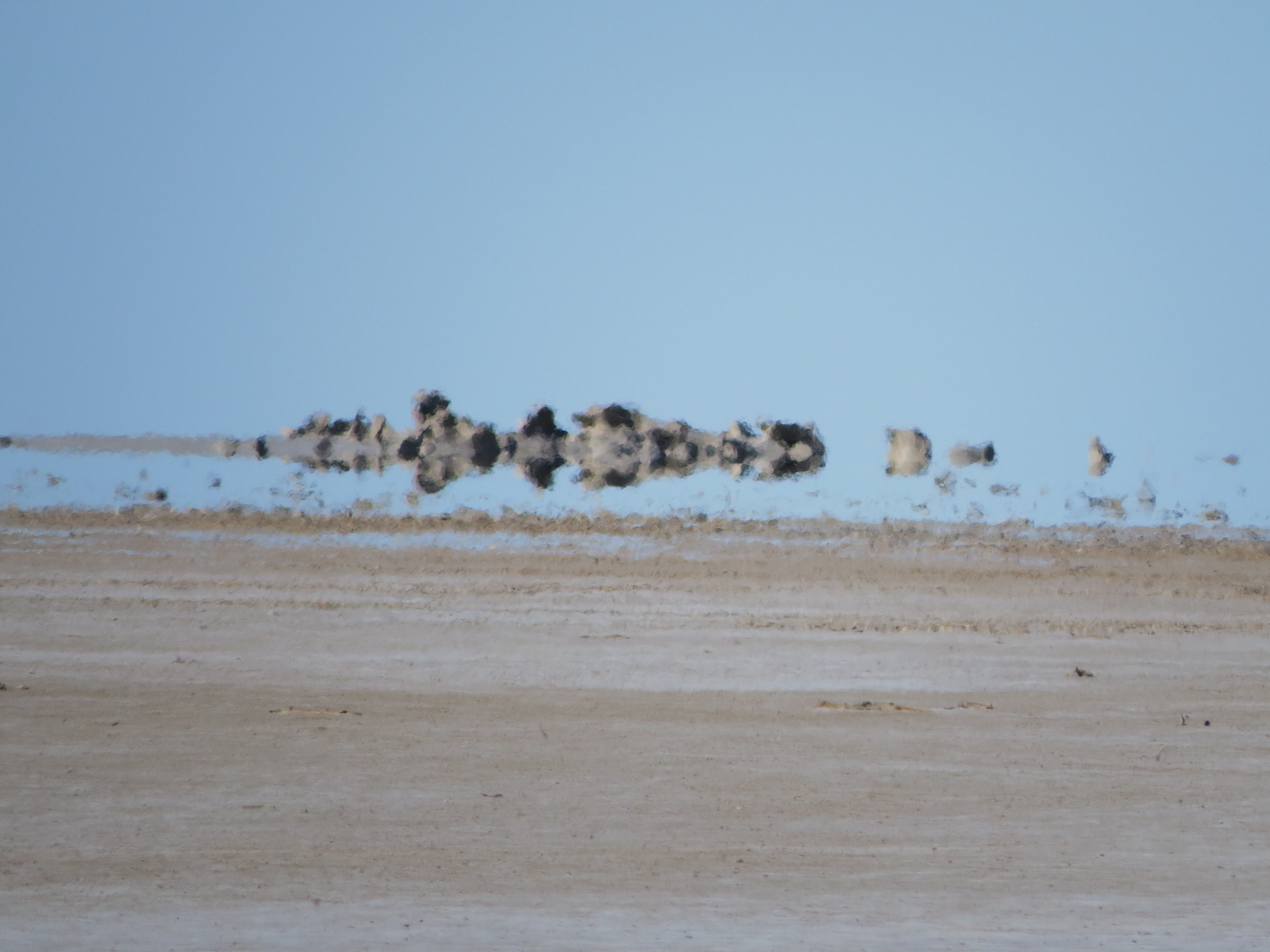
Just out of William Creek “township” is the turnoff to Kati Thanda – Lake Eyre National Park, and the 60-odd kilometre road, which passes through varying landscapes, ranging from dry cattle grazing to gibber plains to a most unexpected “moonscape” of dark rock and mesas, and finally takes you out to Halligan Bay Campground, at the edge of Lake Eyre.  Not sure what to expect out there as there had been varying reports of water in the lake after all the rain up north, but on arrival we found the lake to be much as it usually is – a dry crusted salt pan, and walking out onto it for a couple of hundred metres convinced us that we would not get to see any water there except by turning our feet back and forth in the salt and sand to bring some to the surface. This did not however take away from our experience of Lake Eyre, as it simply must be seen to be appreciated. It is just MASSIVE! At no point could we see the other side, and maybe, just maybe, we were able to see reflections of rocks on distant water – or it may have been reflected on the endless white of the salt.

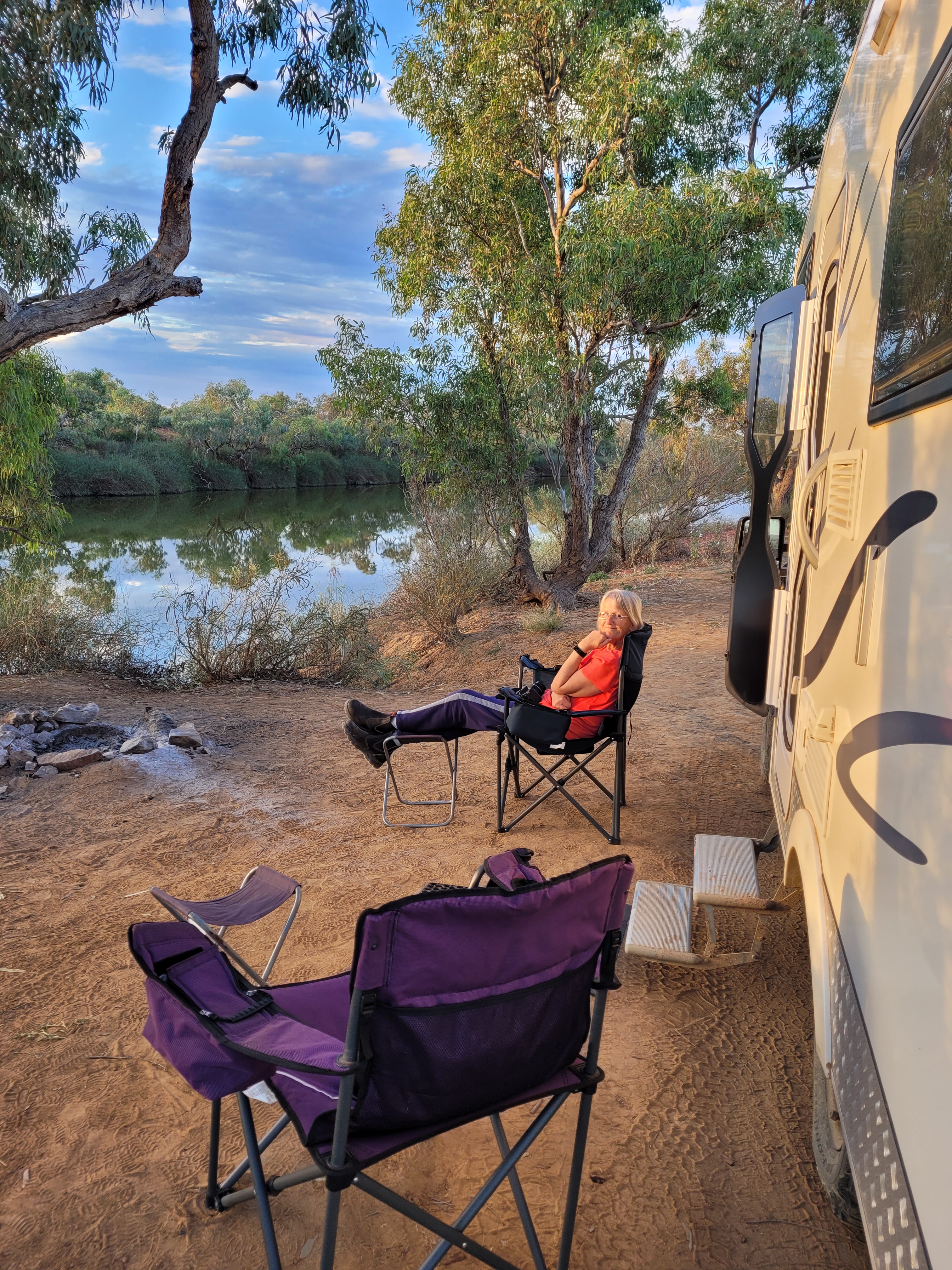
Overnight campsites along the Oodnadatta generally consist of pulling up at the old railway sidings, but the best spot in my view, was the Algebuckina Waterhole, across the track from the historic 527-metre-long railway bridge – the longest on the Track and at one time the longest in SA.  The waterhole is well off the main track, and we spent a lovely night there watching a variety of birds coming and going, including lots of yellow green “swarms” of budgies – just amazing to see!

WTF?? Or HaHa!!

  • Getting back to our site in Mildura after several hours out, we found our outside doormats, which, being very wet, we had left on site to keep our spot, were no longer there. But, new neighbours right next to us had, funnily enough, exactly same ones, even placed in same positions as we had left them. So I knocked on their door and politely said, “You don’t mind if I take our mats back now, do you?” to which he sheepishly replied, “Well, it was very wet when we got in here!”  -no attempt to deny he’d taken them…and from then on, no eye contact or greetings offered!
  • Burra Burra mine site is part of a Tourist Passport where you need a key to access some of the sites. As it turns out, the mine site is one that needs a key. Being on foot wasn’t an issue for us, but a carload of visitors who had driven into the site after finding the gate open, found themselves locked in after their drive around the site. Last we saw of them, they were parked inside the locked gate, trying to ring for help to get them out!
  • Halligan Bay-Lake Eyre – just on sunset a car drives into the campground, round the loop without even stopping and back out again. Why?? It’s a 61-kilometre 4WD-recommended road to get out there and they didn’t even stop!!
  • Algebuckina Bridge -527 metres long, iconic photo-op. so why does this idiot park right under the bridge meaning no one can get a good shot of the bridge without getting his rig in it too?
  • Pink Roadhouse in Oodnadatta – iconic, great hamburgers you can’t jump over, but diesel at $2.999 per litre did hurt a bit!
Oodnadatta’s iconic Pink Roadhouse

Sydney to the High Plains

(Click on images to enlarge.)

The year is passing so quickly and despite the restrictions placed on us again with Covid-19 outbreaks, we have still managed to escape a couple of times and get out there in Roxy.

Our first getaway for the year was a couple of days in Melbourne, not in Roxy of course, but staying in a city hotel for the first few days of the year. We try to do this at this time every year as the city is much quieter which makes for easier getting around, although this year it was eerily quiet with many places still shut due to covid. So we spent the days shopping, going to the movies, walking and eating out. We took the train down to Geelong for a day to visit the National Geographic “Wildlife Photographer of the Year” exhibition which was well worth seeing. We also took the opportunity to visit Herring Island, a National Park on a tiny island in the Yarra River. I’m sure most people aren’t even aware that this NP exists right in Melbourne, but on a pleasant day it’s a lovely spot to escape the city and wander amongst the picnic areas, and sculpture gardens, and despite its proximity to the city, it is quite peaceful and relaxing.

We had a couple of maintenance and warranty issues we wanted done on Roxy, so decided to incorporate a visit to the factory with our next trip away. Borders (NSW/Vic) were open, so we headed up the Hume, taking an overnight stop on the way, then a night in a caravan park not far from the factory. Up bright and early next morning, we navigated our way through the outer Sydney traffic to the factory, and after a quick discussion with them, supplying a list of our requirements, we left Roxy in their care for the day. Deciding they’d probably have her for the whole day, we took a train into the city, and almost an hour later, when we were almost at Central Station, we got a phone call: they ran through the list with Gary and finished up by double checking that they could have Roxy till late the NEXT day! No problem!

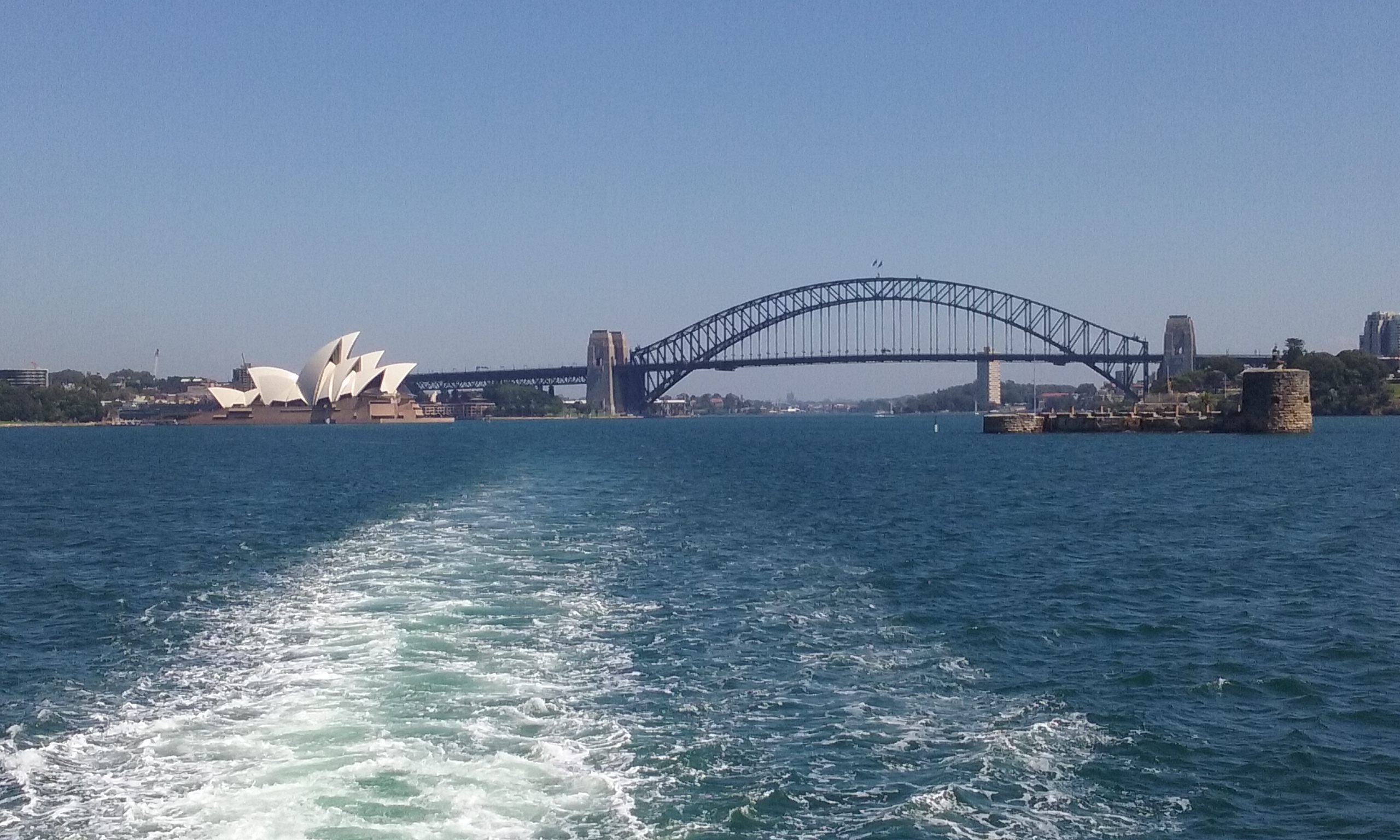
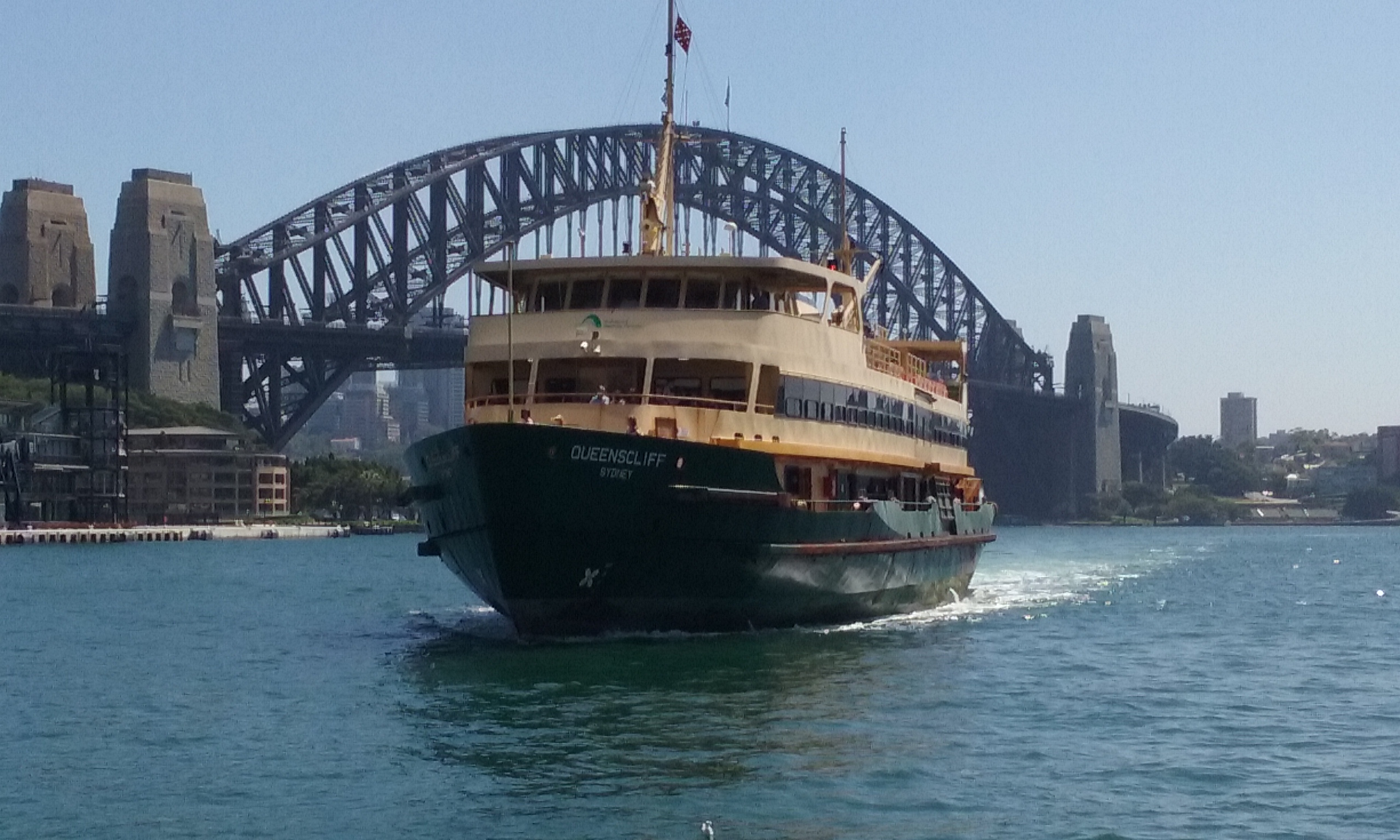
So there we were in Sydney with just the clothes we were wearing for the day, and phone and wallet. Never to pass an opportunity, Gary suggested we take the ferry across to Manly, and as I had never been there before, we did exactly that. Managing to secure accommodation at a nice hotel on the waterfront made it even more enticing, so across the harbor we went and spent a lovely warm day exploring and walking from one end of Manly to the other – after buying some bare essential toiletries to keep us decent for the night!

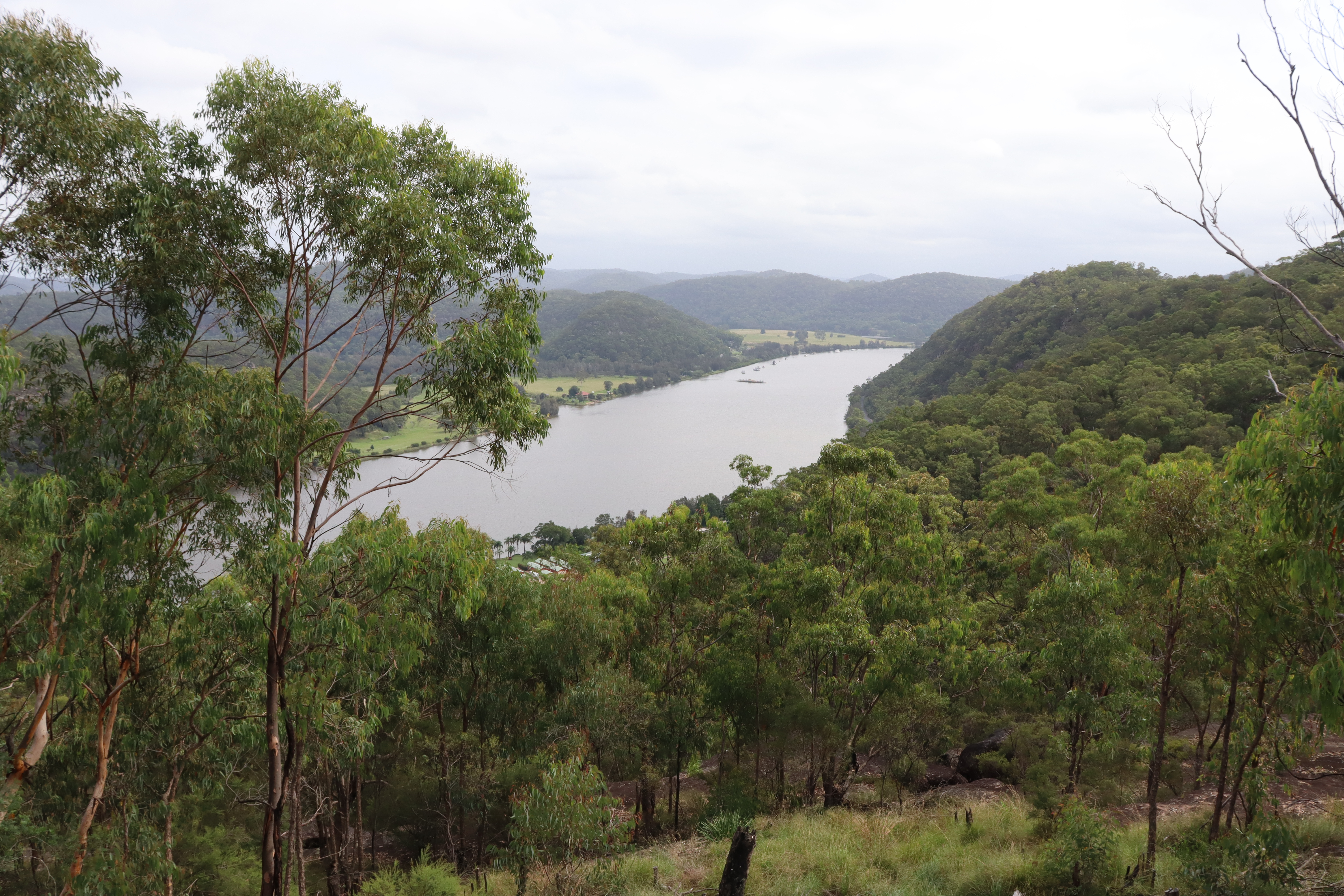
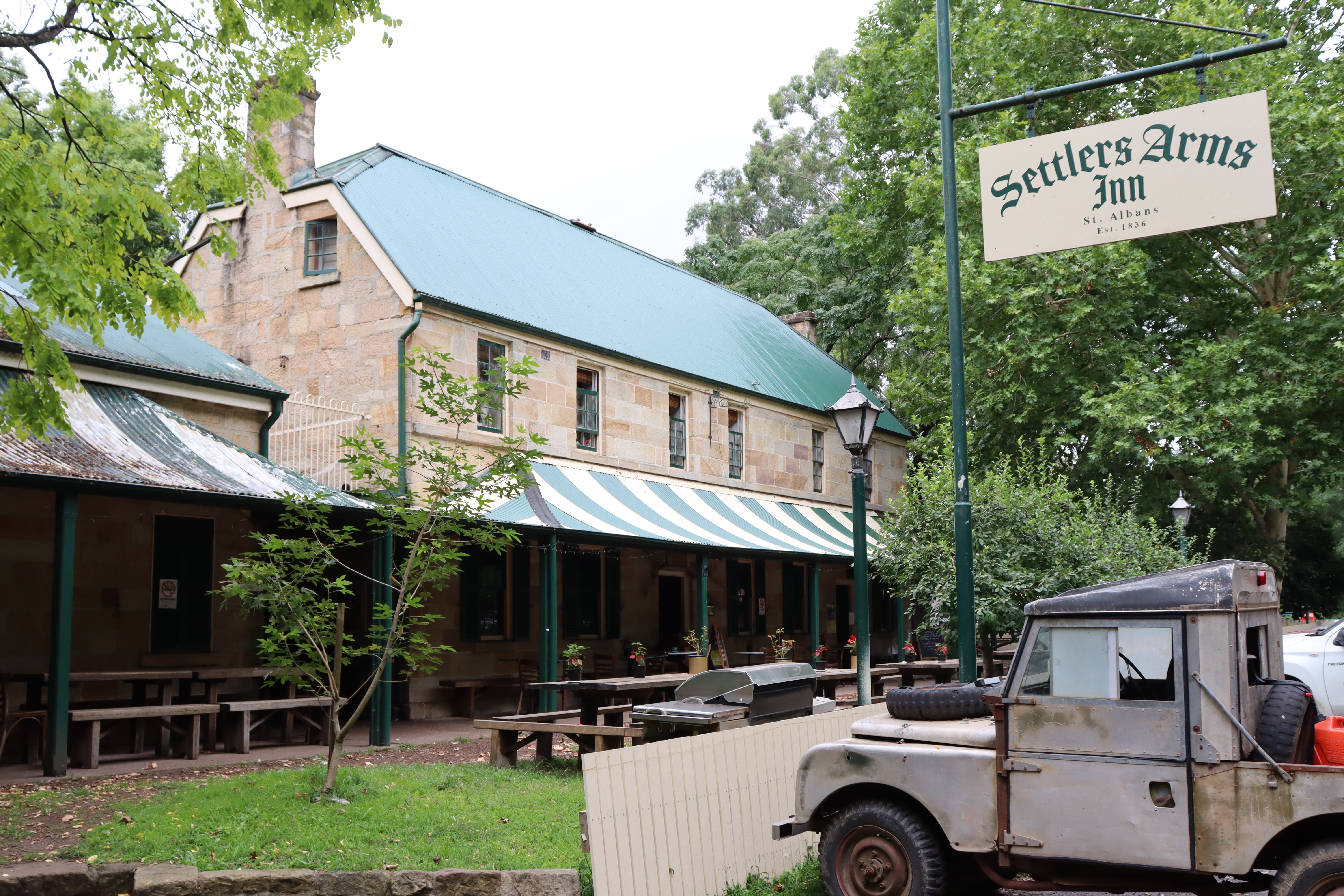
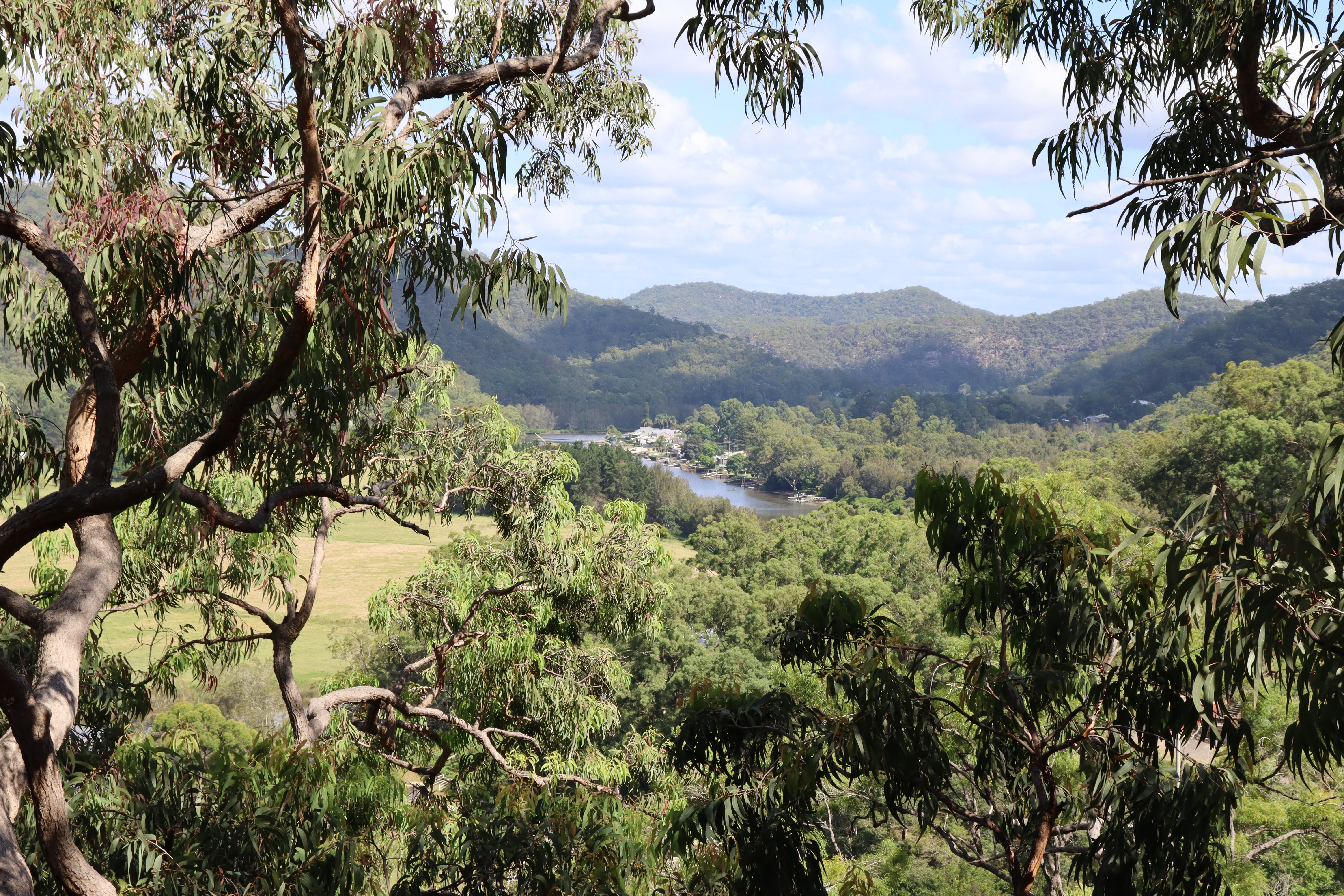
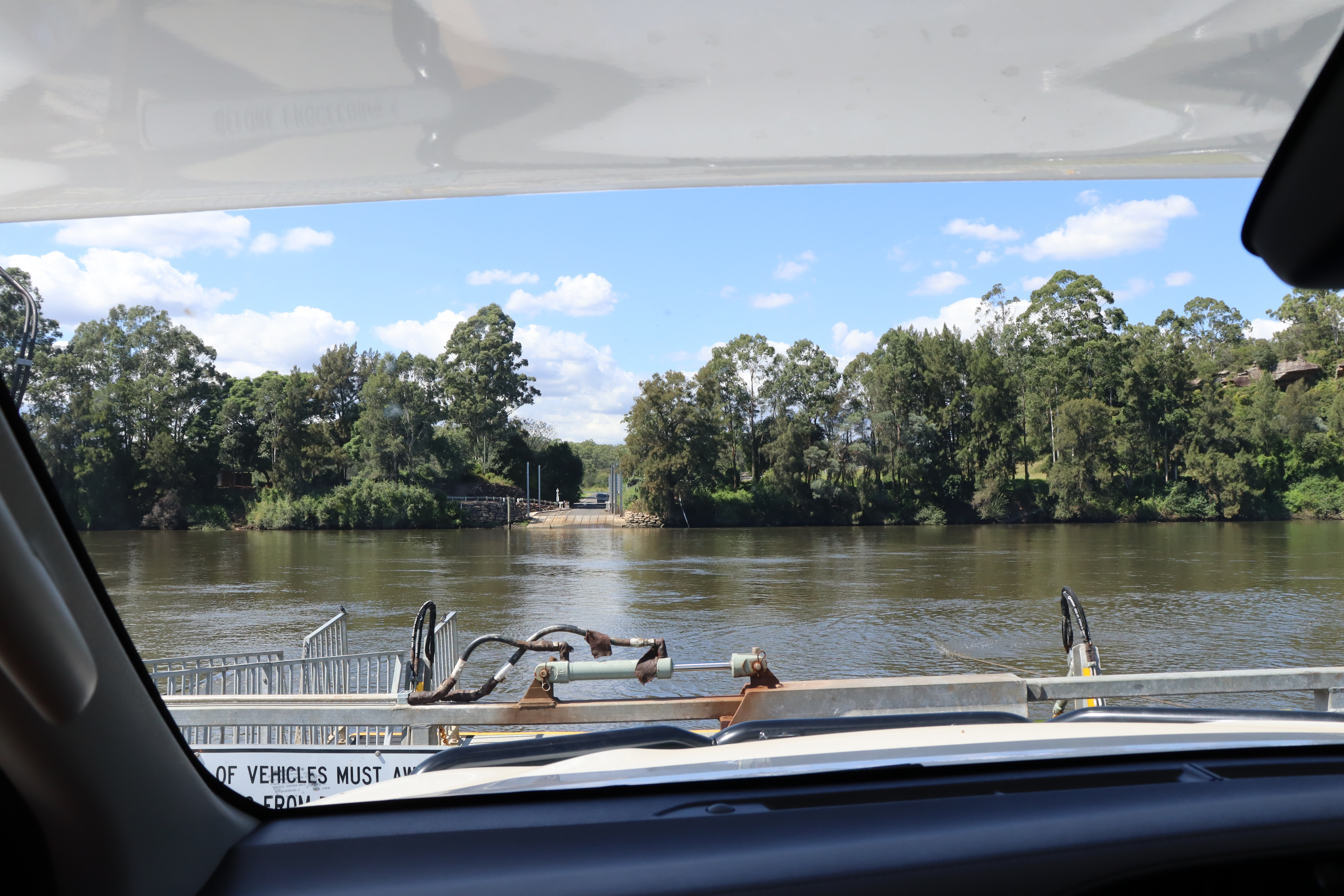
Once we had picked up Roxy, we started heading north out of town towards Wisemans Ferry, with its two ferries crossing the expansive Hawkesbury River one way and the lesser (but not much less) Webb Creek the other. After driving up to St Albans for a quick look at the historic pub and cemetery, we headed back down to Dharug National Park where we had two nights in the campground. What a great place! Not too far from the city (only about 80km) but you’d think you were a couple of hundred kilometres away. It’s such peaceful, native bushland, with the river nearby, large grass trees with huge flowers – and we had it virtually all to ourselves. Well, except for several lace monitors that roamed through the campsite and several lyrebirds that graced us with their presence and with their repertoire of mimicry.

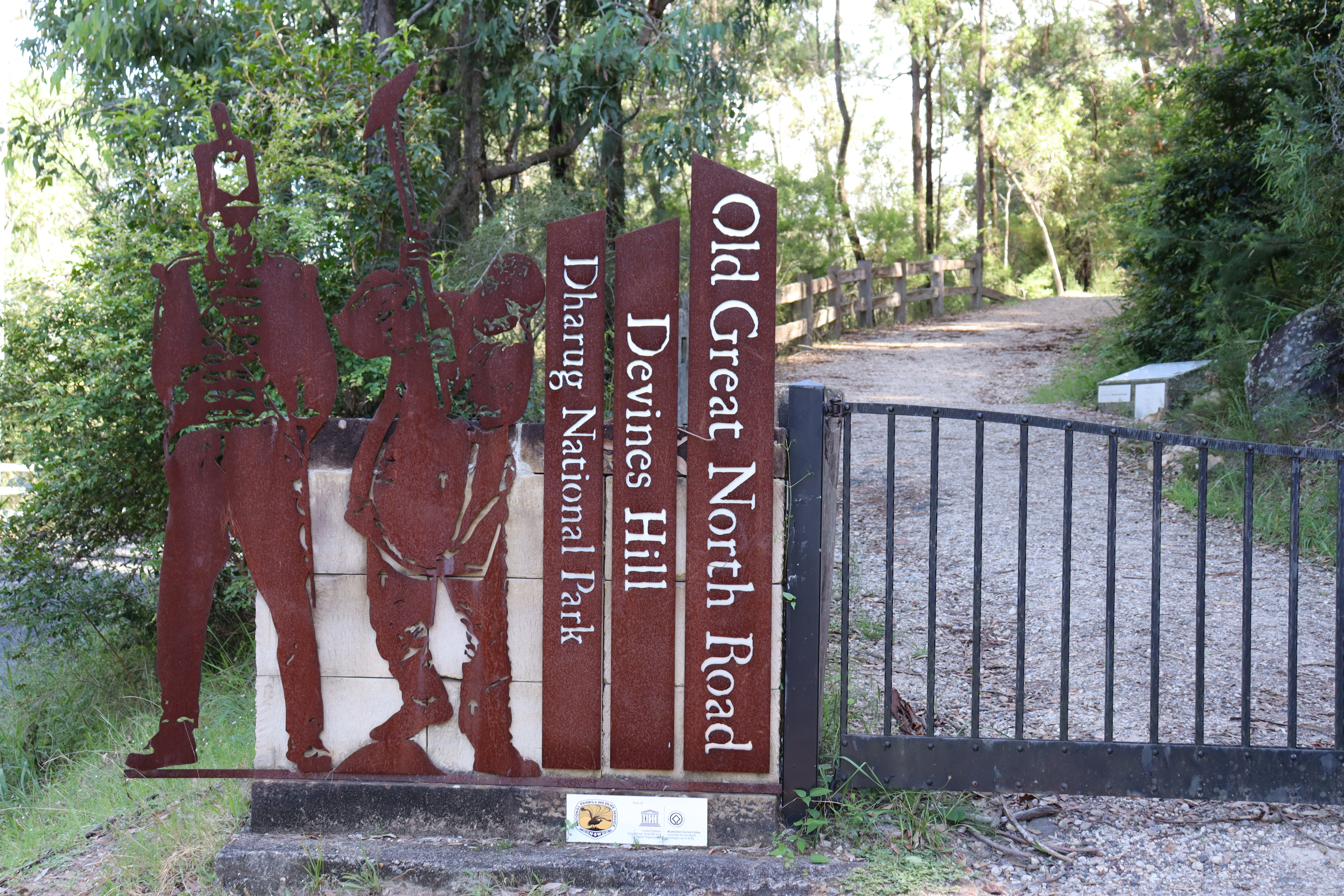
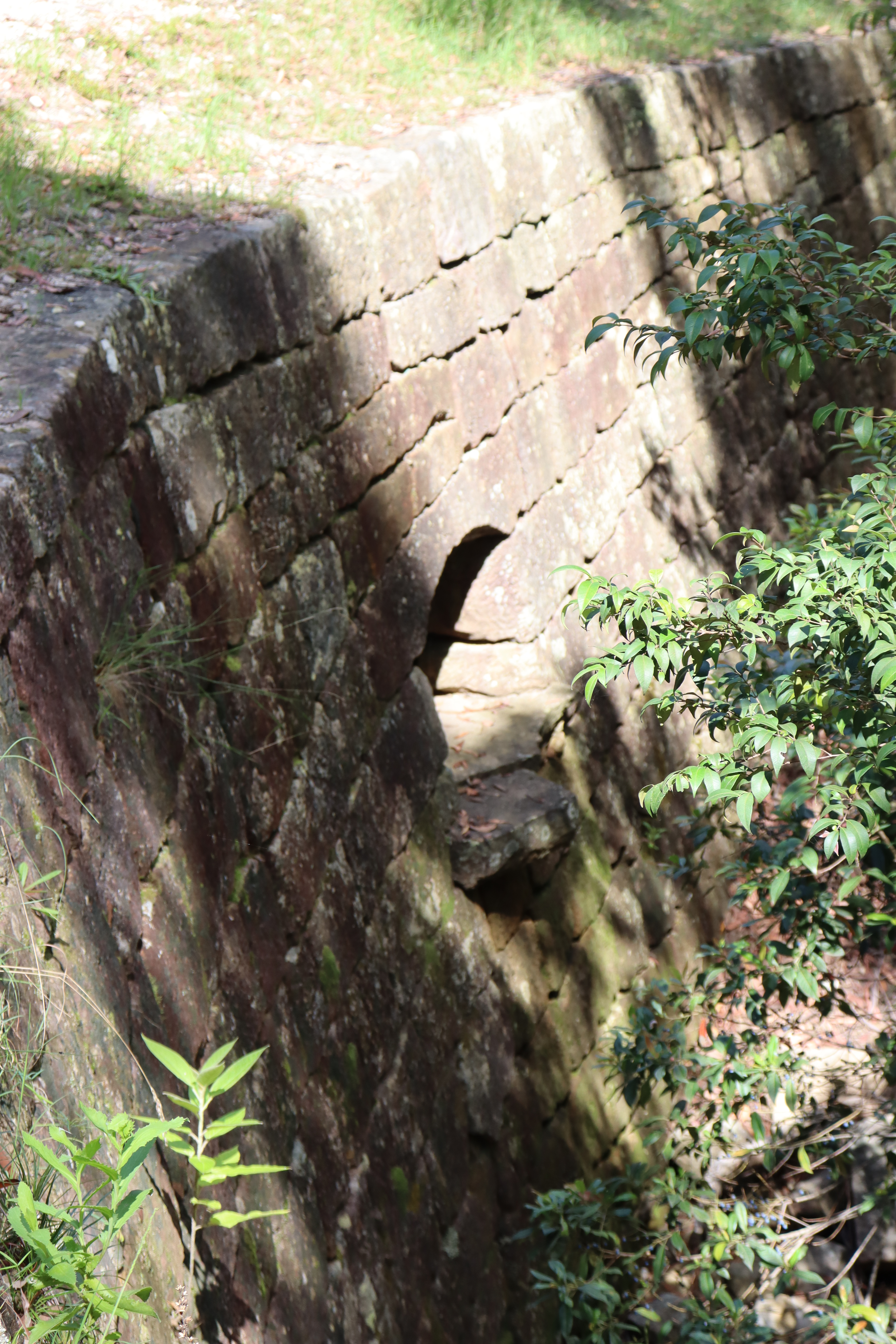
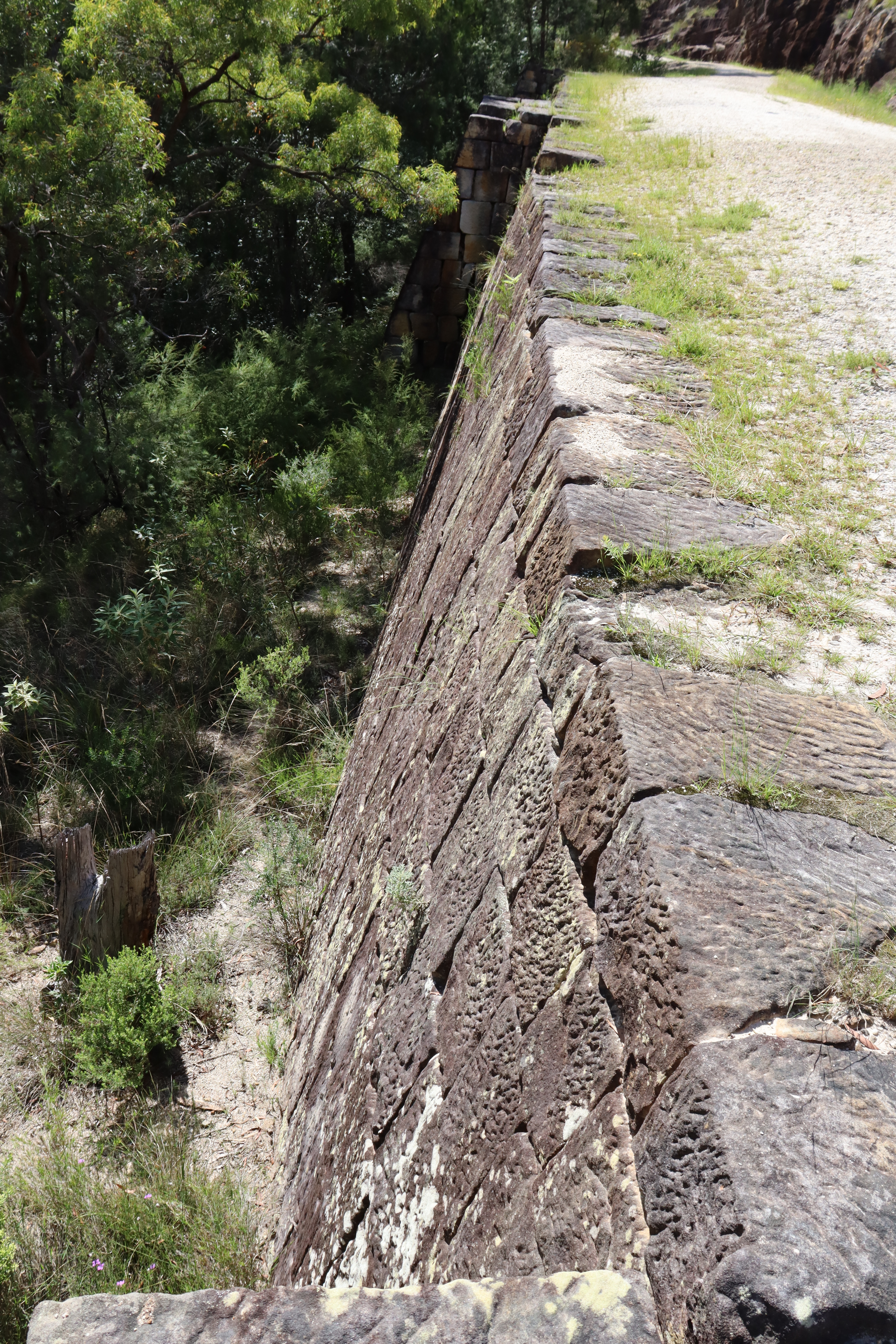
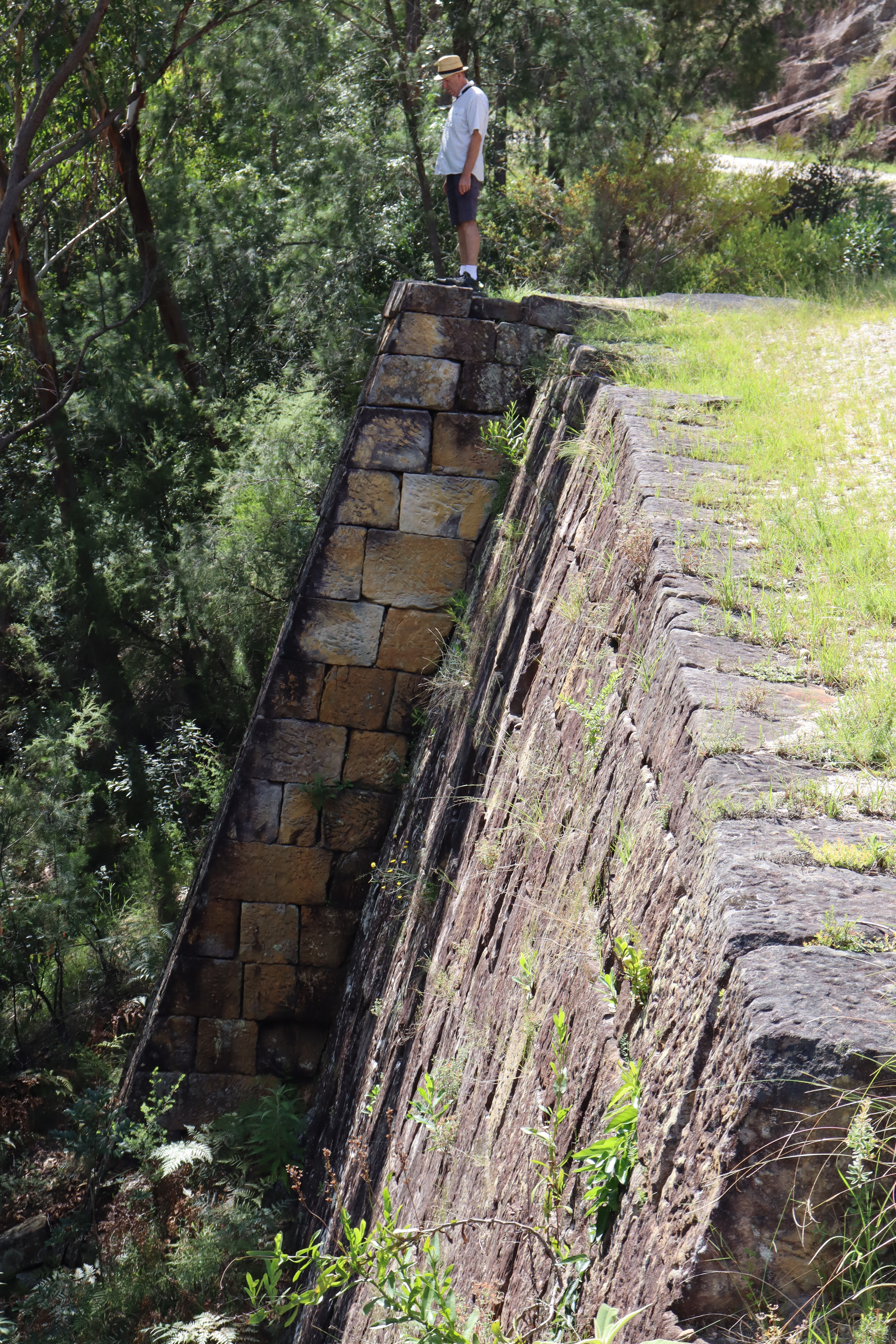
Within the National Park is the Convict Trail Walk, which takes you up the Devine’s Hill section of the Old Great North Road. This steep 1.8 kilometre section of the road was built by chain-gangs of convicts over the eleven years from 1825 – 1836. Listed on the UNESCO World Heritage Register, it was to be a route linking Sydney to the Hunter Valley, and shows an amazing feat of engineering and workmanship, where the convicts cut huge blocks of sandstone from the hillside and placed them with precision to build the road’s supporting walls and buttresses up to 12 metres in height, with culverts and drains running underneath to prevent water from undermining the road. Along the walk are information boards which tell the fascinating story of this road, which sadly became redundant even before it was finished, as steamships became the preferred mode of travel along this route. A walk well worth the effort!

Leaving the Dharug NP, we followed the Hawkesbury down to Sackville and back up to Lower Portland, then followed the Colo River, staying in the Upper Colo Reserve, which despite its cold showers, appears to be a very popular weekend camp spot! From there we headed down to Lithgow, driving along the Bells Line of Road which revealed incredible views of the Blue Mountains cliff faces that are more visible now since the devastating fires in the area a couple of years ago.

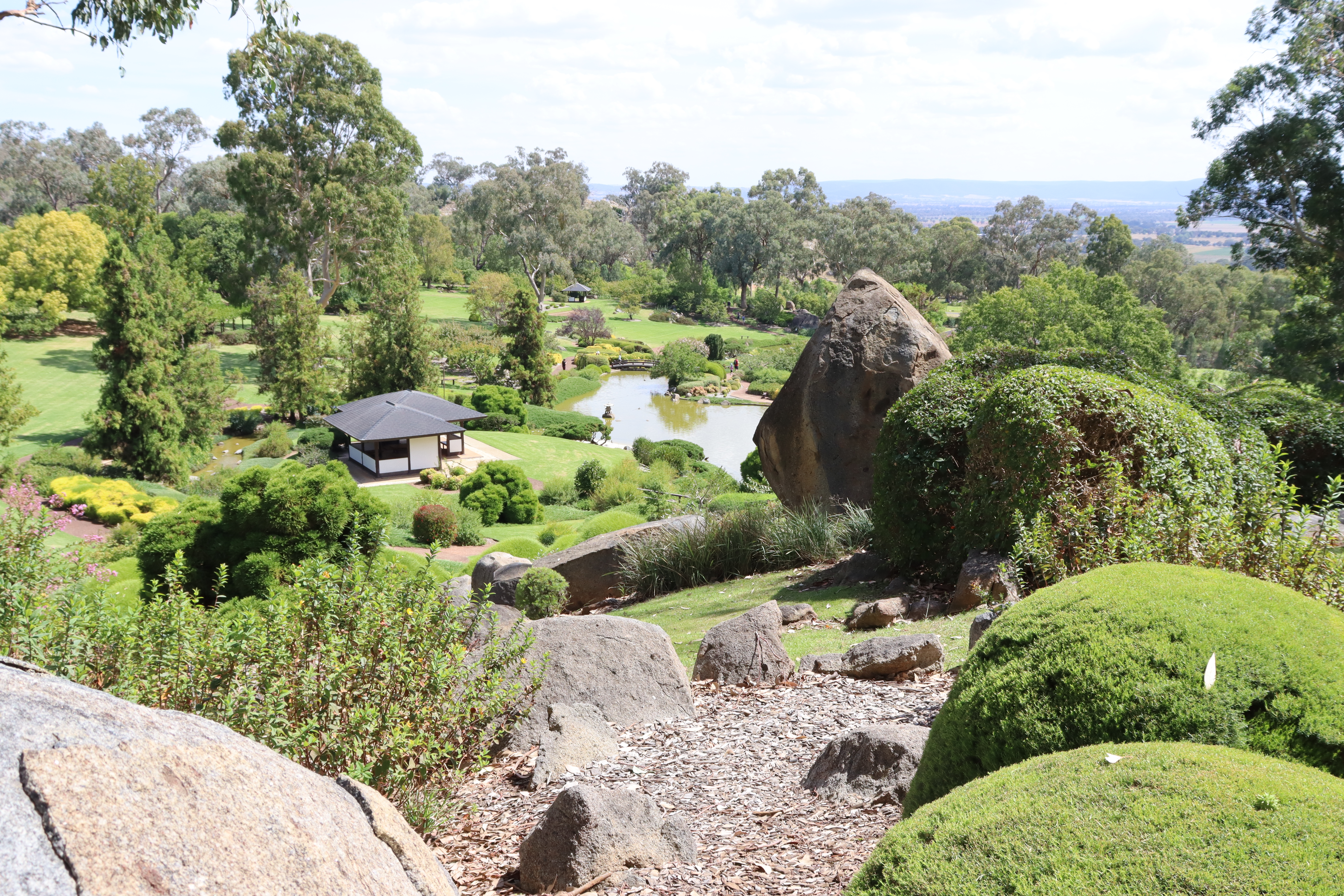
Cowra was our next port of call, taking time to visit the wonderful Japanese Gardens and the very sobering POW Internment Camp and Japanese Cemetery, where victims of the “Cowra Breakout” and those who died in the POW camp are buried. I still cannot understand why second and third generation Japanese in Australia were interned and treated like enemies during the war?? A sad part of our history, indeed.

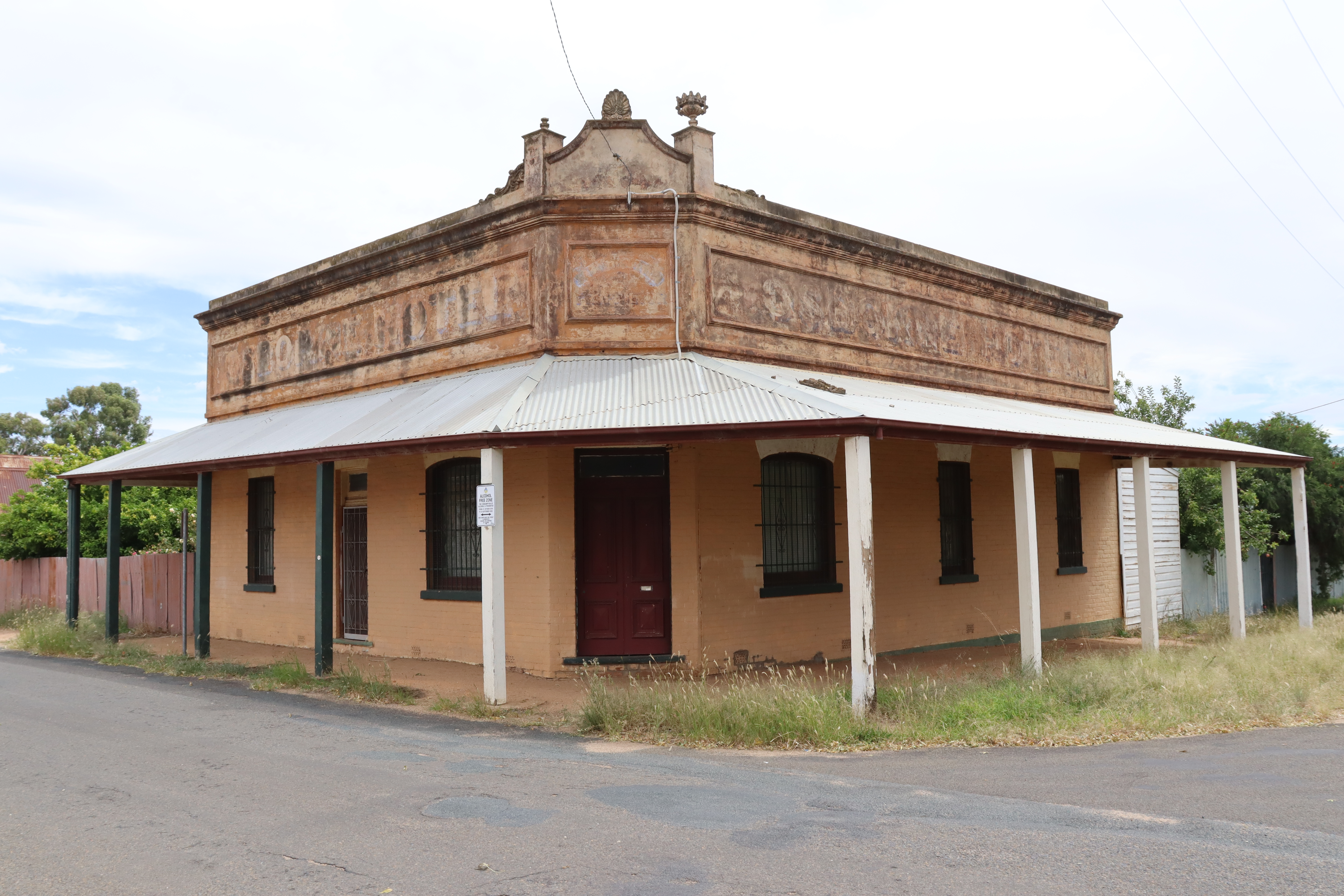
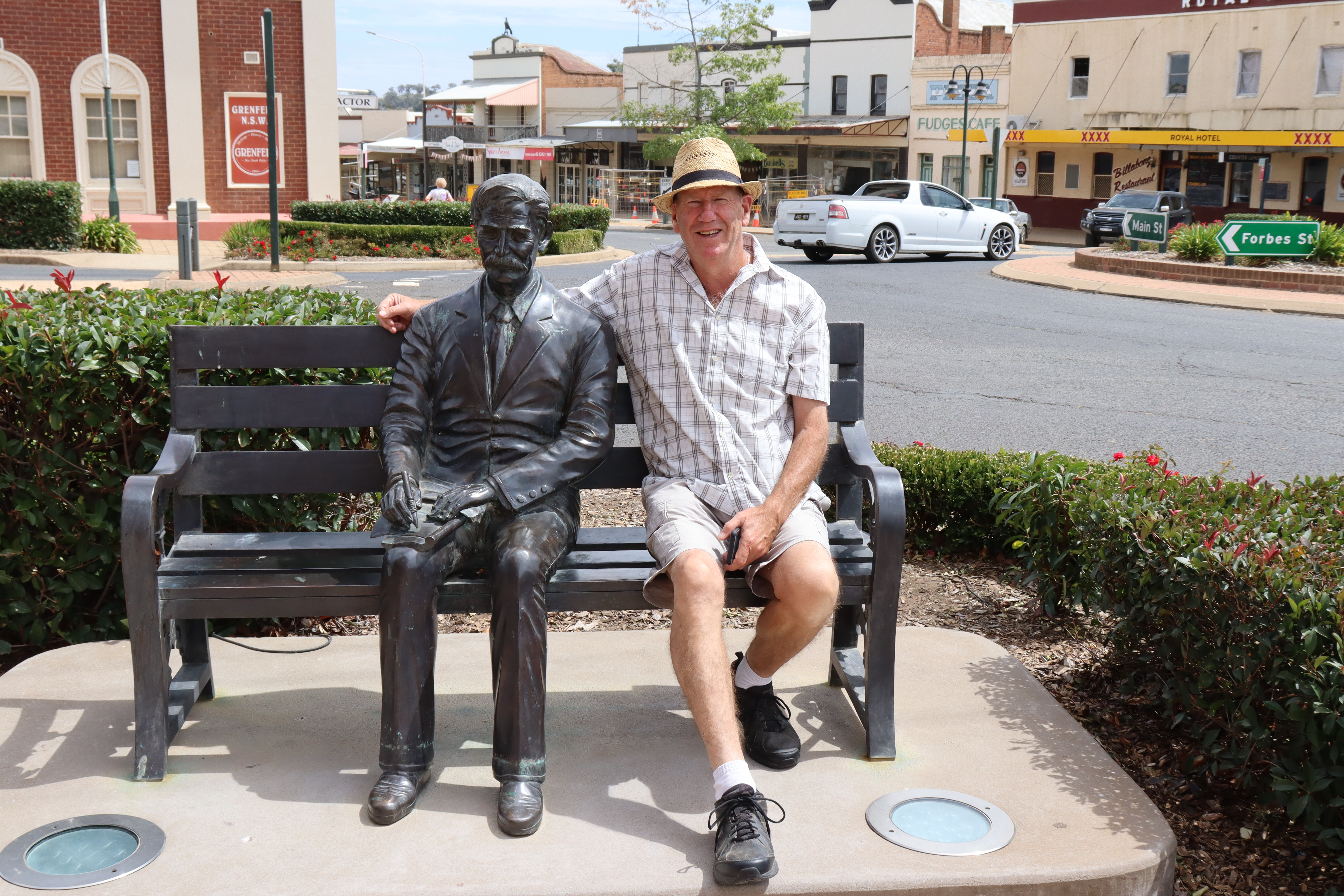
Grenfell, a town with many historic buildings, was once a gold mining town and is now noted as being the birthplace of our famous writer and poet, Henry Lawson, and therefore many monuments to the man can be found around the town. Not far from Grenfell we ventured into the Weddin Mountains National Park to walk up to Ben Halls Cave, reputedly where he and other bushrangers hid out to escape the law. Whilst in the NP we also visited Seaton’s Farm, where the Seaton family, having arrived in 1936, began farming the land and eked out an existence for over 35 years with the most primitive farming buildings and implements, mostly made from scrounged scrap materials, with nothing going to waste as there would always be a use for it.

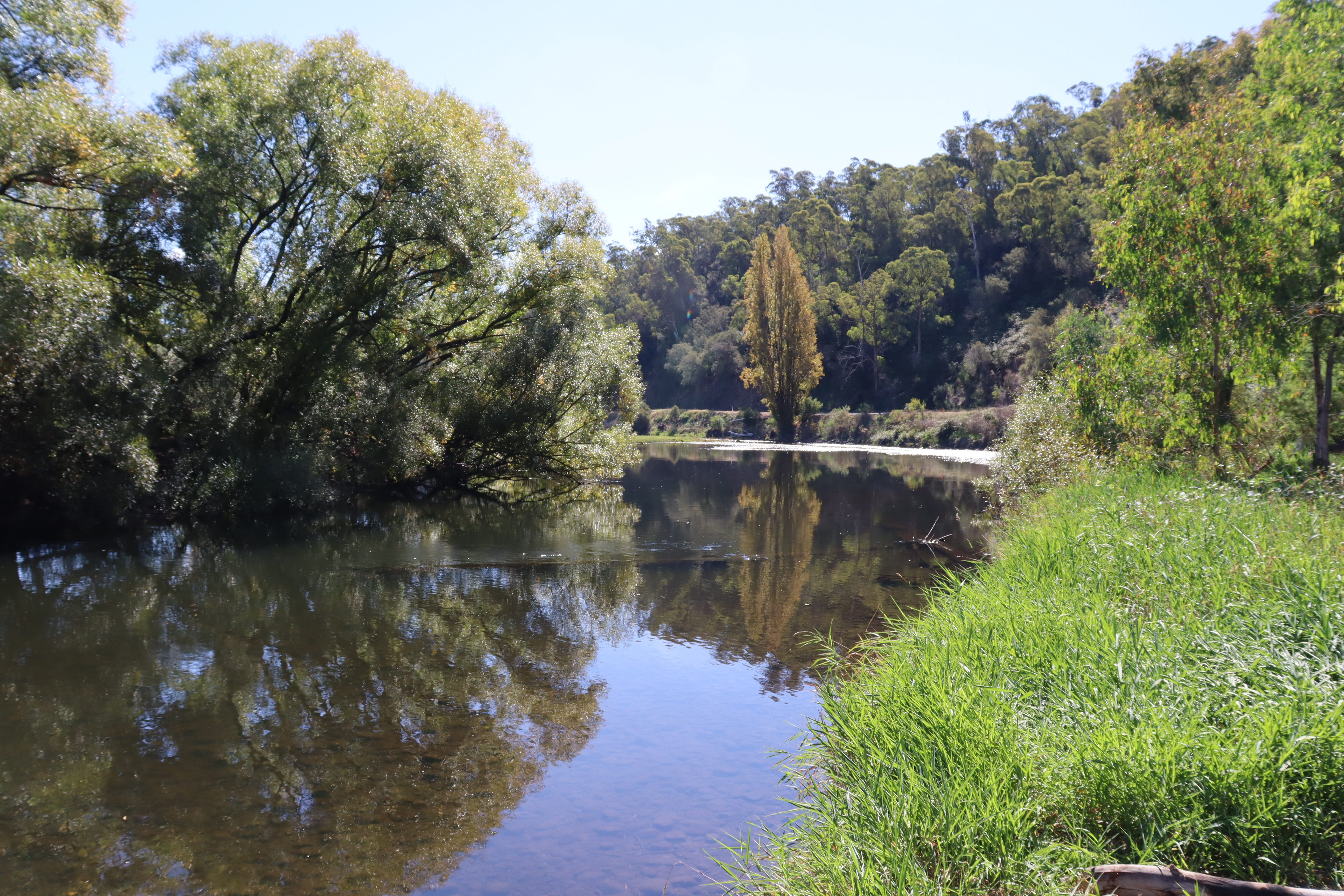
Passing through several small towns before crossing the Murray and back into Victoria at Jingellic, we headed for the Omeo Highway to take us southward to Mitta Mitta, where we camped in a lovely campground just out of town on the banks of the Mitta Mitta River. The Katie Peters Memorial Reserve was established in memory of a young 20-year-old local woman who was tragically killed by a falling tree whilst fighting bushfires in 2013. This campground is expansive, with lots of river front sites and plenty of shade for those who need it and is well maintained, providing a night of peace and tranquility.

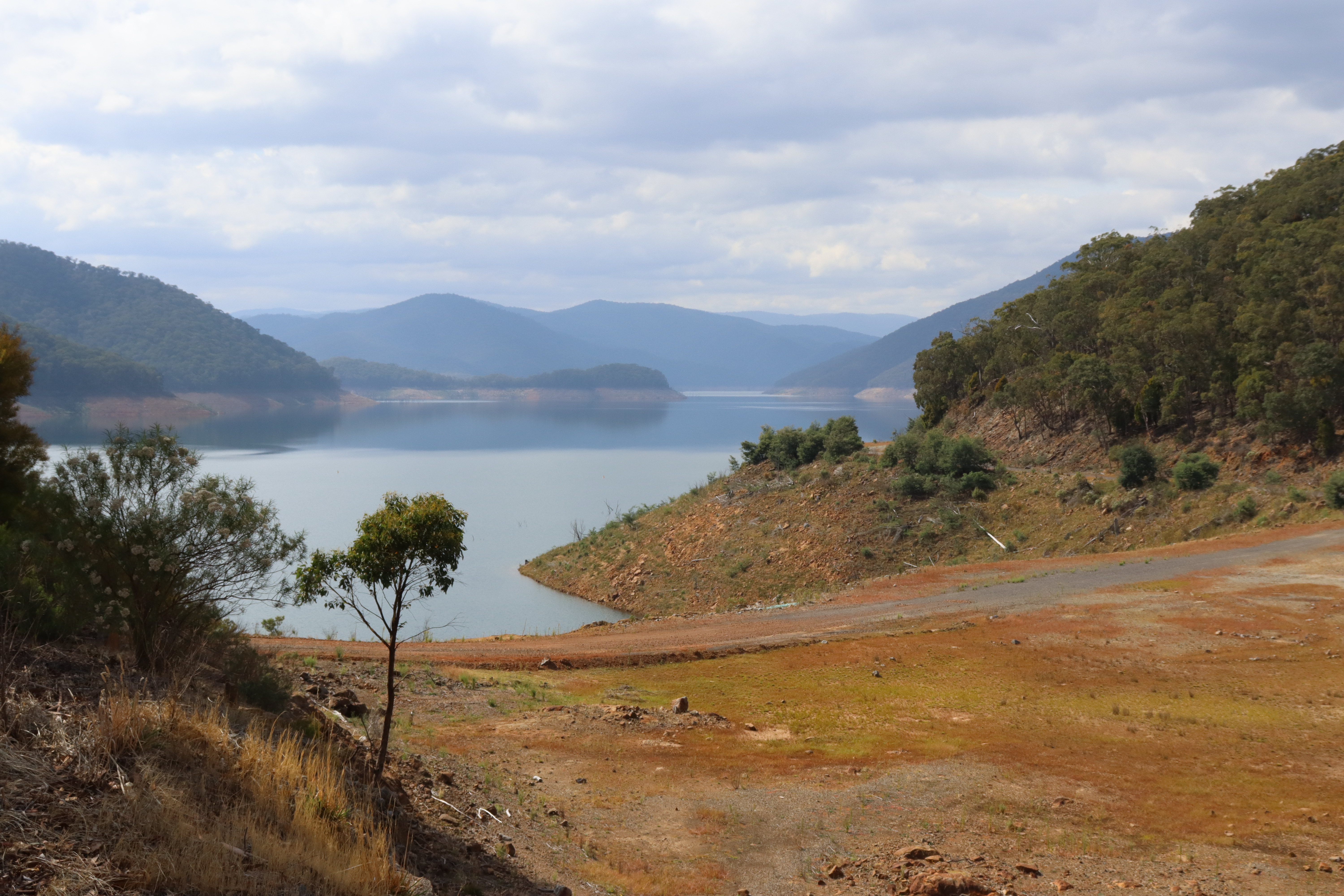
After checking out the nearby Dartmouth Dam – at 180 metres high this is the highest dam in Australia and the largest water storage in the River Murray Catchment – we continued down the Omeo Highway, enjoying forested areas and vast mountain views before turning onto the Bogong High Plains Road and back into the high country of Alpine National Park. This part of our journey  proved very scenic and enjoyable with lots of stopping points along the way.

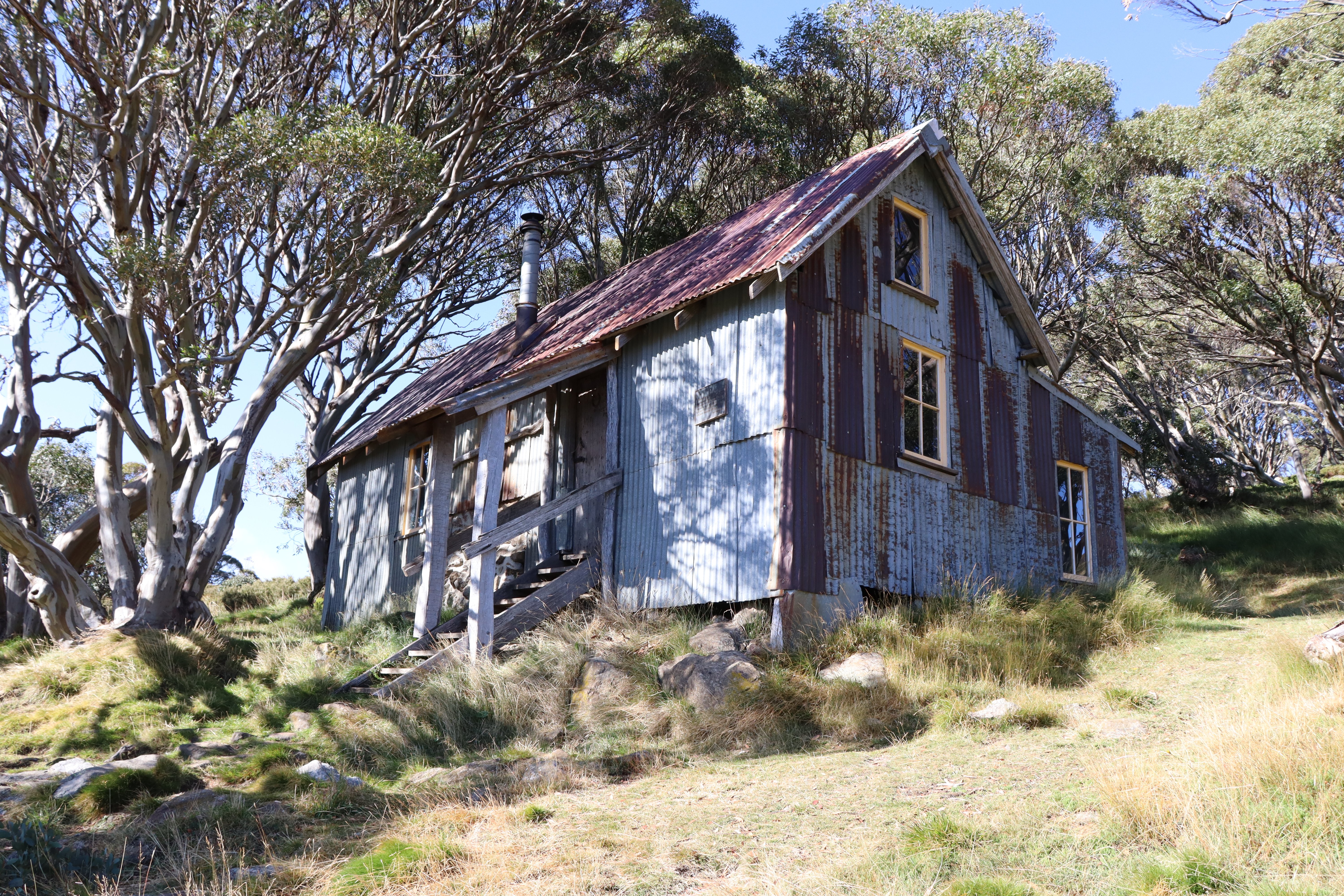
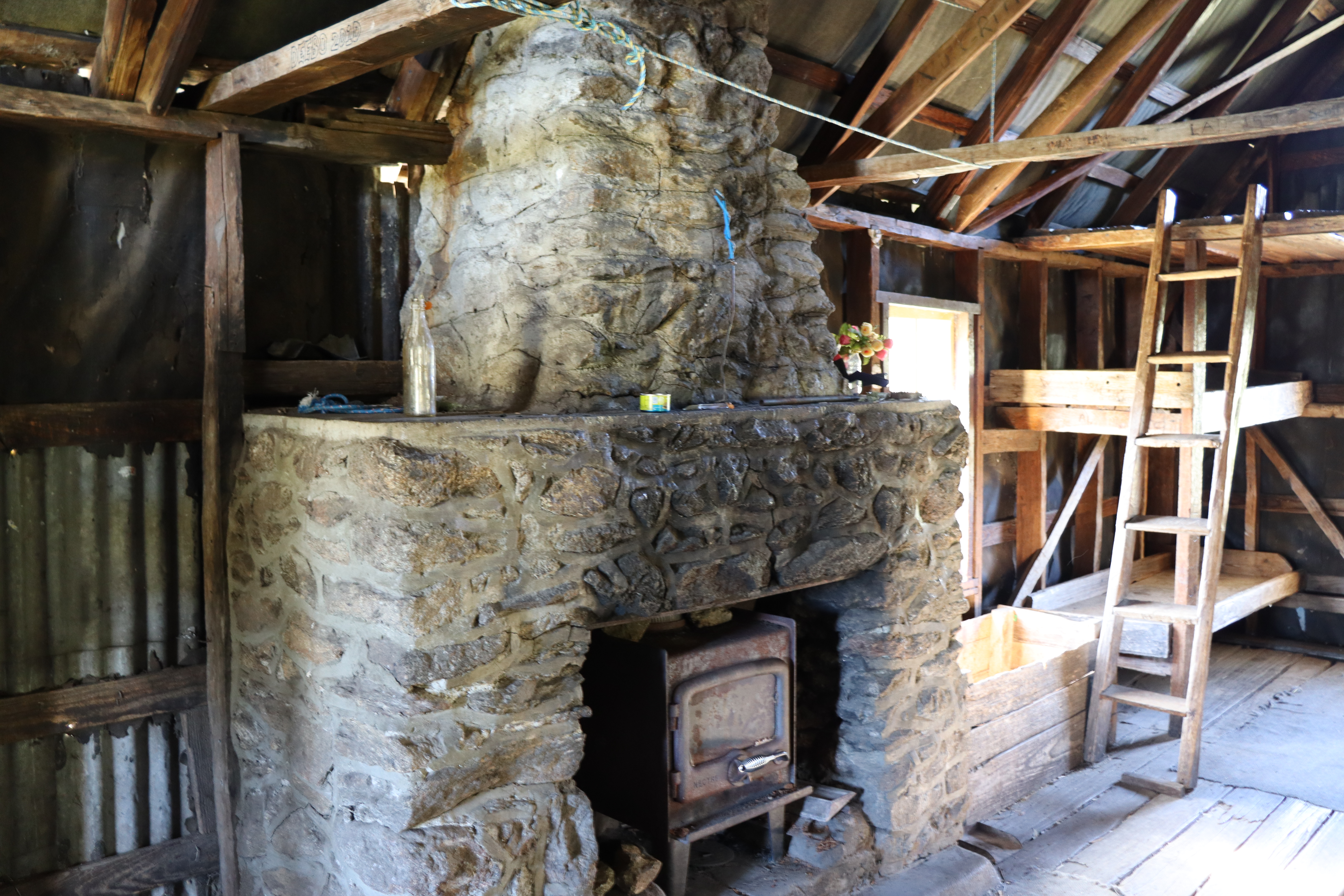
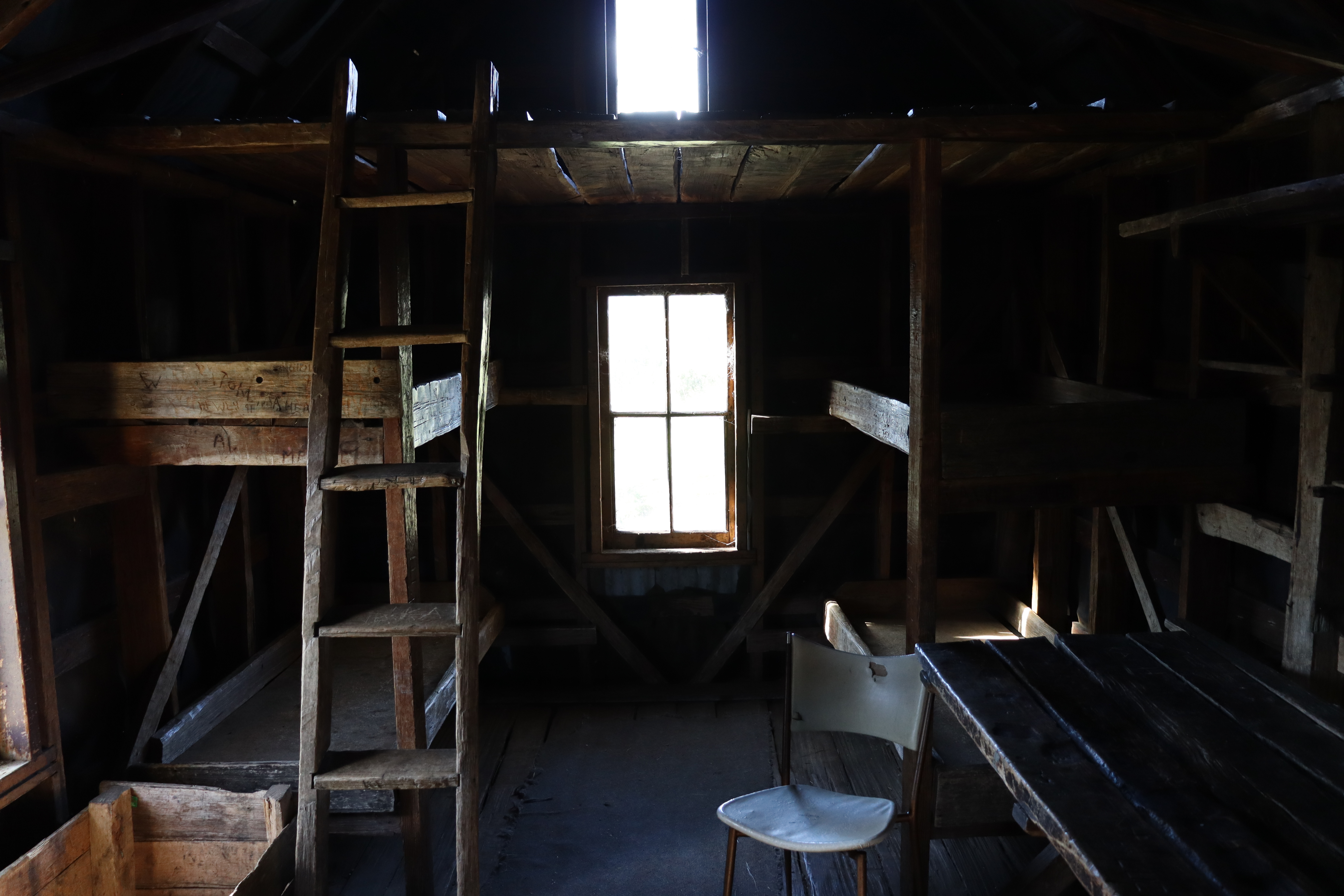
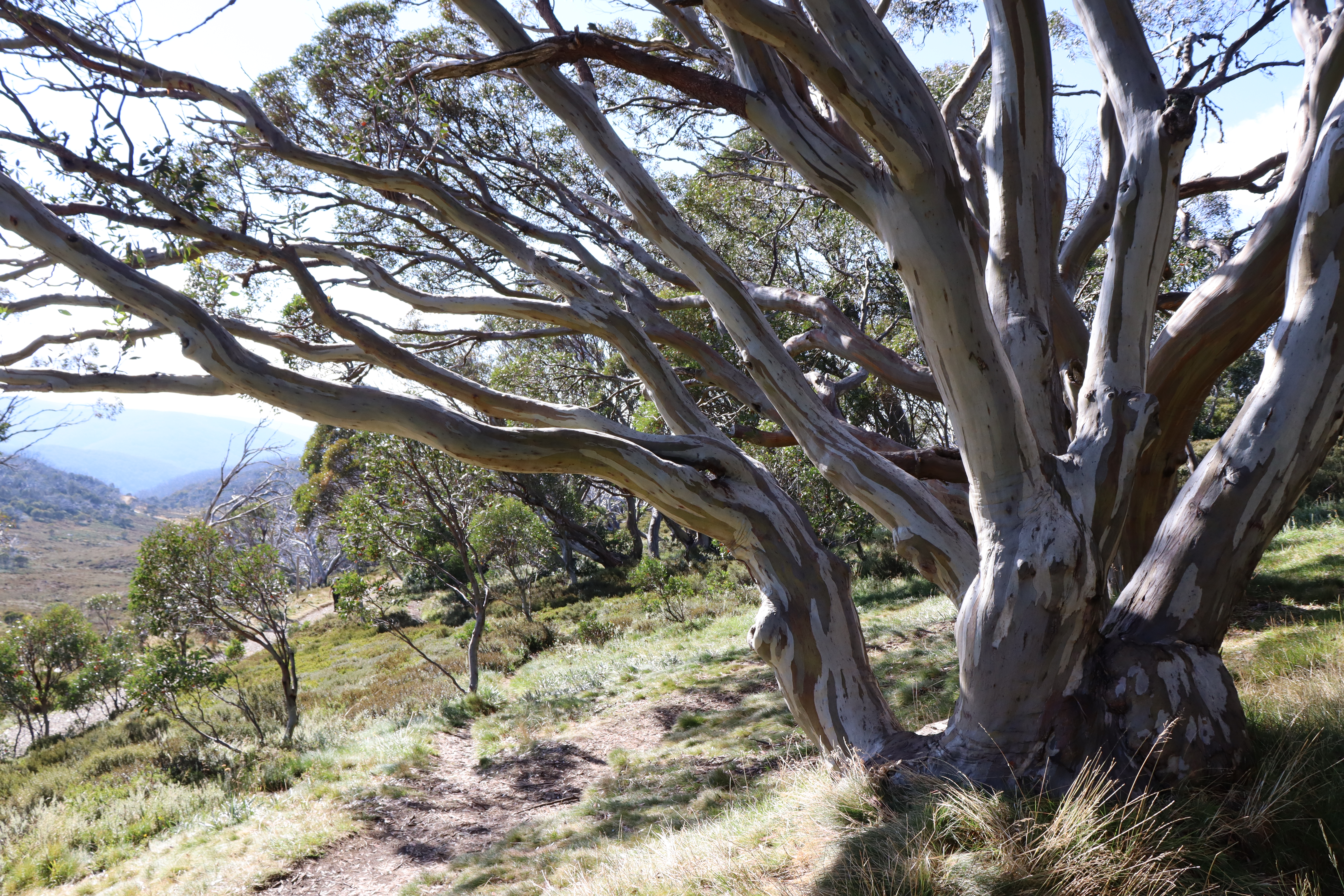
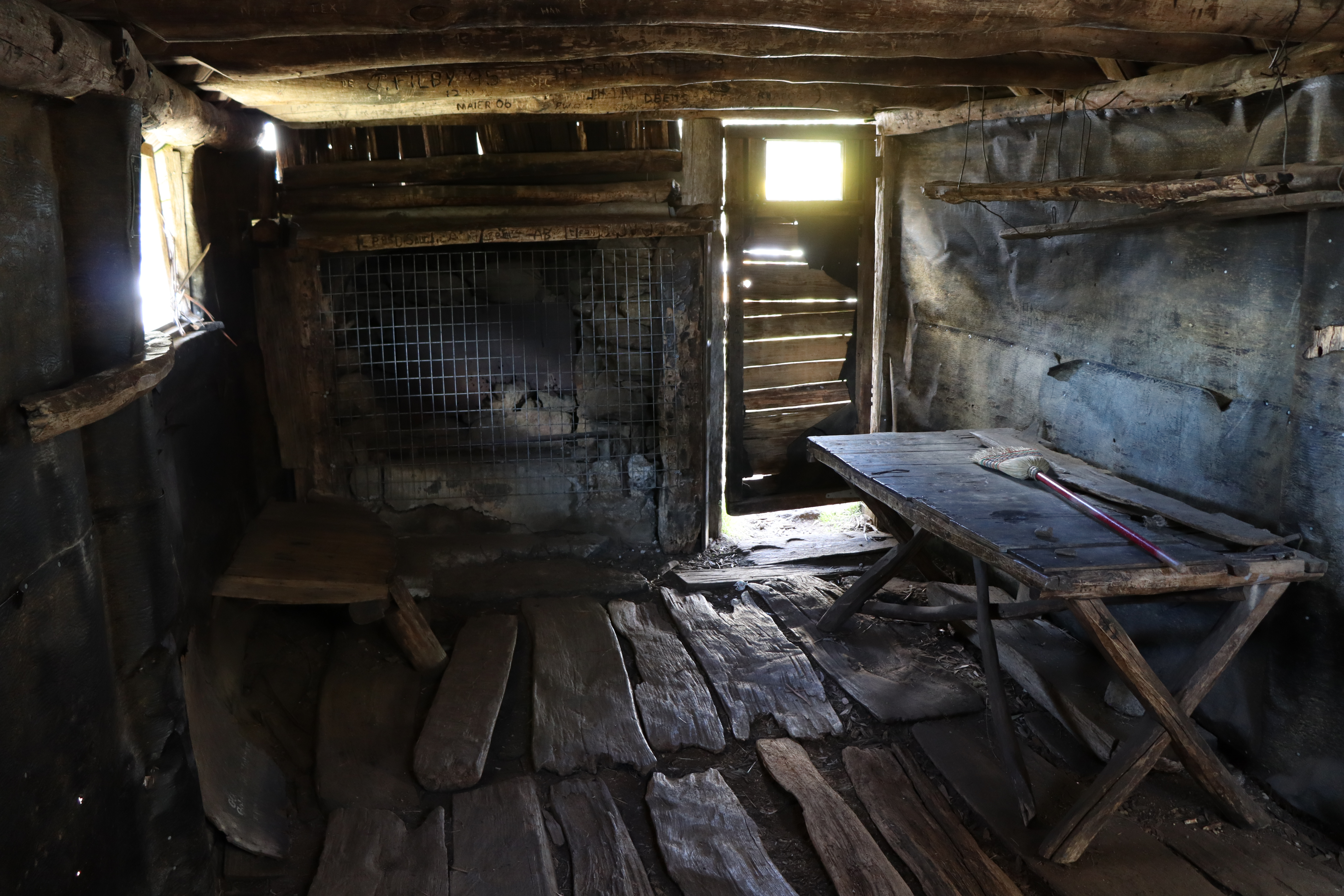
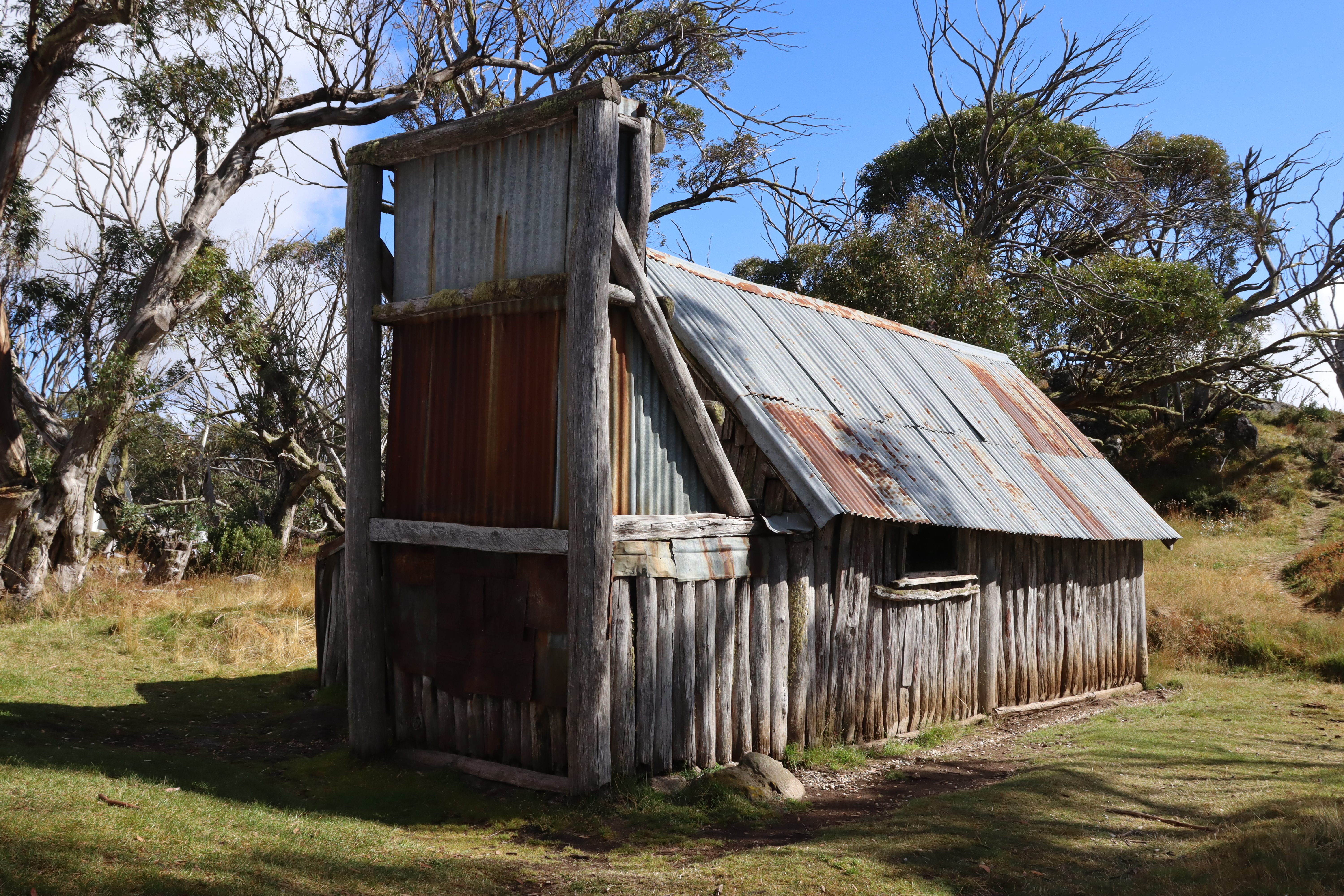
First stop was Cope Hut, built in 1929 as a stopover or rest point for cross country skiers and unlike most other high country huts, this was the first purpose-built tourist structure on the high plains. Nestled amongst the snowgums, with its welcoming fireplace, water on tap and 8 bunks, it would be a welcome relief for many a skier traversing the high country trails. A short distance away, our next visit was to Wallace’s Hut. Built by the Wallace brothers in 1889 as shelter for cattlemen from the valleys below bringing cattle up to the high plains for summer grazing, it is the oldest of the Cattlemen’s Huts still standing in the Alpine National Park and as such has been classified by the National Trust. Expecting to find this rustic building standing alone amongst the snowgums, we were somewhat surprised or even gobsmacked to be greeted with a most unexpected and surprising sight – lots of tables spread with white linen, set with fine cutlery and adorned with tall vases of roses, a host of people rushing about in the throes of organization, and a “kitchen” and a “bar” complete with a variety of wines and sparklings. Assuming this to be the setting for a high plains wedding, our looks of (apparently obvious) confusion must have been noticed by one kind lady who explained that they were gearing up for their tenth annual “Worlds Biggest Lunch” fundraiser, with about two hundred guests coming by bus from Falls Creek to enjoy the day. We hoped the imminent-looking rain held off for them!

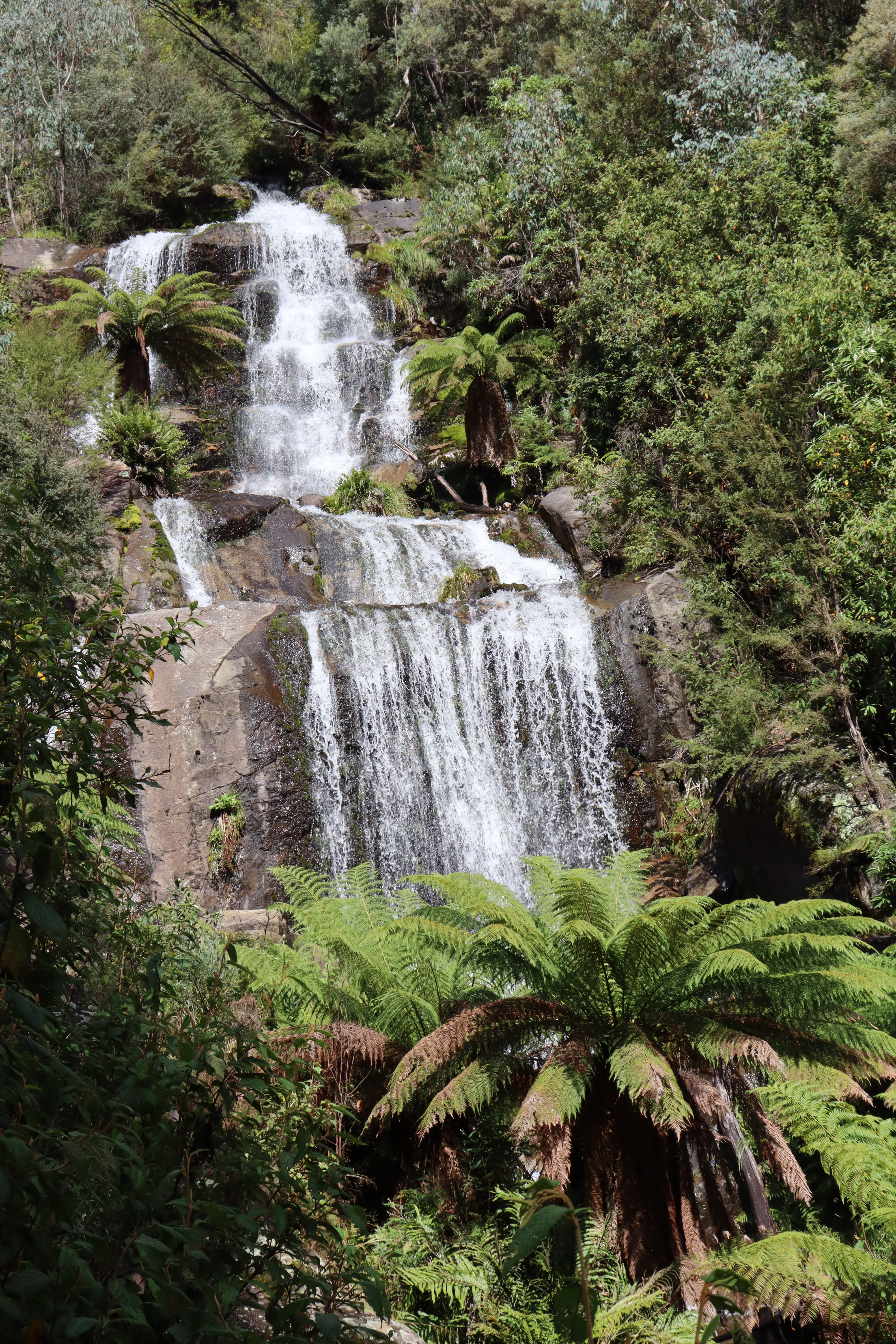
Passing by Rocky Valley Dam and through Falls Creek village, we came to Fainter Falls with its short trail down to a lookout and about 200 metres of steep steps to a better, closer viewpoint of these impressive waterfalls cascading about 60 metres over several tiers surrounded by tree ferns.

From there we headed through Mt Beauty and Harrietville to Danny’s Lookout at Mt Hotham, before backtracking to the Dargo High Plains Road which took us back down out of the high country and back to civilization and home after travelling almost 2800 kilometres in our two weeks away.

 Happily, Roxy is proving to be comfortable and reliable.

WTF?

  • On a hot Melbourne day, were looking forward to a nice cold milkshake, so into the ice-cream/milkshake shop we went. “Sorry we only have soy or almond milk – ran out of normal milk this morning!” This was around 3pm – what – they haven’t had time to go get some more??
  • Woman drives into the National Park campground and lets out her three large dogs, none of them on leash and one promptly disappears. After we commented on her irresponsibility, she argued that she didn’t know dogs weren’t allowed. Who, unless they are a complete idiot, doesn’t know that???
  • Carcour Dam – why are there steps and ladders leading to the bottom or the dam and across the spillway?
  • Those beautifully dressed tables at Wallaces Hut! (no words!)